Get your free personalized podcast brief
We scan new podcasts and send you the top 5 insights daily.
To achieve a state where AI agents handle nearly all coding, a solo founder must implement a surprisingly formal Software Development Lifecycle (SDLC), like one for a large team. This includes rigorous processes like mandatory Pull Requests (PRs), providing a structured system for agent-driven development.

Related Insights
To maximize leverage, reframe every SDLC component—docs, tests, review agents—as a way to 'prompt inject' non-functional requirements into the agent. This approach teases out expert knowledge from engineers' heads and makes it part of the automated system, guided by the agent's mistakes.
Unlike co-pilots that assist developers, Factory's “droids” are designed to be autonomous. This reframes the developer's job from writing code to mastering delegation—clearly defining tasks and success criteria for an AI agent to execute independently.

The ease of creating PRs with AI agents shifts the developer bottleneck from code generation to code validation. The new challenge is not writing the code, but gaining the confidence to merge it, elevating the importance of review, testing, and CI/CD pipelines.
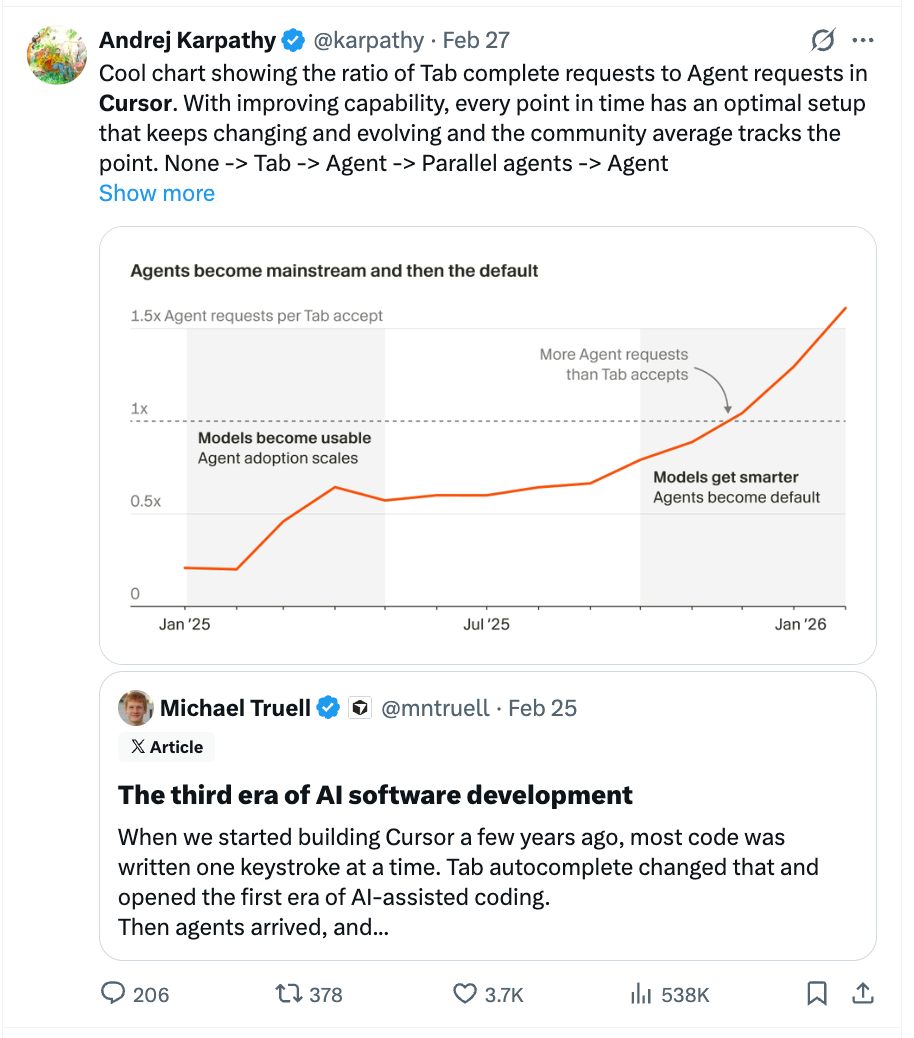
A three-person team built a system where AI agents handle the entire software development lifecycle, from roadmap to deployment, without humans writing or reviewing code. The role of engineers shifts to managing the AI, with budgets allocated for AI tokens instead of traditional resources.

The endgame for software development isn't just code completion, but an "AI factory." A chain of specialized agents will handle design, coding, review, and security. This requires an interoperable platform where different models can check each other's work, with humans as "agent managers."

Inspired by fully automated manufacturing, this approach mandates that no human ever writes or reviews code. AI agents handle the entire development lifecycle from spec to deployment, driven by the declining cost of tokens and increasingly capable models.
The Ralph AI coding loop automates software development by copying the agile Kanban process. It sequentially pulls small, defined tasks (user stories) from a list, implements the code, tests it against criteria, commits the result, and repeats. This mirrors how human engineering teams build features, but does so autonomously.

AI acts as a massive force multiplier for software development. By using AI agents for coding and code review, with humans providing high-level direction and final approval, a two-person team can achieve the output of a much larger engineering organization.

The current model of a developer using an AI assistant is like a craftsman with a power tool. The next evolution is "factory farming" code, where orchestrated multi-agent systems manage the entire development lifecycle—planning, implementation, review, and testing—moving it from a craft to an industrial process.

The debate isn't between manual coding and blindly trusting AI ("vibe coding"). A new discipline, "agentic engineering," is emerging. This involves creating new best practices, security controls, and governance for using AI agents to build software. This structured approach will replace the current era of unchecked individual developer experimentation.
