Get your free personalized podcast brief
We scan new podcasts and send you the top 5 insights daily.
Iran's government operates like a mafia, creating a layered society where economic benefits are distributed based on an individual's loyalty to the regime, not their rights as a citizen. A loyal foreign proxy can receive more resources from the state than a domestic professional.

Related Insights
Iran's Islamic Revolutionary Guard Corps (IRGC) isn't funded by the state budget. It operates a global network of front companies for construction and other projects, laundering money to create a self-sustaining financial ecosystem. If the regime collapses, the IRGC would likely persist as a heavily-armed mafia with international criminal ties.

Doing business in Iran is perilous not just because it's an authoritarian state, but because it's a chaotic one with competing internal power centers. Like appeasing multiple, rival Greek gods, securing an agreement with one faction offers no protection from another, creating crippling uncertainty for businesses.
The Islamic Revolutionary Guard Corps (IRGC) has eclipsed the clergy, controlling major political and economic institutions. Ayatollah Khamenei maintains power through a symbiotic relationship with the IRGC, leveraging their military and economic might, rather than just religious authority.

Once an Iranian startup becomes successful, it crosses a threshold where it attracts the attention of the security state. To survive, founders are often pressured into giving up equity to middlemen connected to powerful entities like the Revolutionary Guards, who offer 'protection' from state-sponsored harassment.
The Iranian regime consistently treats its economy as a means to an ideological end (e.g., self-sufficiency), not as an end in itself. This explains why Western diplomatic strategies based on economic incentives often fail; the leadership is unwilling to compromise its ideology for popular prosperity.
The IRGC isn't just a military force; it's a paramilitary organization with near-monopolistic control over Iran's key economic sectors, from telecom to banking. This deep economic entrenchment makes it a uniquely powerful and resilient entity, capable of turning strategic chokepoints like the Strait of Hormuz into a personal toll booth.

The Revolutionary Guards leverage their military power for economic gain. In one instance, after losing a bid to operate a new airport, they drove armored vehicles onto the runway and scrambled a fighter jet to prevent planes from landing until the foreign contract was cancelled and state firms took over.
When Iran attempted to privatize major industries, it was not a genuine market reform. Instead, state-owned assets like factories were sold at very low prices to individuals connected to the security forces. Many of these new owners then stripped the assets for cash rather than running the businesses.
While US sanctions are a factor, the Iranian currency's freefall is largely due to structural corruption. The economy is dominated by the military and clerical foundations, a political-economic model that stifles growth and fuels public anger—a problem sanctions relief alone cannot solve.
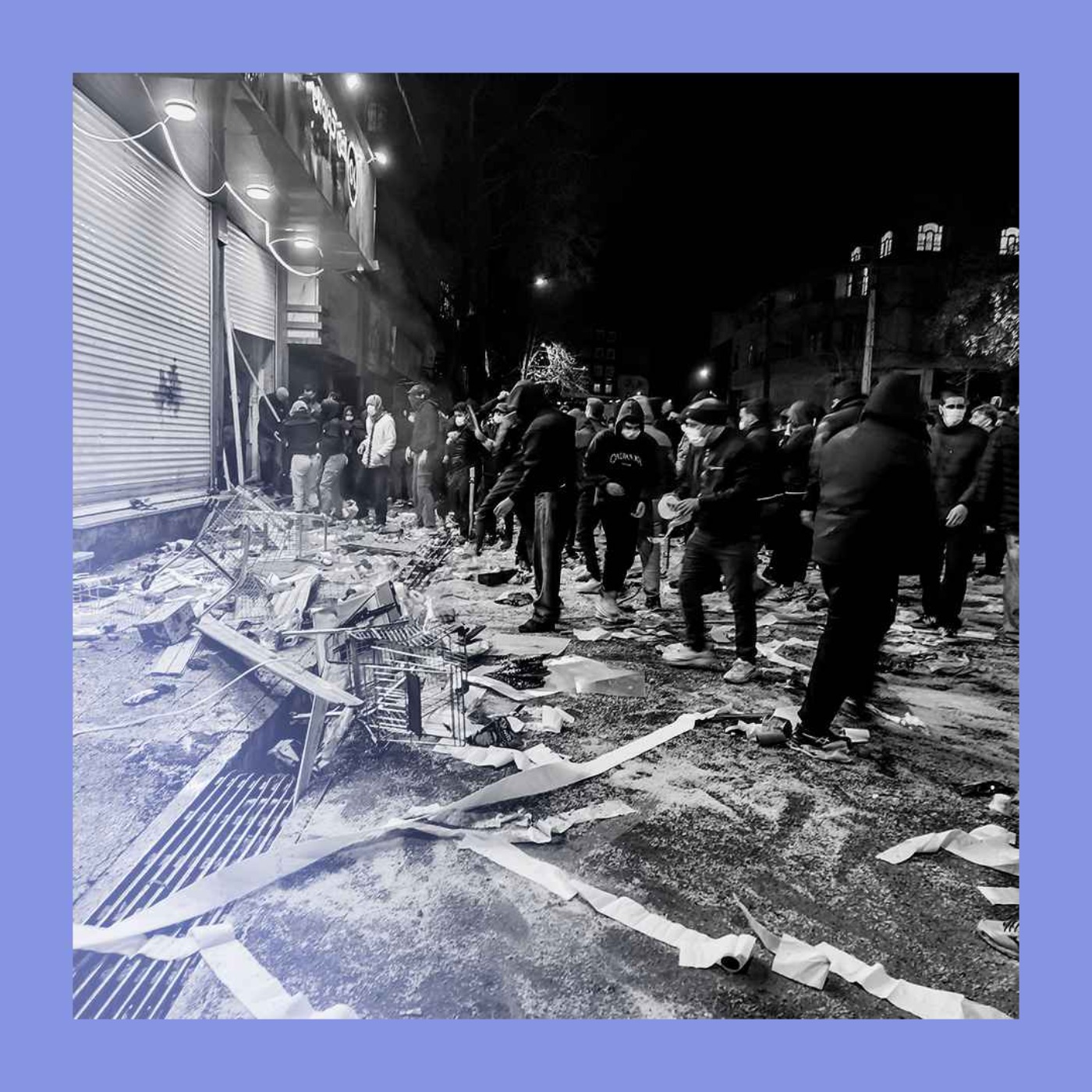
Widespread protests are fueled by everyday grievances like poverty and environmental destruction. These issues trace back to the Islamic Revolutionary Guard Corps (IRGC) systematically extorting and taking over successful private businesses, creating a corrupt and inefficient economy that angers the populace.