Get your free personalized podcast brief
We scan new podcasts and send you the top 5 insights daily.
For enterprise AI, standard RAG struggles with granular permissions and relationship-based questions. Atlassian's "teamwork graph" maps entities like teams, tasks, and documents. This allows it to answer complex queries like "What did my team do last week?"—a task where simple vector search would fail by just returning top documents.

Related Insights
Beneath the surface, sales 'opportunities,' support 'tickets,' and dev 'issues' are all just forms of work management. The core insight is that a single, canonical knowledge graph representing 'work,' 'identity,' and 'parts' can unify these departmental silos, which first-generation SaaS never did.

Rather than relying on a single LLM, LexisNexis employs a "planning agent" that decomposes a complex legal query into sub-tasks. It then assigns each task (e.g., deep research, document drafting) to the specific LLM best suited for it, demonstrating a sophisticated, model-agnostic approach for enterprise AI.

According to IBM's AI Platform VP, Retrieval-Augmented Generation (RAG) was the killer app for enterprises in the first year after ChatGPT's release. RAG allows companies to connect LLMs to their proprietary structured and unstructured data, unlocking immense value from existing knowledge bases and proving to be the most powerful initial methodology.
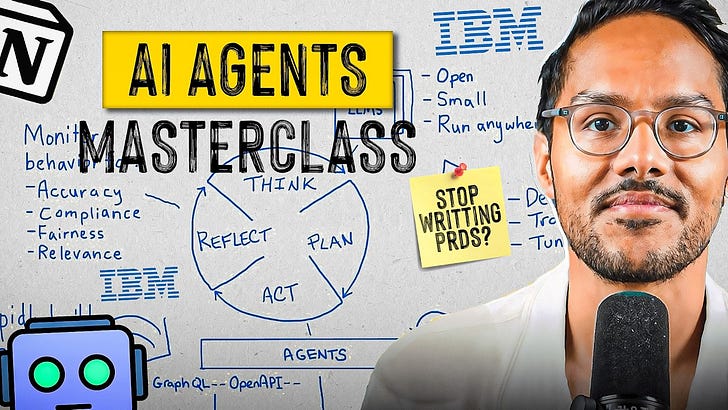
Early AI adoption by PMs is often a 'single-player' activity. The next step is a 'multiplayer' experience where the entire team operates from a shared AI knowledge base, which breaks down silos by automatically signaling dependencies and overlapping work.
While vector search is a common approach for RAG, Anthropic found it difficult to maintain and a security risk for enterprise codebases. They switched to "agentic search," where the AI model actively uses tools like grep or find to locate code, achieving similar accuracy with a cleaner deployment.

While generic AIs in tools like Notion are powerful, they struggle to identify the 'source of truth' in an infinite sea of documents. A purpose-built PM tool has a smaller, defined information domain, making it more effective and reliable for specialized tasks.
Companies with an "open by default" information culture, where documents are accessible unless explicitly restricted, have a significant head start in deploying effective AI. This transparency provides a rich, interconnected knowledge base that AI agents can leverage immediately, unlike in siloed organizations where information access is a major bottleneck.
Teams often agonize over which vector database to use for their Retrieval-Augmented Generation (RAG) system. However, the most significant performance gains come from superior data preparation, such as optimizing chunking strategies, adding contextual metadata, and rewriting documents into a Q&A format.
Before diving into SQL, analysts can use enterprise AI search (like Notion AI) to query internal documents, PRDs, and Slack messages. This rapidly generates context and hypotheses about metric changes, replacing hours of manual digging and leading to better, faster analysis.
Salesforce's Chief AI Scientist explains that a true enterprise agent comprises four key parts: Memory (RAG), a Brain (reasoning engine), Actuators (API calls), and an Interface. A simple LLM is insufficient for enterprise tasks; the surrounding infrastructure provides the real functionality.