Get your free personalized podcast brief
We scan new podcasts and send you the top 5 insights daily.
Before diving into SQL, analysts can use enterprise AI search (like Notion AI) to query internal documents, PRDs, and Slack messages. This rapidly generates context and hypotheses about metric changes, replacing hours of manual digging and leading to better, faster analysis.

Related Insights
After running a survey, feed the raw results file and your original list of hypotheses into an AI model. It can perform an initial pass to validate or disprove each hypothesis, providing a confidence score and flagging the most interesting findings, which massively accelerates the analysis phase.
Instead of presenting static charts, teams can now upload raw data into AI tools to generate interactive visualizations on the fly. This transforms review meetings from passive presentations into active analysis sessions where leaders can ask new questions and explore data in real time without needing a data analyst.

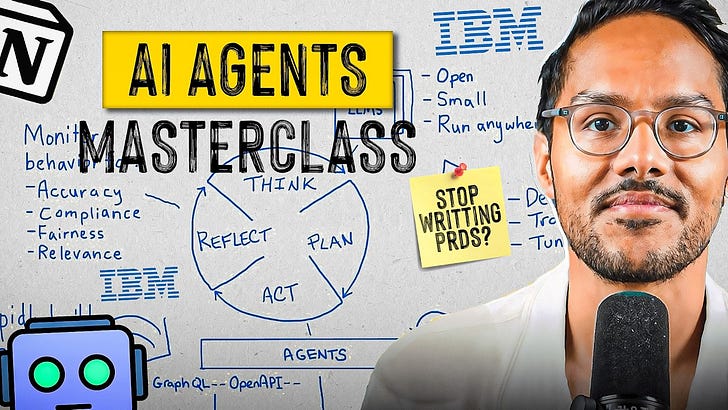
According to IBM's AI Platform VP, Retrieval-Augmented Generation (RAG) was the killer app for enterprises in the first year after ChatGPT's release. RAG allows companies to connect LLMs to their proprietary structured and unstructured data, unlocking immense value from existing knowledge bases and proving to be the most powerful initial methodology.
To enable AI tools like Cursor to write accurate SQL queries with minimal prompting, data teams must build a "semantic layer." This file, often a structured JSON, acts as a translation layer defining business logic, tables, and metrics, dramatically improving the AI's zero-shot query generation ability.
Using plain-English rule files in tools like Cursor, data teams can create reusable AI agents that automate the entire A/B test write-up process. The agent can fetch data from an experimentation platform, pull context from Notion, analyze results, and generate a standardized report automatically.
AI developer environments with Model Context Protocols (MCPs) create a unified workspace for data analysis. An analyst can investigate code in GitHub, write and execute SQL against Snowflake, read a BI dashboard, and draft a Notion summary—all without leaving their editor, eliminating context switching.
Instead of manual survey design, provide an AI with a list of hypotheses and context documents. It can generate a complete questionnaire, the platform-specific code file for deployment (e.g., for Qualtrics), and an analysis plan, compressing the user research setup process from days to minutes.
A killer app for AI in IT is automating tedious but critical tasks. For example, investigating why daily cloud spend deviates by more than 5%. This simple-sounding query requires complex data analysis across multiple services—a perfect, high-value problem for an AI agent to solve.
Founders can get objective performance feedback without waiting for a fundraising cycle. AI benchmarking tools can analyze routine documents like monthly investor updates or board packs, providing continuous, low-effort insight into how the company truly stacks up against the market.
AI tools connected to GitHub allow non-technical roles to conduct "forensic investigations" of a codebase. By prompting an AI, they can generate a full timeline of commits and PRs for a specific feature, providing ground-truth context during business incidents without needing engineering help.