Get your free personalized podcast brief
We scan new podcasts and send you the top 5 insights daily.
Amazon's notorious burnout culture may stem less from top-down pressure and more from extreme employee autonomy. When given vast personal agency, individuals who struggle to set boundaries or say "no" are prone to overcommitting and burning out, even when managers explicitly encourage them to stop working.

Related Insights
To cultivate a culture of high agency, frame ultimate responsibility as a privilege, not a burden. By telling new hires 'everything's your fault now,' you immediately set the expectation that they have control and are empowered to solve problems. This approach attracts and retains individuals who see ownership as an opportunity to make an impact.

Many driven individuals feel they must justify rest through intense work, viewing it as a reward rather than a fundamental need. This "earn your rest" mentality leads to burnout by framing rest as an indulgence instead of a biological necessity for sustained performance.

When a leader models extreme behavior, like working immediately after surgery, it sends an implicit message to the team: 'Your personal crises don't matter; the mission is everything.' This can inadvertently create a culture where employees feel they can't take time for personal emergencies.
Leaders often burn out because their team is overly reliant on them. This dependency isn't a sign of a weak team but rather a leader's subtle micromanagement and failure to truly empower them, creating a self-fulfilling prophecy of indispensability.
Founders often equate constant hustle with progress, saying yes to every opportunity. This leads to burnout. The critical mindset shift is recognizing that every professional "yes" is an implicit "no" to personal life. True success can mean choosing less income to regain time, a decision that can change a business's trajectory.

Connective labor can be sustaining, not draining. Burnout occurs when the "social architecture" lacks support systems like "sounding boards" for practitioners to process their work. The problem isn't the emotional work itself, but the conditions under which it's performed.
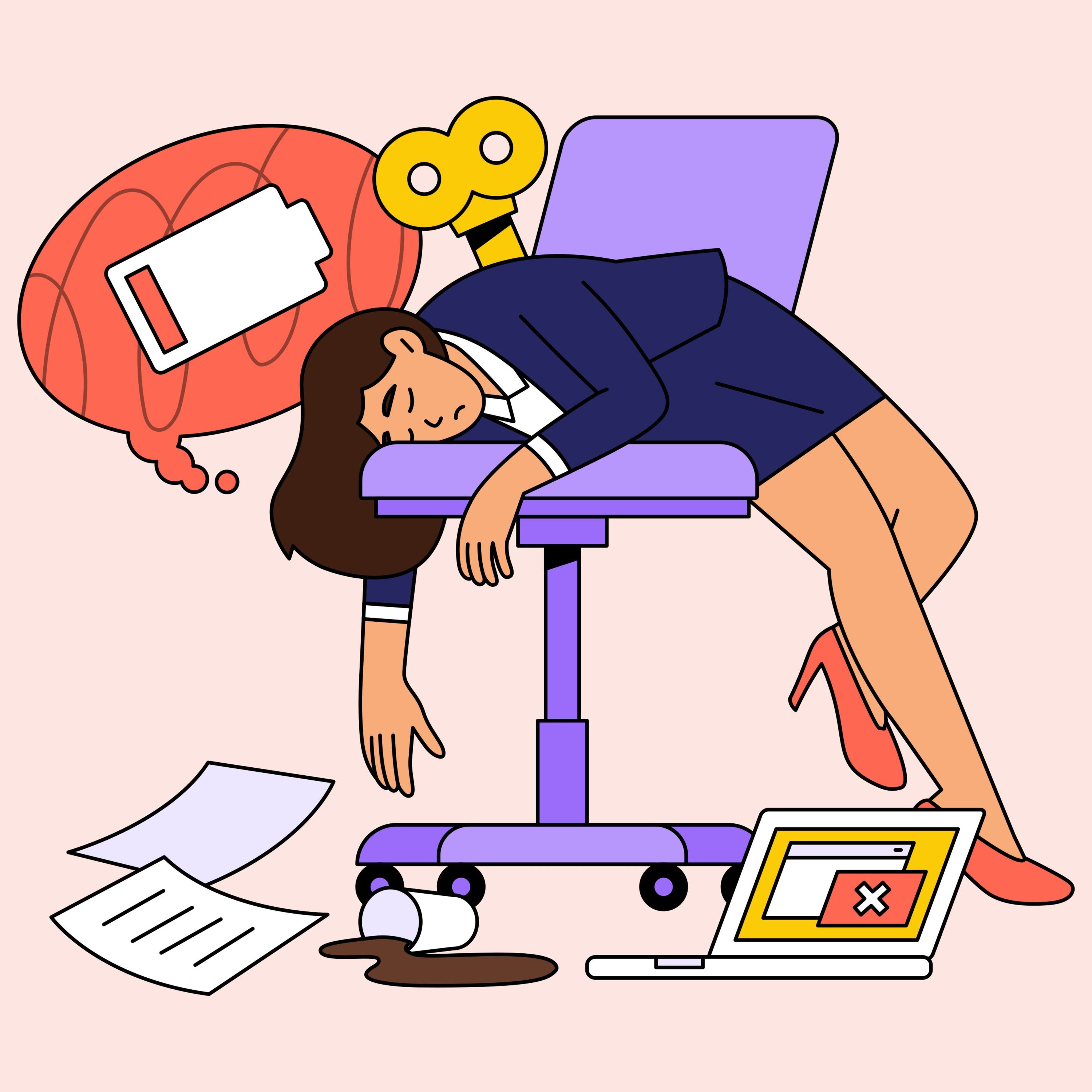
A slow job market has created a new burnout phenomenon: "quiet breaking." Unlike quiet quitting (doing the bare minimum), employees feel trapped in their current roles. They are burning out from working harder than ever in jobs they are unhappy with but cannot easily leave.

If your business stops the moment you do, burnout is an inevitable outcome of a flawed model. Use this exhaustion as a signal to build systems, delegate, or create passive income streams. This shifts the focus from personal endurance to creating a sustainable enterprise that can function without your constant presence.
An entrepreneur's drive to work far ahead, rooted in her past as a gymnast, results in a low-stress business. However, this same habit is tied to an unconscious belief that prevents her from resting, revealing how productive systems can have a detrimental personal cost.
The free market is ruthlessly efficient at pushing commodity service providers to a point of burnout, where they give maximum effort for minimum sustainable pay. To escape burnout, you must escape commoditization by creating a unique, high-value offer.
