Get your free personalized podcast brief
We scan new podcasts and send you the top 5 insights daily.
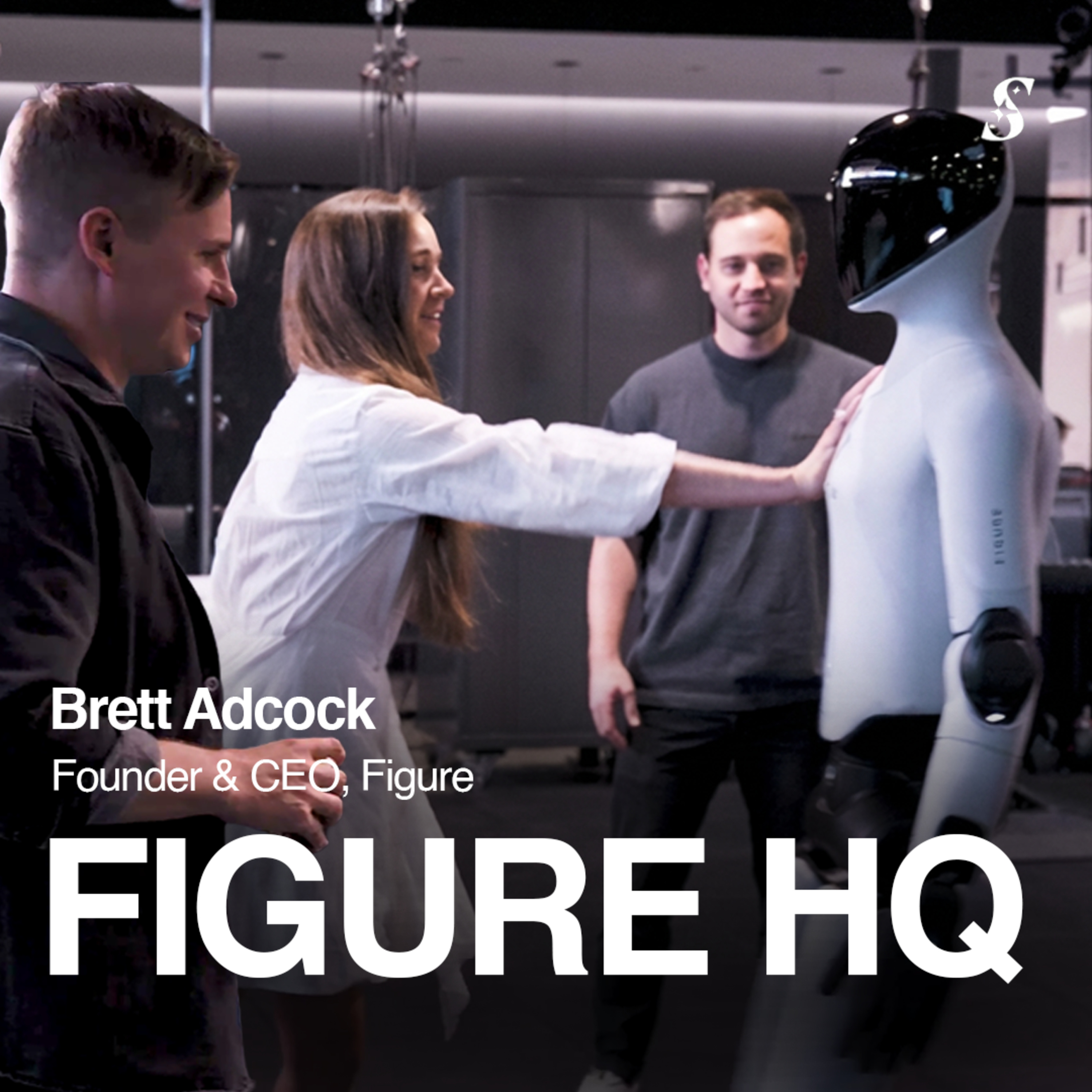
The fabric clothing on Figure's robots serves a practical purpose. It can be easily unzipped and replaced if dirty or damaged, avoiding the need for a technician. This also allows for simple customization with client logos and colors, effectively turning the robot into branded, functional workwear.
Related Insights
Figure is intentionally designing its robots to avoid two extremes: menacing appearances and overly friendly looks with "googly eyes." The goal is to position the humanoid as a sophisticated, high-end piece of technology—a tool for humanity—rather than trying to fool users into thinking it's a toy or a person.

After realizing its initial tendon-driven hand design was an engineering dead end, the team pivoted quickly. Rather than wait months for a full redesign, they repurposed motors from the robot's feet to power the wrist, creating a 'Frankenstein' prototype that allowed AI development to continue without delay.
Unlike cloud-reliant AI, Figure's humanoids perform all computations onboard. This is a critical architectural choice to enable high-frequency (200Hz+) control loops for balance and manipulation, ensuring the robot remains fully functional and responsive without depending on Wi-Fi or 5G connectivity.
To achieve continuous, autonomous operation, Figure's robots recharge by standing on a 2kW wireless inductive charging pad. This design, similar to a phone charger, allows a robot to recharge for an hour to gain 4-5 hours of operational time, enabling seamless 24/7 work cycles without manual intervention.
Figure's first robots were optimized for development speed using expensive CNC manufacturing. For its third generation, the company focused on design-for-manufacturing, successfully reducing the cost by nearly an order of magnitude while simultaneously improving the robot's capabilities and slimming its design.
While IP protection is a concern, Figure's primary reason for in-house manufacturing is the product's immaturity. The novelty of humanoid robots requires extremely tight control and rapid feedback loops between design, testing, and production that would be impossible to achieve with a contract manufacturer.
To prevent catastrophic failures, Figure's 'Vulcan' project trains its AI to handle hardware failures gracefully. If a robot loses power to a knee joint, it automatically locks the joint and begins hobbling on the remaining leg, allowing it to move to safety or await replacement without falling.
Figure designs nearly every component of its robots in-house, from motors to batteries. This extreme vertical integration, though costly upfront, prevents being at the mercy of third-party vendor timelines, code problems, or supply chain issues, enabling faster iteration and deeper system control.

Figure's robots do not rely on a cloud connection for their core functions. The Helix AI model runs inference on GPUs located inside the robot's torso. This allows them to perform complex tasks like logistics or tidying a house even if they lose network connectivity, ensuring high operational reliability.
Machina Labs' containerized robotic manufacturing cells allow for a hybrid approach with traditional assembly lines. After a standard part is mass-produced (e.g., stamped), these cells can add unique, complex customizations at the end of the line, enabling personalization at scale for industries like automotive.
