Get your free personalized podcast brief
We scan new podcasts and send you the top 5 insights daily.
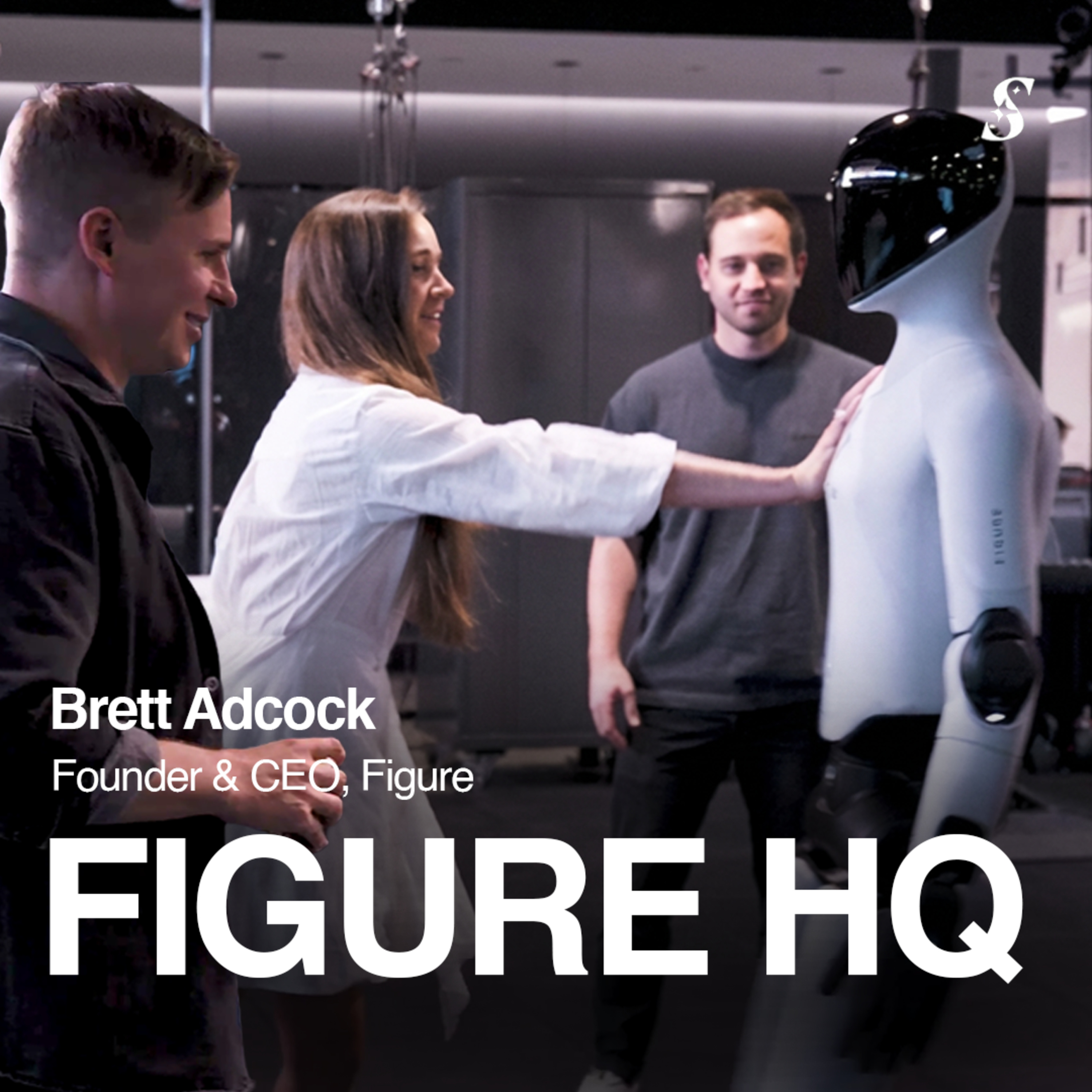
Figure trains its robot's stability controller entirely in a physics simulator, akin to a video game. This allows them to test countless scenarios synthetically. The resulting AI model is so effective it can be 'zero-shot' deployed directly onto the physical robot, achieving human-level stability immediately.
Related Insights
The primary challenge in robotics AI is the lack of real-world training data. To solve this, models are bootstrapped using a combination of learning from human lifestyle videos and extensive simulation environments. This creates a foundational model capable of initial deployment, which then generates a real-world data flywheel.

While language models understand the world through text, Demis Hassabis argues they lack an intuitive grasp of physics and spatial dynamics. He sees 'world models'—simulations that understand cause and effect in the physical world—as the critical technology needed to advance AI from digital tasks to effective robotics.

Unlike cloud-reliant AI, Figure's humanoids perform all computations onboard. This is a critical architectural choice to enable high-frequency (200Hz+) control loops for balance and manipulation, ensuring the robot remains fully functional and responsive without depending on Wi-Fi or 5G connectivity.

In robotics, purely imitating human actions is insufficient. A model trained this way doesn't learn how to recover from inevitable errors. Comma AI solves this by training its models in a simulator where they are forced to learn recovery paths from off-course situations, a critical step for real-world deployment.

GI is not trying to solve robotics in general. Their strategy is to focus on robots whose actions can be mapped to a game controller. This constraint dramatically simplifies the problem, allowing their foundation models trained on gaming data to be directly applicable, shifting the burden for robotics companies from expensive pre-training to more manageable fine-tuning.

Figure determined that coding robot movements is unscalable due to the infinite possible states (360^40). They pivoted from traditional C++ to Helix, an AI policy that controls the robot's entire body from camera inputs, treating robotics as a neural network problem, not a software engineering one.
Beyond supervised fine-tuning (SFT) and human feedback (RLHF), reinforcement learning (RL) in simulated environments is the next evolution. These "playgrounds" teach models to handle messy, multi-step, real-world tasks where current models often fail catastrophically.

To prevent catastrophic failures, Figure's 'Vulcan' project trains its AI to handle hardware failures gracefully. If a robot loses power to a knee joint, it automatically locks the joint and begins hobbling on the remaining leg, allowing it to move to safety or await replacement without falling.
Intuition Robotics' core bet is that the transfer from simulated to physical worlds is unlocked by a shared action interface. Since many real-world robots like drones and arms are already operated with game controllers, an agent trained in diverse gaming environments only needs to adapt to a new visual world, not an entirely new action space.

Unlike older robots requiring precise maps and trajectory calculations, new robots use internet-scale common sense and learn motion by mimicking humans or simulations. This combination has “wiped the slate clean” for what is possible in the field.
