Get your free personalized podcast brief
We scan new podcasts and send you the top 5 insights daily.
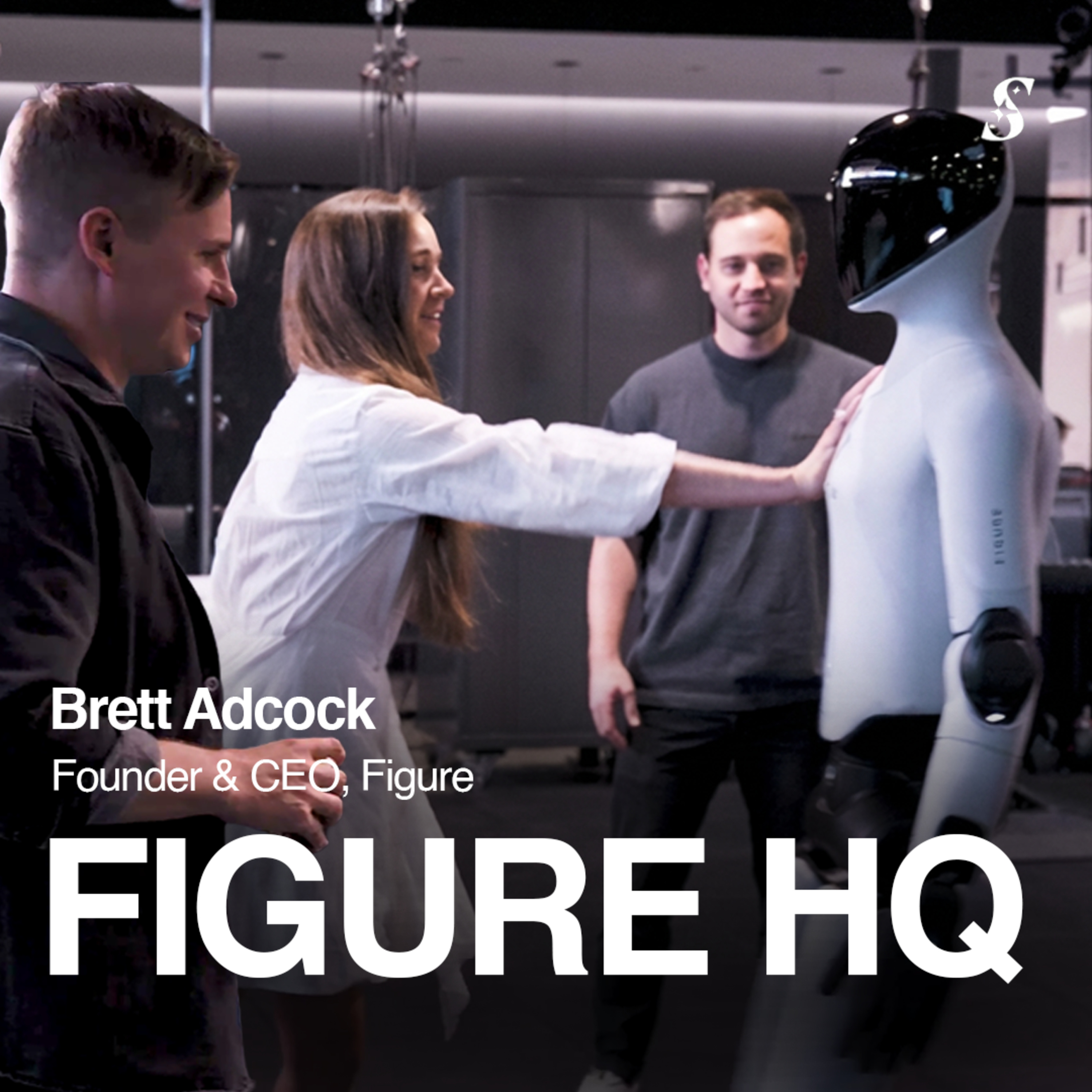
CEO Brett Adcock posits that real-world interaction is the 'last missing piece' for AGI. Because humanoid robots can learn from physically touching the world, trial-and-error, and consequences, he believes they may be the first embodiments to achieve artificial general intelligence, surpassing purely digital models.
Related Insights
Human cognition is a full-body experience, not just a brain function. Current AIs are 'disembodied brains,' fundamentally limited by their lack of physical interaction with the world. Integrating AI into robotics is the necessary next step toward more holistic intelligence.

Brett Adcock argues that designing humanoid robots for extreme feats like backflips creates expensive, heavy, and unsafe machines. The optimal design targets the "fat part of the distribution" of human tasks—laundry, dishes, companionship—to build a practical, general-purpose robot for the mass market.

While language models understand the world through text, Demis Hassabis argues they lack an intuitive grasp of physics and spatial dynamics. He sees 'world models'—simulations that understand cause and effect in the physical world—as the critical technology needed to advance AI from digital tasks to effective robotics.

While LLMs dominate headlines, Dr. Fei-Fei Li argues that "spatial intelligence"—the ability to understand and interact with the 3D world—is the critical, underappreciated next step for AI. This capability is the linchpin for unlocking meaningful advances in robotics, design, and manufacturing.

Language is just one 'keyhole' into intelligence. True artificial general intelligence (AGI) requires 'world modeling'—a spatial intelligence that understands geometry, physics, and actions. This capability to represent and interact with the state of the world is the next critical phase of AI development beyond current language models.

Large Language Models are limited because they lack an understanding of the physical world. The next evolution is 'World Models'—AI trained on real-world sensory data to understand physics, space, and context. This is the foundational technology required to unlock physical AI like advanced robotics.
Society is unprepared for the imminent combination of AGI 'brains' with physically superior humanoid robots. This fusion creates a new form of existence that is stronger, faster, and more adaptable than humans. Pal argues this isn't just an advanced tool; it's the emergence of a new species.

Arvind Krishna firmly believes that today's LLM technology path is insufficient for reaching Artificial General Intelligence (AGI). He gives it extremely low odds, stating that a breakthrough will require fusing current models with structured, hard knowledge, a field known as neurosymbolic AI, before AGI becomes plausible.

While the US prioritizes large language models, China is heavily invested in embodied AI. Experts predict a "ChatGPT moment" for humanoid robots—when they can perform complex, unprogrammed tasks in new environments—will occur in China within three years, showcasing a divergent national AI development path.

Brett Adcock states that Figure AI's "Helix 2" neural net provides the right technical stack for general robotics. The biggest remaining obstacle is not hardware but the immense data required to train the robot for a wide distribution of tasks. The company plans to spend nine figures on data acquisition in 2026 to solve this.