Get your free personalized podcast brief
We scan new podcasts and send you the top 5 insights daily.
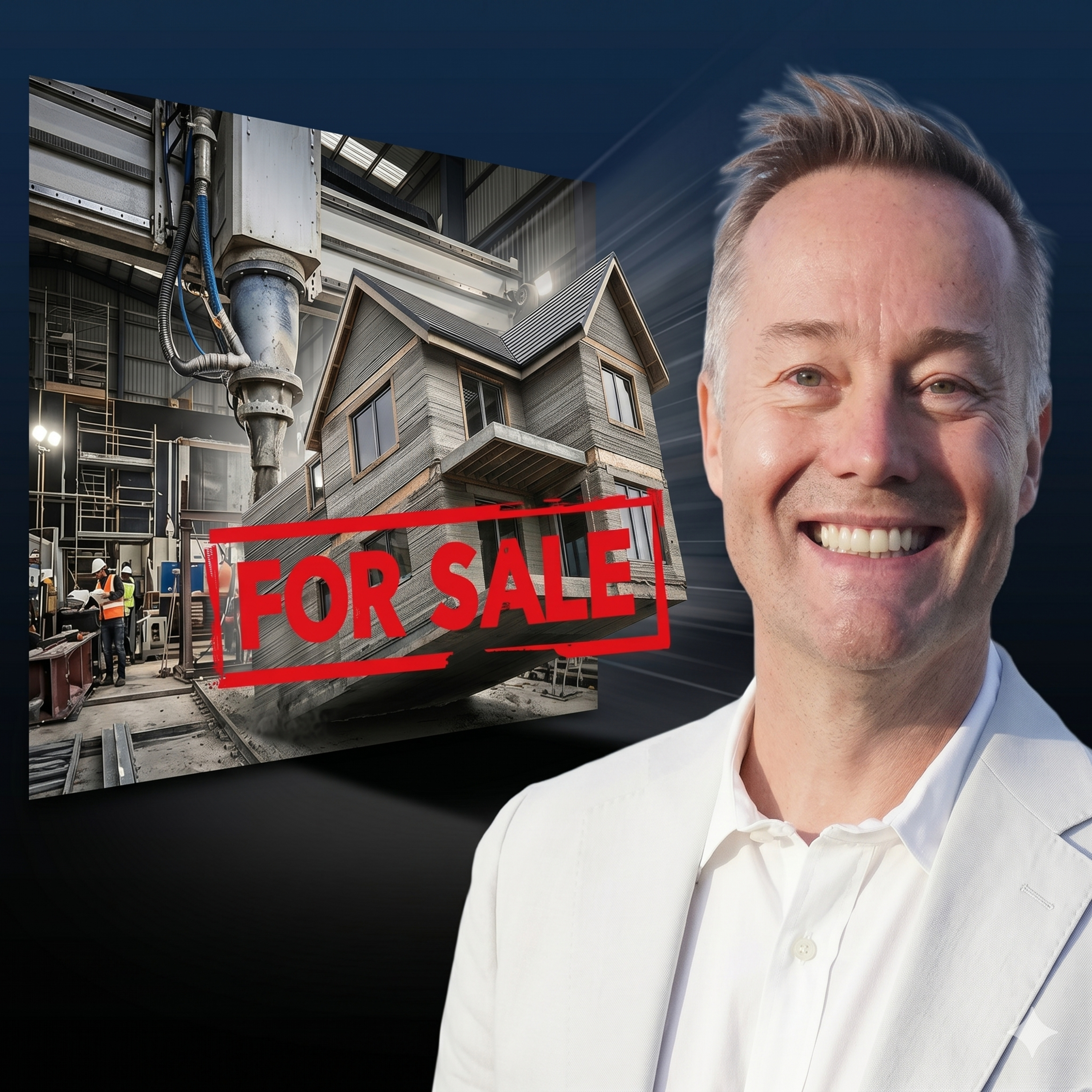
Construction tech startup ICON has succeeded where others failed by vertically integrating the entire home-building process. They control the design software, robotics, proprietary material science (Lavacrete), and regulatory navigation. This holistic approach solves the whole problem, unlike predecessors who merely sold printing hardware.

Related Insights
Subcontracting creates fixed interfaces between teams, leading to a "calcified architecture" where system-level optimization is impossible. Vertically integrating engineering and manufacturing in-house allows for dynamic trade-offs between disciplines, accelerating innovation and reducing costs.
![Scott Nolan - SpaceX, Founders Fund, and Rebuilding American Uranium Enrichment - [Invest Like the Best, EP.467] thumbnail](https://megaphone.imgix.net/podcasts/5edee546-3776-11f1-b41d-a76759576e87/image/908aaa6e87baf2b3d364892c4b7f9fd8.jpg?ixlib=rails-4.3.1&max-w=3000&max-h=3000&fit=crop&auto=format,compress)
Startups often fail to displace incumbents because they become successful 'point solutions' and get acquired. The harder path to a much larger outcome is to build the entire integrated stack from the start, but initially serve a simpler, down-market customer segment before moving up.

ICON recognized that digital architecture combined with a fluid building material (concrete) breaks the traditional link between complexity and cost. A beautiful, curved wall costs the same to print as a simple square one, reintroducing aesthetic aspiration into affordable housing without raising the price.
Northwood cut ground station deployment time from 3 years to 3 months. They achieved this by vertically integrating the entire value chain—antenna R&D, land procurement, construction, and software APIs. This holistic approach aligns incentives and enables system-level optimization impossible with siloed vendors.

Believing the construction industry wouldn't adopt new software alone, EquipmentShare built a vertically integrated equipment rental business on top of their own tech platform. This allowed them to control the entire stack, demonstrate value, and drive change in a resistant market.

For hard tech startups, the decision to vertically integrate and build a factory shouldn't be automatic. It's a strategic imperative only when "cadence"—the speed of iteration and delivery—is the primary competitive advantage. In such cases, the in-house capability to move fast outweighs the high capital cost.

The defensibility of complex hard tech companies doesn't rely on a single patent or technology. Instead, their moat is "novel in the aggregate"—the difficult-to-replicate integration of dozens of complex systems across design, manufacturing, supply chain, and regulation. This holistic execution is the true barrier to entry.
For zero-to-one technologies like humanoid robotics, relying on a supply chain is too slow. ONE X develops everything in-house, from new materials to foundation AI models. This enables rapid, cross-disciplinary iteration, as key discoveries happen at the intersection of hardware, software, and materials science.
For large funds seeking massive returns, companies that control their entire value chain are more attractive than those making a single component. Full-stack companies can avoid supply chain dependencies and capture more value, making them a better fit for billion-dollar fund scale.

ICON's long-term strategy isn't just to be a construction company but a technology provider. By selling their new multi-story printers to other builders and channel partners, they can scale their impact on the global housing crisis much faster than by building every home themselves.