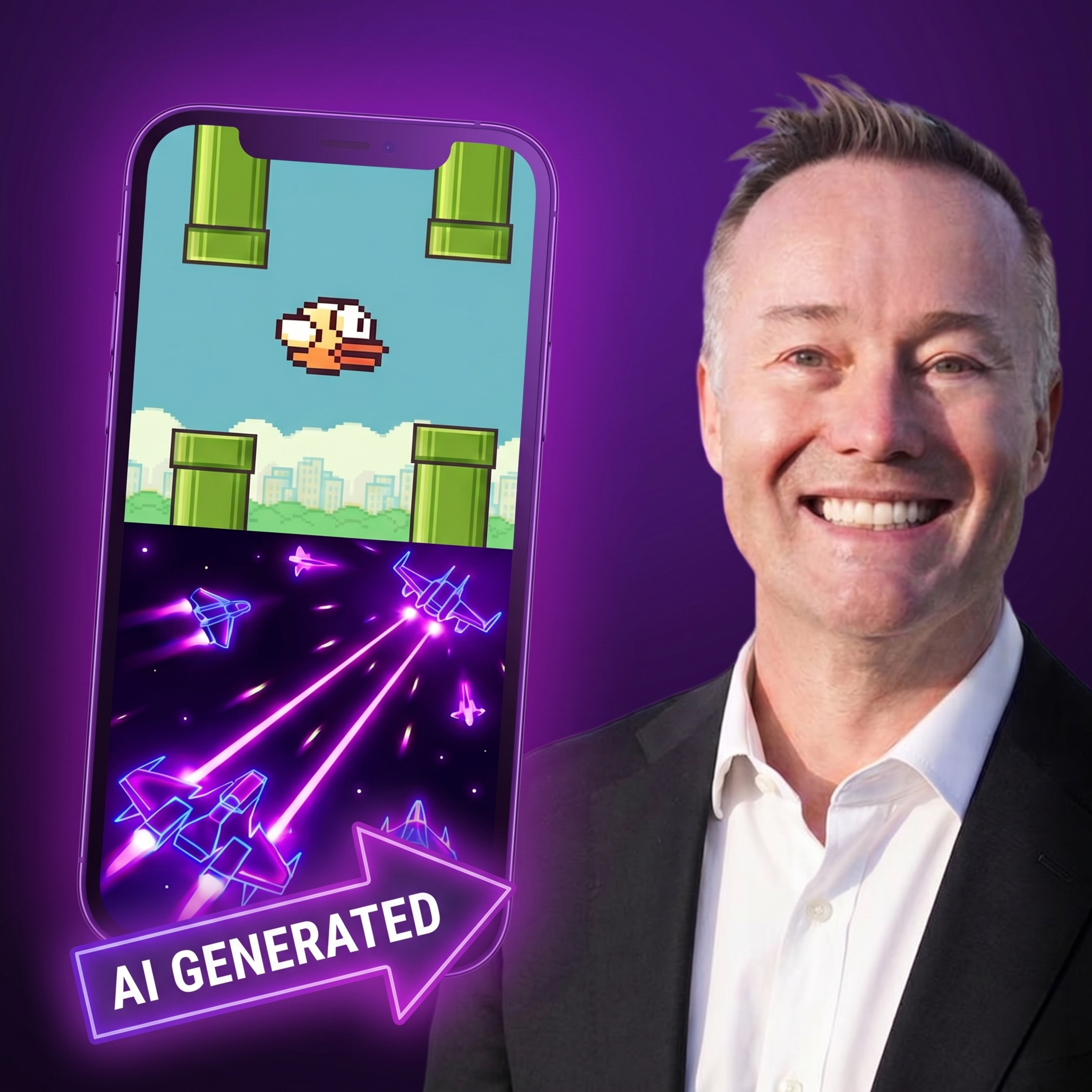
Nanogram, a 'TikTok for games' app, uses AI agents and a custom engine to allow users to generate fully playable 3D games from simple text prompts. What once took a programmer a week can now be accomplished in about 90 seconds, dramatically lowering the barrier to game creation.
Instead of focusing on in-app purchases, Nanogram's founders envision a future where brands create engaging, interactive ads. For example, Domino's could build a playable game where asteroids are pizzas, and the call-to-action is to order the pizza created in-game.
The mobile gaming app has 20% of its users playing over 25 games per session, with average session times of 21 minutes. This high level of engagement, achieved without a sophisticated content algorithm, indicates a powerful core product loop and strong initial product-market fit.
While people commonly share video clips or text, sharing interactive games is not an established behavior. Nanogram is changing this, observing that for every 100 likes on a game, it receives 30 to 50 shares. This high ratio suggests the platform is creating a new viral loop.
Contrary to starting in controlled industrial settings, ONE X believes the complex, diverse, and social nature of the home is the best environment to develop true general intelligence. The robot must learn to navigate social context, like holding a door for someone, which is data unavailable in a factory.
ONE X designs its robots with human-like physical properties, down to skin tissue stiffness. This allows them to effectively leverage the internet's vast repository of human video data (e.g., YouTube) as a training set, bootstrapping intelligence without needing to create an entirely new internet-sized dataset.
Instead of reacting to its environment, ONE X's world model AI allows its robots to 'think' forward and simulate potential outcomes of an action. Like a human anticipating spilling hot coffee, the robot can identify risks and select the safest trajectory, which is critical for operating in a home.
For zero-to-one technologies like humanoid robotics, relying on a supply chain is too slow. ONE X develops everything in-house, from new materials to foundation AI models. This enables rapid, cross-disciplinary iteration, as key discoveries happen at the intersection of hardware, software, and materials science.
To create a powerful data flywheel for AI training, ONE X estimates that deploying 10,000 robots into the world would generate a data influx comparable to the daily upload rate of YouTube. This provides a concrete benchmark for the scale required to achieve self-improving general intelligence in robotics.