Get your free personalized podcast brief
We scan new podcasts and send you the top 5 insights daily.
Microsoft's forthcoming homegrown AI models are not designed to be state-of-the-art. Instead, their strategy is to offer 'good enough' performance at a significantly lower price point. This classic value-based approach targets developers feeling the pinch from the rising costs of frontier models from competitors like Anthropic and OpenAI.

Related Insights
To survive against subsidized tools from model providers like OpenAI and Anthropic, AI applications must avoid a price war. Instead, the winning strategy is to focus on superior product experience and serve as a neutral orchestration layer that allows users to choose the best underlying model.

Nadella posits a future where the winner isn't the company with the best model. Instead, value accrues to the platform that provides the data, context, and tools (the 'scaffolding') that make any model useful, especially as capable open-source alternatives proliferate.
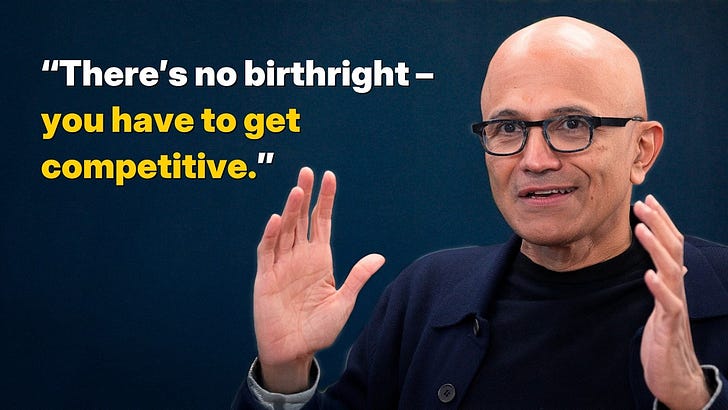
Microsoft's lack of a frontier model isn't a sign of failure but a calculated strategic decision. With full access to OpenAI's models, they are choosing not to spend billions on redundant hyperscaling. Instead, they are playing a long game, conserving resources for a potential late surge, reflecting a more patient and strategically confident approach than competitors.

The assumption that enterprise API spending on AI models creates a strong moat is flawed. In reality, businesses can and will easily switch between providers like OpenAI, Google, and Anthropic. This makes the market a commodity battleground where cost and on-par performance, not loyalty, will determine the winners.

MiniMax is strategically focusing on practical developer needs like speed, cost, and real-world task performance, rather than simply chasing the largest parameter count. This "most usable model wins" philosophy bets that developer experience will drive adoption more than raw model size.

Microsoft's decision to promote Anthropic models on Azure as aggressively as OpenAI's reflects a core belief from CEO Satya Nadella. He anticipates AI models will become commoditized, making the underlying intelligence interchangeable and the cloud platform the primary point of differentiation and value capture.
The common practice of model distillation suggests that AI capabilities will eventually be commoditized. As smaller models can cheaply mimic larger ones, differentiation will shift away from raw performance to product integration and price, likely triggering a massive price war among providers.
AI companies operate under the assumption that LLM prices will trend towards zero. This strategic bet means they intentionally de-prioritize heavy investment in cost optimization today, focusing instead on capturing the market and building features, confident that future, cheaper models will solve their margin problems for them.

Contrary to typical corporate fears, Microsoft's AI lead views the rapid commoditization of AI models and resulting price wars as a positive outcome for humanity. The ultimate goal is to make intelligence abundant and near-zero cost, with Microsoft's business model focused on value-added software integrations.

Unlike general-purpose NVIDIA GPUs, Microsoft's custom Maya 200 chip focuses specifically on running existing AI models (inference). Microsoft claims this makes it cheaper for certain tasks, like its own Copilot tools, creating a cost-saving value proposition for potential customers like Anthropic.