Get your free personalized podcast brief
We scan new podcasts and send you the top 5 insights daily.
Contrary to typical corporate fears, Microsoft's AI lead views the rapid commoditization of AI models and resulting price wars as a positive outcome for humanity. The ultimate goal is to make intelligence abundant and near-zero cost, with Microsoft's business model focused on value-added software integrations.

Related Insights
While some competitors prioritize winning over ROI, Nadella cautions that "at some point that party ends." In major platform shifts like AI, a long-term orientation is crucial. He cites Microsoft's massive OpenAI investment, committed *before* ChatGPT's success, as proof of a long-term strategy paying off.

Nadella posits a future where the winner isn't the company with the best model. Instead, value accrues to the platform that provides the data, context, and tools (the 'scaffolding') that make any model useful, especially as capable open-source alternatives proliferate.
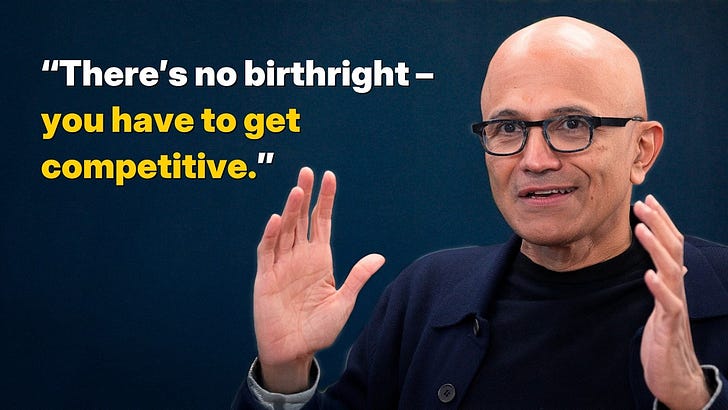
AI's high computational cost (COGS) threatens SaaS margins. Nadella explains that just as the cloud expanded the market for computing far beyond the original server-license model, AI will create entirely new categories and user bases, offsetting the higher costs.
Nadella adopts a grounded perspective on AI's current state. He likens it to past technological revolutions, viewing it as a powerful tool that enhances human intellect and productivity, rather than subscribing to the more mystical 'final revolution' narrative about AGI.
The assumption that AI will create trillions in corporate profit overlooks a key economic reality: only 1% of global GDP is profit above the cost of capital. Intense competition in AI will likely drive prices down, meaning the vast majority of economic benefits will be passed to consumers, not captured by a few monopolistic companies.

AI companies operate under the assumption that LLM prices will trend towards zero. This strategic bet means they intentionally de-prioritize heavy investment in cost optimization today, focusing instead on capturing the market and building features, confident that future, cheaper models will solve their margin problems for them.

Contrary to the idea that technology always gets cheaper, building on AI is less expensive now. The current phase is characterized by abundant venture capital and intense competition among AI tool providers, which subsidizes costs for developers. As the market consolidates, these costs will rise.

Marks questions whether companies will use AI-driven cost savings to boost profit margins or if competition will force them into price wars. If the latter occurs, the primary beneficiaries of AI's efficiency will be customers, not shareholders, limiting the technology's impact on corporate profitability.

Unlike traditional SaaS where high switching costs prevent price wars, the AI market faces a unique threat. The portability of prompts and reliance on interchangeable models could enable rapid commoditization. A price war could be "terrifying" and "brutal" for the entire ecosystem, posing a significant downside risk.
Beyond the equity stake and Azure revenue, Satya Nadella highlights a core strategic benefit: royalty-free access to OpenAI's IP. For Microsoft, this is equivalent to having a "frontier model for free" to deeply integrate across its entire product suite, providing a massive competitive advantage without incremental licensing costs.
