Get your free personalized podcast brief
We scan new podcasts and send you the top 5 insights daily.
Microsoft's lack of a frontier model isn't a sign of failure but a calculated strategic decision. With full access to OpenAI's models, they are choosing not to spend billions on redundant hyperscaling. Instead, they are playing a long game, conserving resources for a potential late surge, reflecting a more patient and strategically confident approach than competitors.

Related Insights
While some competitors prioritize winning over ROI, Nadella cautions that "at some point that party ends." In major platform shifts like AI, a long-term orientation is crucial. He cites Microsoft's massive OpenAI investment, committed *before* ChatGPT's success, as proof of a long-term strategy paying off.

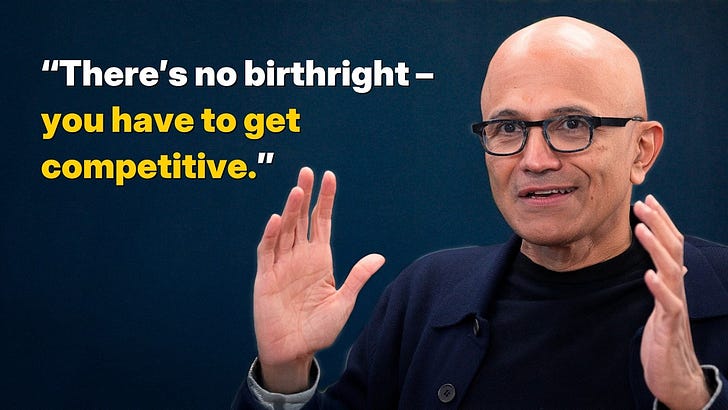
Nadella posits a future where the winner isn't the company with the best model. Instead, value accrues to the platform that provides the data, context, and tools (the 'scaffolding') that make any model useful, especially as capable open-source alternatives proliferate.
Reports that OpenAI hasn't completed a new full-scale pre-training run since May 2024 suggest a strategic shift. The race for raw model scale may be less critical than enhancing existing models with better reasoning and product features that customers demand. The business goal is profit, not necessarily achieving the next level of model intelligence.

Unlike competitors focused on vertical integration, Microsoft's "hyperscaler" strategy prioritizes supporting a long tail of diverse customers and models. This makes a hyper-optimized in-house chip less urgent. Furthermore, their IP rights to OpenAI's hardware efforts provide them with access to cutting-edge designs without bearing all the development risk.

To navigate the massive capital requirements of AI, Nadella reframes the investment in cutting-edge training infrastructure. Instead of being purely reactive to customer demand, a significant portion is considered R&D, allowing for sustained, order-of-magnitude scaling necessary for breakthroughs.
Satya Nadella reveals that Microsoft prioritizes building a flexible, "fungible" cloud infrastructure over catering to every demand of its largest AI customer, OpenAI. This involves strategically denying requests for massive, dedicated data centers to ensure capacity remains balanced for other customers and Microsoft's own high-margin products.

The widely discussed compute shortage is primarily an inference problem, not a training one. According to Mustafa Suleiman, Microsoft has enough power for training next-gen models, but is constrained by the massive demand for running existing services like Copilot.

Microsoft's early OpenAI investment was a calculated, risk-adjusted decision. They saw that generalizable AI platforms were a 'must happen' future and asked, 'Can we remain a top cloud provider without it?' The clear 'no' made the investment a defensive necessity, not just an offensive gamble.
Despite appearing to lose ground to competitors, Microsoft's 2023 pause in leasing new datacenter sites was a strategic move. It aimed to prevent over-investing in hardware that would soon be outdated, ensuring it could pivot to newer, more power-dense and efficient architectures.
Beyond the equity stake and Azure revenue, Satya Nadella highlights a core strategic benefit: royalty-free access to OpenAI's IP. For Microsoft, this is equivalent to having a "frontier model for free" to deeply integrate across its entire product suite, providing a massive competitive advantage without incremental licensing costs.