Get your free personalized podcast brief
We scan new podcasts and send you the top 5 insights daily.
At its Build conference, Microsoft is strategically pitching its own suite of homegrown AI models for coding, reasoning, and more. The play is to leverage its massive, existing developer community to create a viable third option in the AI model market, competing on cost, performance, and integration against the perceived OpenAI/Anthropic duopoly.

Related Insights
Nadella posits a future where the winner isn't the company with the best model. Instead, value accrues to the platform that provides the data, context, and tools (the 'scaffolding') that make any model useful, especially as capable open-source alternatives proliferate.
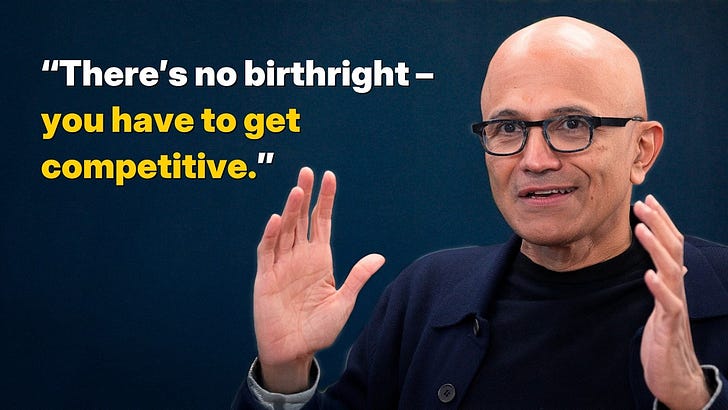
OpenAI is building products that directly compete with Microsoft, its largest investor. This move, along with Microsoft's diversification into deals with rivals like Anthropic, indicates their relationship is evolving into "co-opetition," where they are both strategic partners and direct competitors in key markets.
Specialized SaaS companies like Writer and Intercom are moving beyond simply wrapping OpenAI or Anthropic APIs. They are now training their own foundation models to create more defensible, vertically-integrated AI products, signaling a shift away from platform dependency toward bespoke AI stacks.

Microsoft is not solely reliant on its OpenAI partnership. It actively integrates competitor models, such as Anthropic's, into its Copilot products to handle specific workloads where they perform better, like complex Excel tasks. This pragmatic "best tool for the job" approach diversifies its AI capabilities.

Microsoft's decision to promote Anthropic models on Azure as aggressively as OpenAI's reflects a core belief from CEO Satya Nadella. He anticipates AI models will become commoditized, making the underlying intelligence interchangeable and the cloud platform the primary point of differentiation and value capture.
Top-tier coding models from Google, OpenAI, and Anthropic are functionally equivalent and similarly priced. This commoditization means the real competition is not on model performance, but on building a sticky product ecosystem (like Claude Code) that creates user lock-in through a familiar workflow and environment.

Despite being key backers of OpenAI, Microsoft and NVIDIA are investing heavily in its competitor, Anthropic. This signals a strategic shift by tech giants to diversify their AI investments, ensuring no single lab becomes dominant and fostering a more competitive ecosystem.

Microsoft's forthcoming homegrown AI models are not designed to be state-of-the-art. Instead, their strategy is to offer 'good enough' performance at a significantly lower price point. This classic value-based approach targets developers feeling the pinch from the rising costs of frontier models from competitors like Anthropic and OpenAI.
Counter to the idea of a few dominant frontier models, Satya Nadella believes the AI model market will mirror the database market's evolution. He expects a proliferation of specialized models, including open-source and proprietary ones, with firms eventually embedding their unique tacit knowledge into custom models they control.
Microsoft, despite its deep ties to OpenAI, was alarmed by the capabilities of Anthropic's new productivity platform. This reaction signifies a competitive shift where Anthropic is now seen as a primary threat, forcing Microsoft to rapidly prototype similar features to maintain its edge in AI productivity tools.