Get your free personalized podcast brief
We scan new podcasts and send you the top 5 insights daily.
Categorize all AI token spend into three buckets: 'Tokens that Teach' (valuable experimentation), 'Tokens that Produce' (work output), and 'Tokens that Spin' (wasteful, idle processes). The optimal strategy is to aggressively eliminate 'spin' tokens, optimize 'produce' tokens, and fiercely protect the budget for 'teach' tokens to foster innovation.

Related Insights
The optimal strategy for managing AI costs is neither total restriction nor a free-for-all. It's providing engineers with dedicated "learning budgets" and experimentation pools, coupled with clear visibility into costs. This fosters innovation responsibly without incurring surprise invoices and turns cost into a first-class constraint.
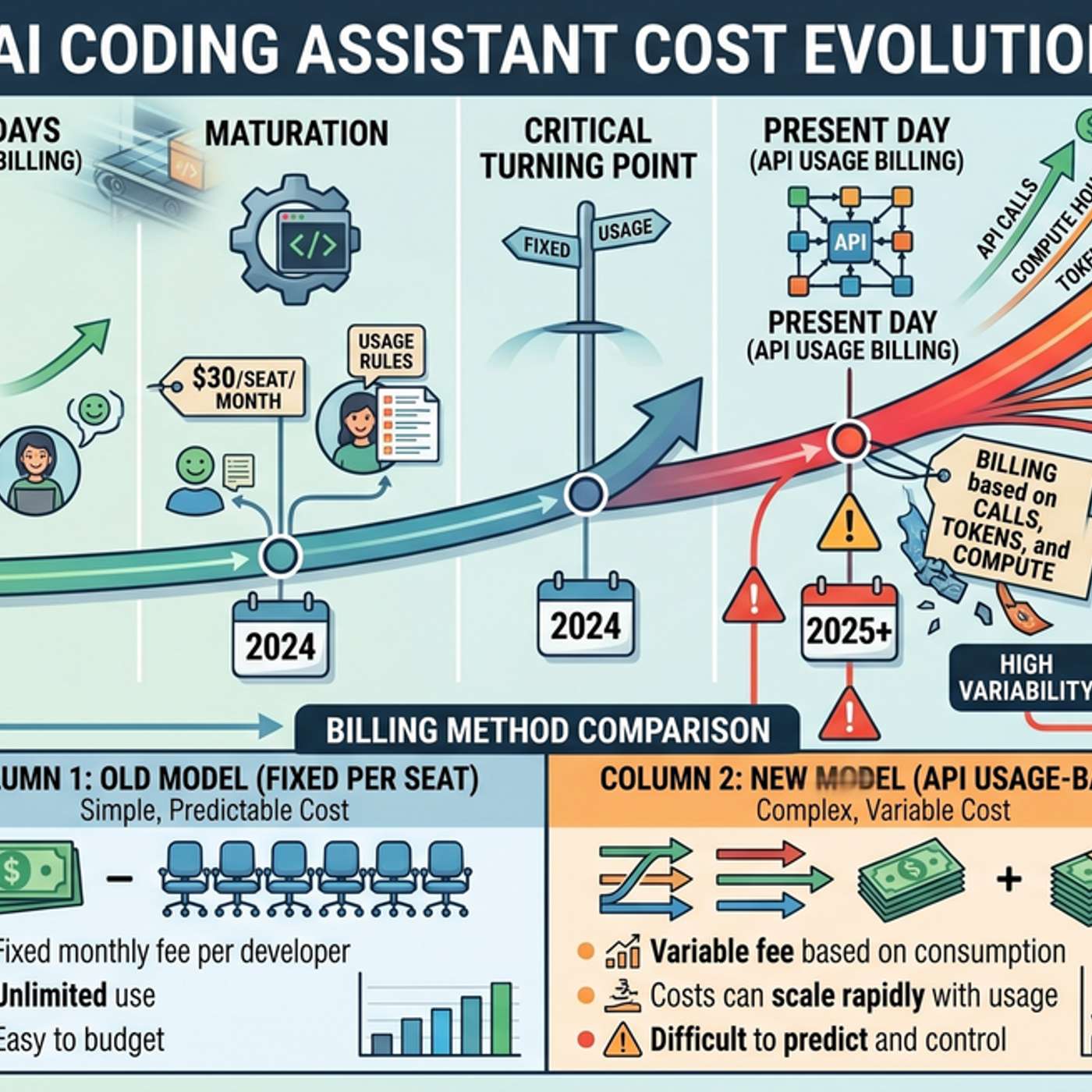
If your team cannot articulate the specific business outcome of their AI usage in a single sentence, you don't have an AI strategy. You simply have 'token maxing'—usage for the sake of usage. This framework forces a direct link between AI spend and business results.

Enterprises that track and reward high AI token usage risk incentivizing the wrong behavior. This is a modern "Cobra Effect," where employees generate unnecessary output to hit metrics, much like people who bred cobras to collect a bounty. The focus must be on utility, not volume.

After initial unrestricted spending led to budget overruns at companies like Uber, major enterprises are shifting focus. They are moving away from measuring raw AI usage (tokens) and toward implementing AI only for proven use cases with clear ROI, which may benefit cheaper, open-source models over expensive frontier ones.
Incentivizing high AI token usage is not waste, but a form of R&D. In the new agentic paradigm, there are no best practices. Mass experimentation, even with failures, is the only way to discover future workflows and avoid being left behind.
The trend of "token maxing"—unrestrained spending on AI usage—is being corrected. Companies like Meta are realizing that, like any business expense, AI token consumption must be "min-maxed": optimizing for the highest leverage output at the lowest possible cost, not just maximizing usage.

Companies have moved through distinct phases of AI adoption: from ignoring costs ('token oblivious'), to gamifying usage with leaderboards ('token maximizing'), to a fearful cost-cutting phase ('token anxious'). The next, most effective stage is 'token smart,' focusing on spending wisely, not sparingly, to maximize value.
The initial approach to AI adoption was often "token maxing"—using as many tokens as possible under the assumption that more usage equals more value. A more sophisticated and sustainable strategy is "output maxing," which focuses on achieving the desired result while actively minimizing token consumption and cost.

Tech companies are shifting from a 'token maxing' mindset—using AI tools indiscriminately—to 'token min-maxing.' This borrows from gaming strategy, focusing on achieving the highest output for the lowest resource cost. It marks a maturation from hype-driven consumption to a more structured, ROI-focused approach with budgets and controls.

Giving teams a 'token budget' is flawed because it incentivizes generating low-value output to hit a quota, similar to bad hiring quotas. Instead, companies must tie token consumption directly to business KPIs. This reframes AI spend as a value-creating investment, not a cost to be managed.
