Get your free personalized podcast brief
We scan new podcasts and send you the top 5 insights daily.
As companies adopt AI, token costs become a significant, opaque expense. This creates a need for new financial tools that provide granular analytics to track, understand, and optimize AI spend across models, use cases, employees, and even per customer.

Related Insights
The most heated topic among Fortune 500 CIOs is no longer which AI model is most powerful, but how to manage unpredictable and soaring token costs. Companies are struggling to find the right strategies—from workload prioritization to user-based access tiers—to create a predictable cost model in a rapidly evolving tech landscape.

An anecdote about an engineer spending $100M in a month on AI tokens reveals a core enterprise issue. For Lenovo's CFO, the problem isn't the amount but its lack of planning and clear ROI. This signals a shift from predictable software subscriptions to volatile, usage-based AI compute costs.

While early generative AI costs were negligible, the shift to complex, multi-step agentic workflows is causing a massive spike in token usage. This has elevated cost optimization and ROI from a minor concern to a C-suite priority for the first time.

The shift to AI-driven development introduces a wildly unpredictable cost: token consumption. This expense could range from a minor line item to exceeding the entire engineering payroll, creating an unprecedented budgeting challenge for CFOs and threatening companies' profitability if not managed correctly.

The shift to agentic AI means costs are no longer predictable per-seat subscriptions but variable expenses based on usage (tokens, compute). This requires managing AI like a capital allocation or a new form of labor, not just another software tool, a reality that early adopters are now grappling with.
In response to budget blowouts from agentic AI, enterprises are moving beyond simple adoption to active cost management. A new "token efficiency" stack is emerging, featuring tactics like model routing to cheaper alternatives (e.g., DeepSeek) and custom post-trained models to reduce reliance on expensive foundation models.
AI companies moving to token-based pricing will face the same client scrutiny as law firms with billable hours. Customers, shocked by huge, unpredictable bills, will demand granular usage reports, creating a new market for cost optimization and transparency tools.

A few months ago, the fear was AI replacing SaaS businesses. Now, the pressing issue is managing massive AI bills. This has elevated 'token economics'—optimizing costs by using different models for different tasks (model routing)—from an advanced technique to a non-negotiable, table-stakes practice for any serious AI implementation.

Just as uncontrolled cloud spending in the 2010s spawned the FinOps field, the shift to consumption-based AI pricing will necessitate a similar discipline. This involves attributing costs to specific workloads, setting granular budgets, and providing real-time visibility to prevent budget overruns and measure ROI accurately.
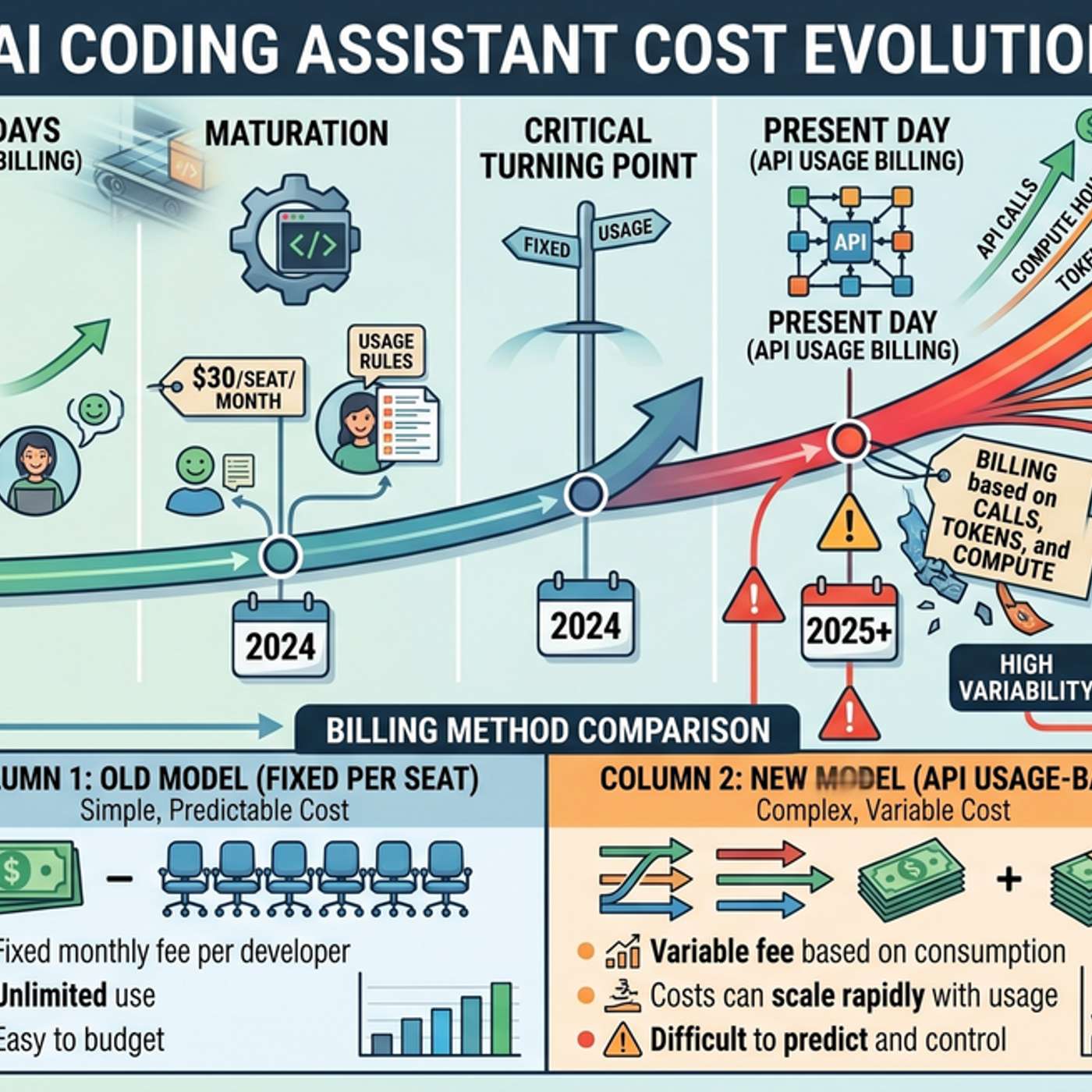
Goldman's CIO predicts that while unit cost per token will decrease, the explosion in token usage from agentic systems will make total AI compute a major corporate expense. He suggests it should be compared to personnel costs, not traditional IT spending.