Get your free personalized podcast brief
We scan new podcasts and send you the top 5 insights daily.
Error analysis showed nearly half the model's mistakes came from a flawed data schema that forced a single label onto dual-intent text (e.g., a combined complaint and request). The root cause wasn't a modeling failure but a data modeling decision made before any training, highlighting that schema design is critical for accuracy.

Related Insights
Data Axle's CEO warns that while AI can make good decisions quickly, it also amplifies errors from a weak data foundation, making bad decisions at an unprecedented speed. This makes data quality more critical than ever in the AI era, as poor data leads to flawed outcomes at scale.

Instead of solving underlying data quality issues, AI agents amplify and expose them immediately. This makes protecting and managing data at its source a critical prerequisite for maintaining trust and achieving successful AI implementation, as poor data becomes an immediate operational bottleneck.

Before deploying AI agents, Sendoso discovered they needed more than just clean data; they had to build a complete data dictionary and ontology. Agents can't interpret ambiguous field names or tribal knowledge, forcing a foundational data cleanup and definition process.

The researchers' failure case analysis is highlighted as a key contribution. Understanding why the model fails—due to ambiguous data or unusual inputs—provides a realistic scope of application and a clear roadmap for improvement, which is more useful for practitioners than high scores alone.
LLMs in production don't often crash spectacularly. Instead, they introduce subtle, probabilistic errors—like incorrect enum values or missing fields—that are hard to debug because they lack clear error patterns, unlike deterministic code failures.
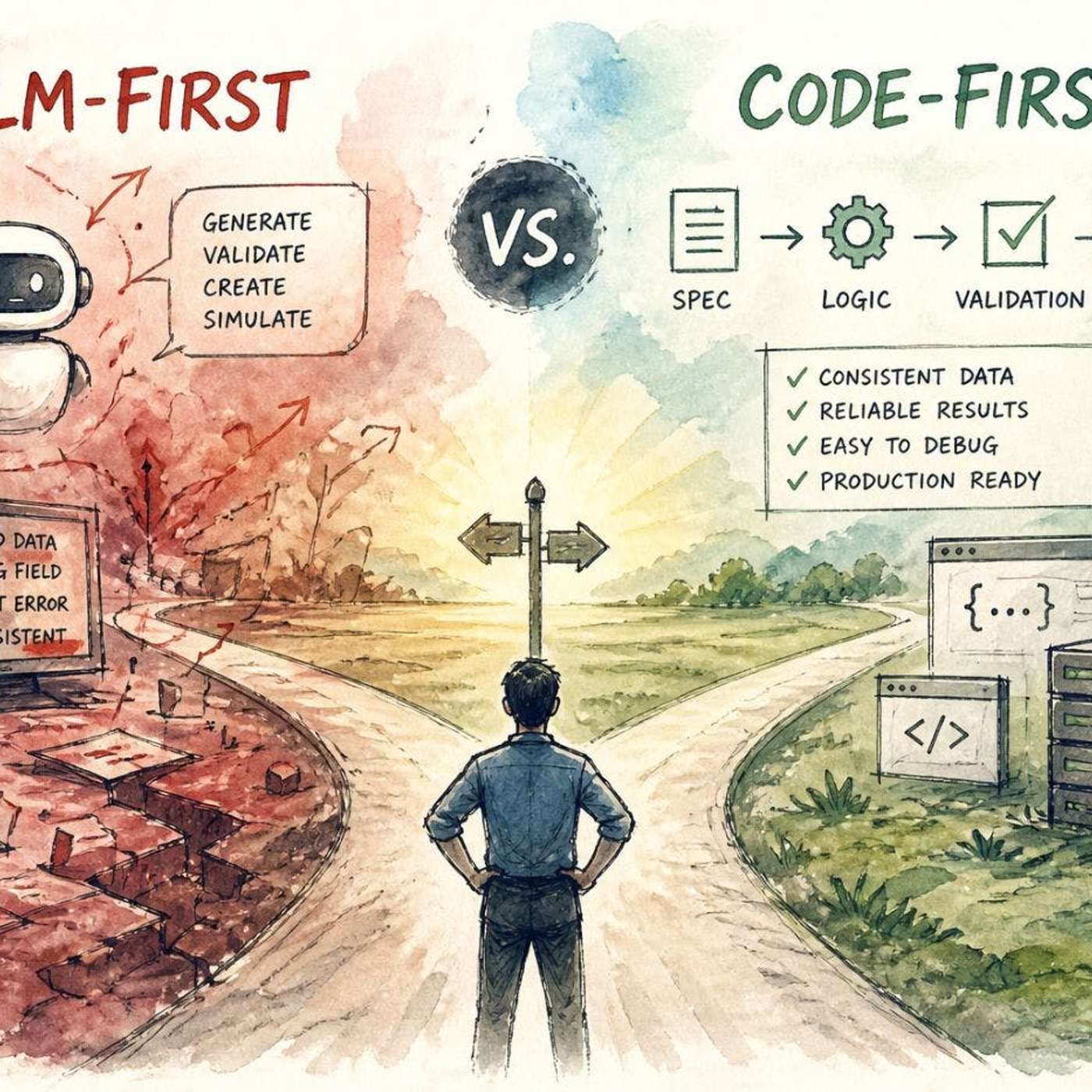
Many organizations excel at building accurate AI models but fail to deploy them successfully. The real bottlenecks are fragile systems, poor data governance, and outdated security, not the model's predictive power. This "deployment gap" is a critical, often overlooked challenge in enterprise AI.

Most production RAG systems fail not because of the LLM or prompt, but due to poor document parsing, chunking, and indexing. Teams mistakenly debug the generation layer when the foundational data processing is the true root cause of poor performance.
Contrary to popular belief, many significant boosts in AI model quality don't originate from novel algorithms. Instead, they come from the less glamorous work of identifying and fixing subtle bugs within the data and model training pipelines.

Using fragmented data to train AI models creates a compounding error effect. Like laying tile from a slightly off corner, a small initial inaccuracy in audience segmentation can lead to massively flawed predictive models and poor campaign performance. The problem isn't the AI, but the flawed data foundation it's building upon.

Teams often try to fix data extraction errors by adding complex instructions to prompts. This fails because the root cause is a structural data engineering problem, not a semantic one. The LLM receives scrambled text tokens before it can even process the prompt's instructions, making the effort futile.