Get your free personalized podcast brief
We scan new podcasts and send you the top 5 insights daily.
Create a custom Claude Code skill that sends a spec or problem to multiple LLM APIs (e.g., ChatGPT, Gemini, Grok) simultaneously. This "council of AIs" provides diverse feedback, catching errors or omissions that a single model might miss, leading to more robust plans.

Related Insights
An effective AI development workflow involves treating models as a team of specialists. Use Claude as the reliable 'workhorse' for building an application from the ground up, while leveraging models like Gemini or GPT-4 as 'advisory models' for creative input and alternative problem-solving perspectives.

Instead of switching between ChatGPT, Claude, and others, a multi-agent workflow lets users prompt once to receive and compare outputs from several LLMs simultaneously. This consolidates the AI user experience, saving time and eliminating 'LLM ping pong' to find the best response.
For stubborn bugs, use an advanced prompting technique: instruct the AI to 'spin up specialized sub-agents,' such as a QA tester and a senior engineer. This forces the model to analyze the problem from multiple perspectives, leading to a more comprehensive diagnosis and solution.
Relying on a single model family for generation and review is suboptimal. Blitzy found that using models from different developers (e.g., OpenAI, Anthropic) to check each other's work produces tremendously better results, as each family has distinct strengths and reasoning patterns.
Instead of relying on a single AI, use different models (e.g., ChatGPT for internal context, Claude for an objective view) for the same problem. This multi-model approach generates diverse perspectives and higher-quality strategic outputs.

To overcome the challenge of reviewing AI-generated code, have different LLMs like Claude and Codex review the code. Then, use a "peer review" prompt that forces the primary LLM to defend its choices or fix the issues raised by its "peers." This adversarial process catches more bugs and improves overall code quality.
Prompting a different LLM model to review code generated by the first one provides a powerful, non-defensive critique. This "second opinion" can rapidly identify architectural issues, bugs, and alternative approaches without the human ego involved in traditional code reviews.
Different LLMs have unique strengths and knowledge gaps. Instead of relying on one model, an "LLM Council" approach queries multiple models (e.g., Claude, Gemini) for the same prompt and then uses an agent to aggregate and synthesize the responses into one superior output.

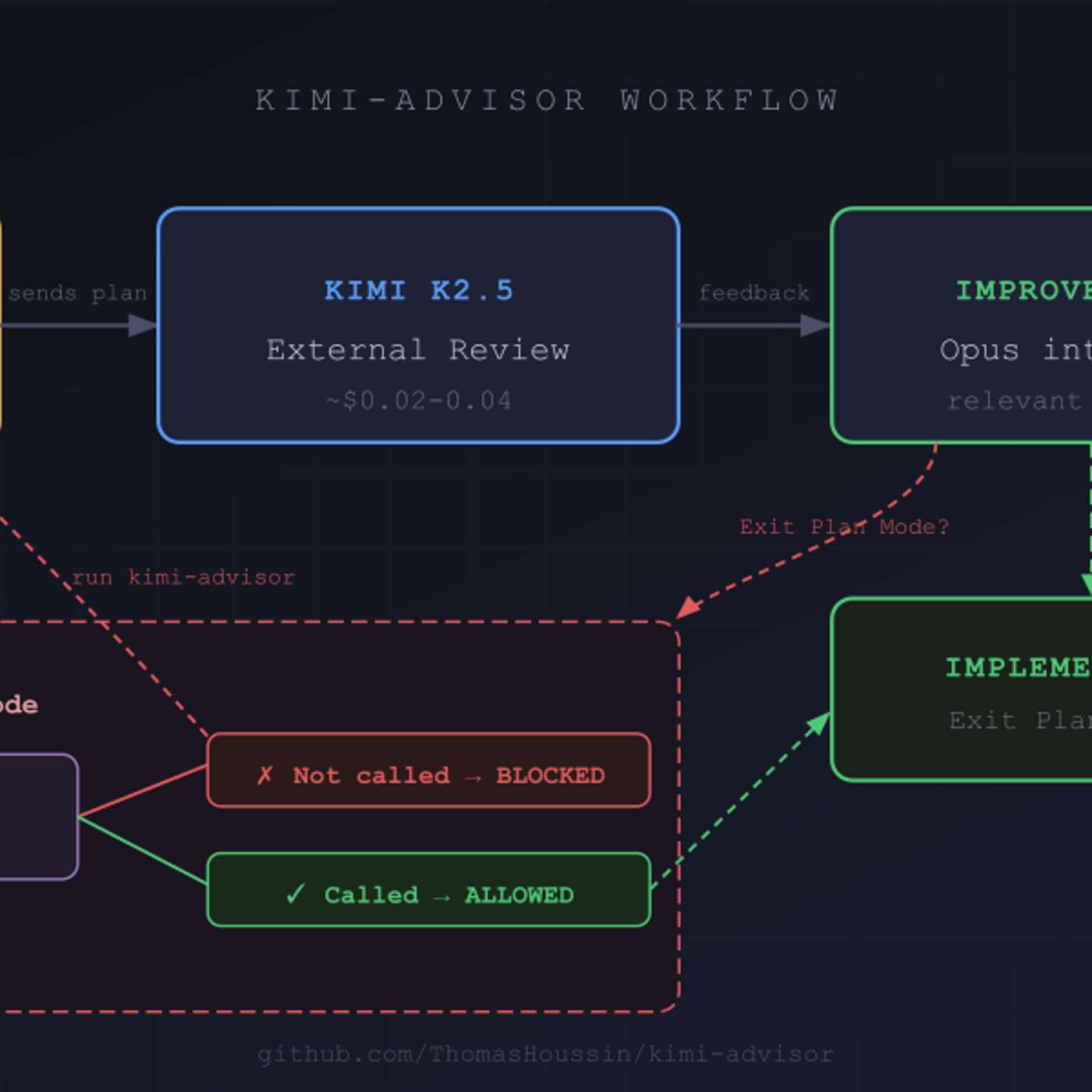
To improve code quality, use a secondary AI model from a different provider (e.g., Moonshot AI's Kimi) to review plans generated by a primary model (e.g., Anthropic's Claude). This introduces cognitive diversity and avoids the shared biases inherent in a single model family, leading to a more robust and enriching review process.
Define different agents (e.g., Designer, Engineer, Executive) with unique instructions and perspectives, then task them with reviewing a document in parallel. This generates diverse, structured feedback that mimics a real-world team review, surfacing potential issues from multiple viewpoints simultaneously.