Get your free personalized podcast brief
We scan new podcasts and send you the top 5 insights daily.
A Microsoft memo states, "Treat AI like a tool and you build a tool that serves people." This is a strategic sales pitch positioning Microsoft's AI as business-focused and value-driven, contrasting it with the grand, AGI-centric missions of labs like Anthropic and OpenAI.

Related Insights
Nadella adopts a grounded perspective on AI's current state. He likens it to past technological revolutions, viewing it as a powerful tool that enhances human intellect and productivity, rather than subscribing to the more mystical 'final revolution' narrative about AGI.
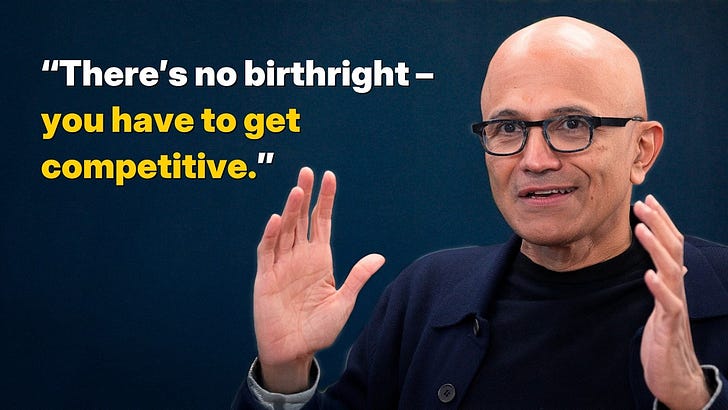
Microsoft is not solely reliant on its OpenAI partnership. It actively integrates competitor models, such as Anthropic's, into its Copilot products to handle specific workloads where they perform better, like complex Excel tasks. This pragmatic "best tool for the job" approach diversifies its AI capabilities.

Microsoft’s approach to superintelligence isn't a single, all-knowing AGI. Instead, the strategy is to develop hyper-competent AI in specific verticals like medicine. This deliberate narrowing of domain is not just a development strategy but a core safety principle to ensure control.
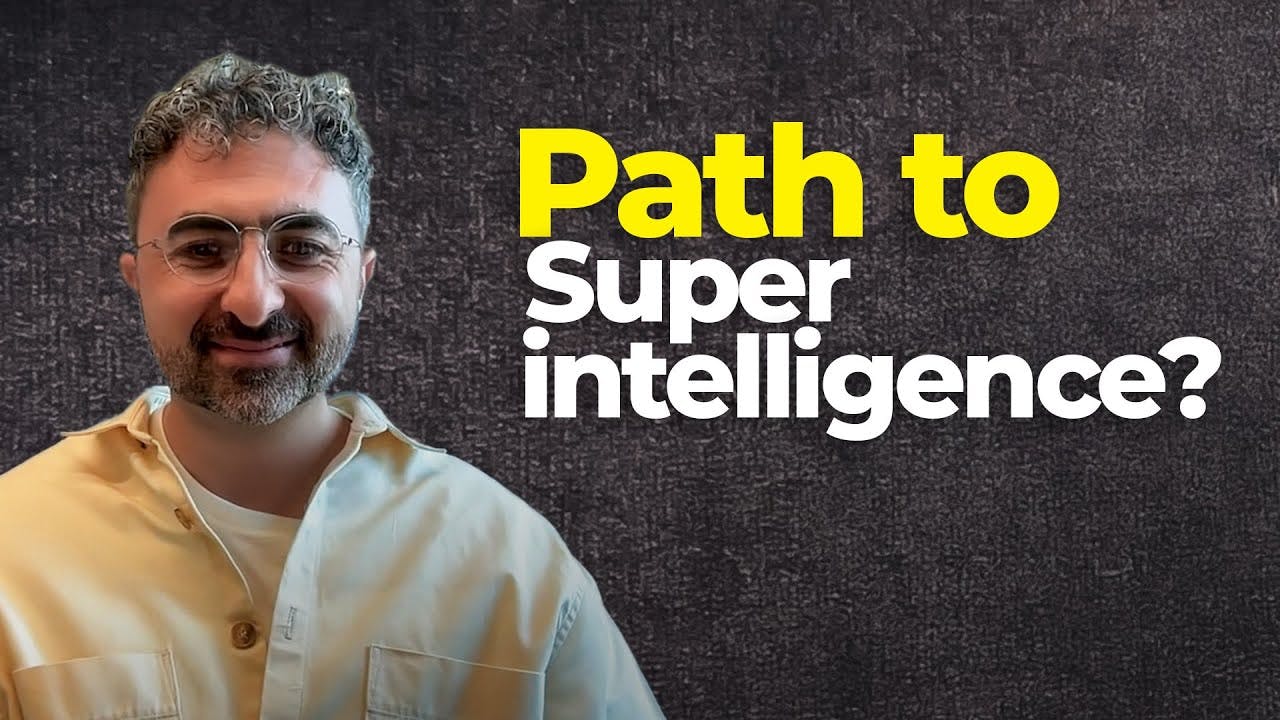
Microsoft CEO Satya Nadella views AI's trajectory in two distinct paths. The first is "cognitive enhancement" tools that assist users, like Copilot. The second, more ambitious path is a "guardian angel," an AGI-like system that oversees and manages tasks. This framework signals a deeper belief in AGI's potential than is commonly associated with him.

Microsoft's AI chief, Mustafa Suleiman, announced a focus on "Humanist Super Intelligence," stating AI should always remain in human control. This directly contrasts with Elon Musk's recent assertion that AI will inevitably be in charge, creating a clear philosophical divide among leading AI labs.
Nadella introduces the 'harness'—the integrated system of data, tools, and context preparation surrounding a model. He posits this harness, which enables multi-model strategies and efficient execution, is where companies create unique value, rather than in the base model alone.

At its Build conference, Microsoft is strategically pitching its own suite of homegrown AI models for coding, reasoning, and more. The play is to leverage its massive, existing developer community to create a viable third option in the AI model market, competing on cost, performance, and integration against the perceived OpenAI/Anthropic duopoly.
Microsoft's forthcoming homegrown AI models are not designed to be state-of-the-art. Instead, their strategy is to offer 'good enough' performance at a significantly lower price point. This classic value-based approach targets developers feeling the pinch from the rising costs of frontier models from competitors like Anthropic and OpenAI.
Microsoft is developing its own AI models from scratch, pitching them as cheaper and more effective for customized enterprise needs than leading models from its partner OpenAI or competitor Anthropic. This signals a strategy to control the full AI stack and compete directly on price.
The focus on achieving Artificial General Intelligence (AGI) is a distraction. Today's AI models are already so capable that they can fundamentally transform business operations and workflows if applied to the right use cases.