Get your free personalized podcast brief
We scan new podcasts and send you the top 5 insights daily.
Nadella introduces the 'harness'—the integrated system of data, tools, and context preparation surrounding a model. He posits this harness, which enables multi-model strategies and efficient execution, is where companies create unique value, rather than in the base model alone.

Related Insights
Nadella posits a future where the winner isn't the company with the best model. Instead, value accrues to the platform that provides the data, context, and tools (the 'scaffolding') that make any model useful, especially as capable open-source alternatives proliferate.

Simply offering the latest model is no longer a competitive advantage. True value is created in the system built around the model—the system prompts, tools, and overall scaffolding. This 'harness' is what optimizes a model's performance for specific tasks and delivers a superior user experience.

Performance gains increasingly come from the "harness"—the surrounding system of tools, data connections, and agentic workflows—not the underlying model. Stanford's "meta-harness" concept shows a 6x performance gap on the same model, suggesting the product layer is where real innovation and competitive advantage now lie.

The specific AI model used is becoming as irrelevant as the specific variety of corn in a gourmet dish. The true value and differentiation lie not in the commodity model itself, but in the entire system—the agentic harnesses, workflows, and user experience—that prepares and presents the final product.

The real intellectual property and performance driver for advanced AI systems like Claude Code isn't the underlying model, but the surrounding orchestration layer. This "agent harness" manages memory, tools, and context, and has become the key competitive differentiator.

Microsoft's decision to promote Anthropic models on Azure as aggressively as OpenAI's reflects a core belief from CEO Satya Nadella. He anticipates AI models will become commoditized, making the underlying intelligence interchangeable and the cloud platform the primary point of differentiation and value capture.

Performance comes from a "harness" surrounding the AI model, which includes curated data, tools, and rich context. This harness, which can be open and multi-model, is where the hard work lies—prepping the context layer so that a model's plan can execute efficiently.
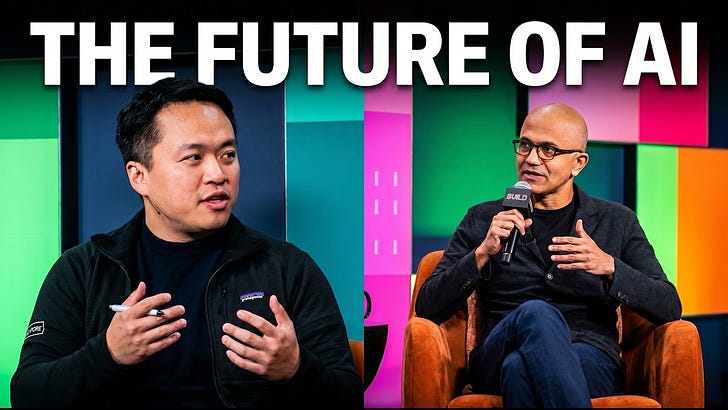
The core differentiator in AI application is shifting from the model itself to the quality of contextual data fed into it. An AI model is compared to a 'brain' that is useless without the 'eyes, ears, and legs' of integrated, proprietary data. This implies a company's data strategy is more critical to its competitive advantage than access to the latest frontier model.
Raw AI models are not useful on their own. A critical new software layer, dubbed a 'harness,' has emerged to make them effective. These harnesses (like OpenClaw or Codex) provide the structure for models to think in patterns and accomplish complex tasks, acting like an operating system for AI.

As AI models become commoditized, a slight performance edge isn't a sustainable advantage. The companies that win will be those that build the best systems for implementation, trust, and workflow integration around those models. This robust, trust-based ecosystem becomes the primary competitive moat, not the underlying technology.
