Get your free personalized podcast brief
We scan new podcasts and send you the top 5 insights daily.
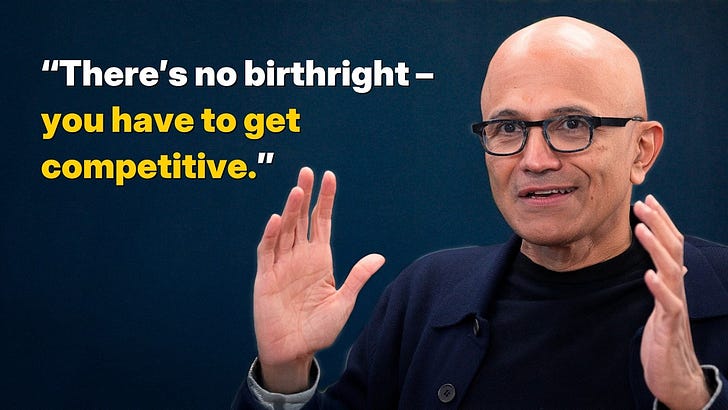
Nadella adopts a grounded perspective on AI's current state. He likens it to past technological revolutions, viewing it as a powerful tool that enhances human intellect and productivity, rather than subscribing to the more mystical 'final revolution' narrative about AGI.
Related Insights
While some competitors prioritize winning over ROI, Nadella cautions that "at some point that party ends." In major platform shifts like AI, a long-term orientation is crucial. He cites Microsoft's massive OpenAI investment, committed *before* ChatGPT's success, as proof of a long-term strategy paying off.

Business owners should view AI not as a tool for replacement, but for multiplication. Instead of trying to force AI to replace core human functions, they should use it to make existing processes more efficient and to complement human capabilities. This reframes AI from a threat into a powerful efficiency lever.

The hype around an imminent Artificial General Intelligence (AGI) event is fading among top AI practitioners. The consensus is shifting to a "Goldilocks scenario" where AI provides massive productivity gains as a synergistic tool, with true AGI still at least a decade away.

AI should be viewed not as a new technological wave, but as the final, mature stage of the 60-year computer revolution. This reframes investment strategy away from betting on a new paradigm and towards finding incumbents who can leverage the mature technology, much like containerization capped the mass production era.

Using the historical parallel of ATMs, CEO Sim Shabalala argues that AI won't eliminate human roles but will automate routine tasks. This frees humans for higher-order work involving empathy, complex problem-solving, and valuable client interaction.
Microsoft CEO Satya Nadella views AI's trajectory in two distinct paths. The first is "cognitive enhancement" tools that assist users, like Copilot. The second, more ambitious path is a "guardian angel," an AGI-like system that oversees and manages tasks. This framework signals a deeper belief in AGI's potential than is commonly associated with him.

Dr. Li rejects both utopian and purely fatalistic views of AI. Instead, she frames it as a humanist technology—a double-edged sword whose impact is entirely determined by human choices and responsibility. This perspective moves the conversation from technological determinism to one of societal agency and stewardship.
Cutting through abstract definitions, Quora CEO Adam D'Angelo offers a practical benchmark for AGI: an AI that can perform any job a typical human can do remotely. This anchors the concept to tangible economic impact, providing a more useful milestone than philosophical debates on consciousness.
Microsoft's AI chief, Mustafa Suleiman, announced a focus on "Humanist Super Intelligence," stating AI should always remain in human control. This directly contrasts with Elon Musk's recent assertion that AI will inevitably be in charge, creating a clear philosophical divide among leading AI labs.
The term "Artificial Intelligence" implies a replacement for human intellect. Author Alistair Frost suggests using "Augmented Intelligence" instead. This reframes AI as a tool that enhances, rather than replaces, human capabilities. This perspective reduces fear and encourages practical, collaborative use.
