Get your free personalized podcast brief
We scan new podcasts and send you the top 5 insights daily.
The System Analyst agent is the linchpin of the AI team. It's tasked with breaking down product requirements, asking clarifying questions, and creating both documentation and development tickets, ensuring clarity and structure before any code is written.
Related Insights
To get superior results from AI coding agents, treat them like human developers by providing a detailed plan. Creating a Product Requirements Document (PRD) upfront leads to a more focused and accurate MVP, saving significant time on debugging and revisions later on.

To build a useful multi-agent AI system, model the agents after your existing human team. Create specialized agents for distinct roles like 'approvals,' 'document drafting,' or 'administration' to replicate and automate a proven workflow, rather than designing a monolithic, abstract AI.

Interacting with powerful coding agents requires a new skill: specifying requirements with extreme clarity. The creative process will be driven less by writing code line-by-line and more by crafting unambiguous natural language prompts. This elevates clear specification as a core competency for software engineers.
Top-performing engineering teams are evolving from hands-on coding to a managerial role. Their primary job is to define tasks, kick off multiple AI agents in parallel, review plans, and approve the final output, rather than implementing the details themselves.

AI coding agents compress product development by turning specs directly into code. This transforms the PM's role from a translator between customers and engineers into a "shaper of intent." The key skill becomes defining a problem so clearly that an agent can execute it, making the spec itself the prototype.

The evolution of AI has shifted the required skill set from simply writing prompts to managing, educating, and delegating complex workflows to autonomous agents. This new role orchestrates teams of AI 'replicants' to achieve business outcomes with massive leverage.
The PM role will expand beyond leveraging off-the-shelf AI. They will be responsible for creating and training specialized AI agents. This involves instilling agents with deep, company-specific knowledge of business models, customers, and strategy, just as they would onboard a new human team member.

Instead of relying on a single, all-purpose coding agent, the most effective workflow involves using different agents for their specific strengths. For example, using the 'Friday' agent for UI tasks, 'Charlie' for code reviews, and 'Claude Code' for research and backend logic.
Instead of creating one monolithic "Ultron" agent, build a team of specialized agents (e.g., Chief of Staff, Content). This parallels existing business mental models, making the system easier for humans to understand, manage, and scale.

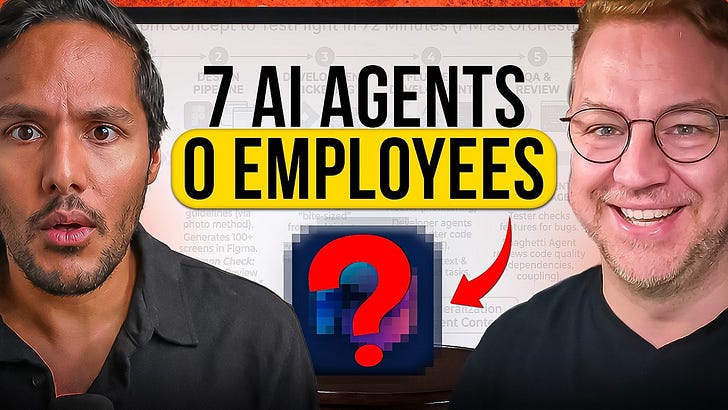
Gabor Meyer replicates a real-world software team by creating specialized AI agents for roles like CTO, System Analyst, and Designer. This structured approach, rather than using a single generalist AI, produces a higher quality, maintainable end product.