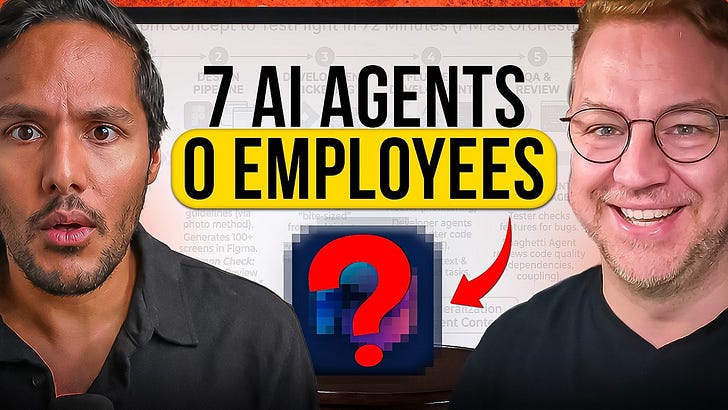
Gabor Meyer replicates a real-world software team by creating specialized AI agents for roles like CTO, System Analyst, and Designer. This structured approach, rather than using a single generalist AI, produces a higher quality, maintainable end product.
The System Analyst agent is the linchpin of the AI team. It's tasked with breaking down product requirements, asking clarifying questions, and creating both documentation and development tickets, ensuring clarity and structure before any code is written.
Before assigning a task, Gabor prompts the LLM to define the characteristics of a 'good' versus a 'bad' system analyst. He then instructs it to embody the 'good' persona, a meta-prompting technique that dramatically improves the quality of the AI's output and alignment.
To combat the problem of AI-generated 'spaghetti code,' Gabor first sets up empty documentation and ticketing systems. Forcing the AI agents to document decisions and work through tickets creates a replicable and maintainable app, avoiding the typical one-prompt mess.
Gabor dictates long, detailed prompts to his AI agents. This allows him to provide significantly more context, nuance, and specific constraints than would be practical to type. The AI can parse the verbose input, leading to a much better-specified final product.
To ensure high code quality, Gabor created a specialized 'code maintainability agent.' This AI's sole job is to check for circular references, enforce naming conventions, and ensure high-quality comments—technical details a product manager might overlook but are critical for long-term project health.
When an AI agent was given one large prompt to create a design, it ignored parts of the style guide. Gabor theorizes this is due to 'context compression' where details are lost in a large prompt. The solution is to break tasks into smaller, ticketed items, mirroring human workflows to ensure fidelity.
The gap between PMs who only use AI for productivity and those who build with it will soon be massive. Gabor advocates for building and shipping a real AI app, not for business, but to gain hands-on experience and create a tangible portfolio item that proves you can build in the AI era.
A key criterion for selecting tools is now their ability to be controlled by AI agents. Gabor chose Atlassian (Jira/Confluence) specifically because its Model-Component-Package (MCP) allows Claude Code agents to connect and operate the software directly, a critical factor for automating the development lifecycle.
Instead of manually connecting screens in Figma to create a clickable prototype, Gabor tasks a specialized 'UX Flow Architect' agent. The agent analyzes the app's documentation and automatically adds all the necessary prototype arrows between screens, saving hours of manual design work.
Struggling to pass final-round FANG interviews, Gabor Meyer hired a coach. Unable to afford the full fee, he negotiated a performance-based deal: half the price if he failed, but double if he succeeded. This high-stakes investment forced extreme focus and ultimately paid off.
Gabor compares AI PM certificates to old Scrum certificates, arguing the credential itself is meaningless. True value comes from the knowledge gained through hands-on building. The best courses are those that result in a shareable project, as a PDF certificate won't help you when you actually have to build something.