Get your free personalized podcast brief
We scan new podcasts and send you the top 5 insights daily.
Startups face a "governance tax" where monitoring platforms charge significantly more than the underlying AI API usage. An example cited is a team nearly paying $36,000 annually for a tool to manage a $14,400 AI spend, representing a 250% markup just for monitoring.

Related Insights
High-tier AI governance platforms justify their cost with features like unlimited seats, SLA guarantees, and concierge onboarding. For a startup, these are often marketing tactics or operational drags, not essential value, which is found in core proxy-level visibility and control.
For years, flat-rate AI subscriptions heavily subsidized power users, masking the true cost of token consumption. As providers shift to usage-based billing, this subsidy is ending. Enterprises now face "sticker shock" and must justify AI spend with clear ROI, moving from rampant experimentation to cost-conscious implementation.
![The AI Token Shortage Begins [AI Monthly Recap] thumbnail](https://d3t3ozftmdmh3i.cloudfront.net/staging/podcast_uploaded_nologo/41472609/41472609-1752234663609-8665756a468e5.jpg)
While security and data privacy are huge risks with AI agents, the most immediate and tangible pain point for businesses is cost. An unexpectedly large bill from a runaway agent is often the catalyst for seeking a governance solution, which then leads to addressing deeper security issues.

Flat-rate AI plans are becoming economically unviable due to token-hungry agents. Companies like Google and Microsoft are pushing usage-based billing, forcing enterprises to confront the surprisingly high real cost of running models at scale, which was previously hidden by subsidized pricing experiments.
Contrary to the belief that enterprises have unlimited budgets, they are focused on the ROI of their AI spend. As agentic workflows cause token bills to skyrocket, orchestration tools that intelligently route queries to the most cost-effective model for a given task are becoming essential infrastructure.

Many AI coding agents are unprofitable because their business model is broken. They charge a fixed subscription fee but pay variable, per-token costs for model inference. This means their most engaged power users, who should be their best customers, are actually their biggest cost centers, leading to negative gross margins.

The $15-$25 per-review price for Anthropic's tool moves AI expenses from a predictable monthly software subscription to a variable cost that scales like human labor. This forces CTOs to justify AI budgets with direct headcount savings, creating immense pressure on ROI.
The move away from seat-based licenses to consumption models for AI tools creates a new operational burden. Companies must now build governance models and teams to track usage at an individual employee level—like 'Bob in accounting'—to control unpredictable costs.

Just as uncontrolled cloud spending in the 2010s spawned the FinOps field, the shift to consumption-based AI pricing will necessitate a similar discipline. This involves attributing costs to specific workloads, setting granular budgets, and providing real-time visibility to prevent budget overruns and measure ROI accurately.
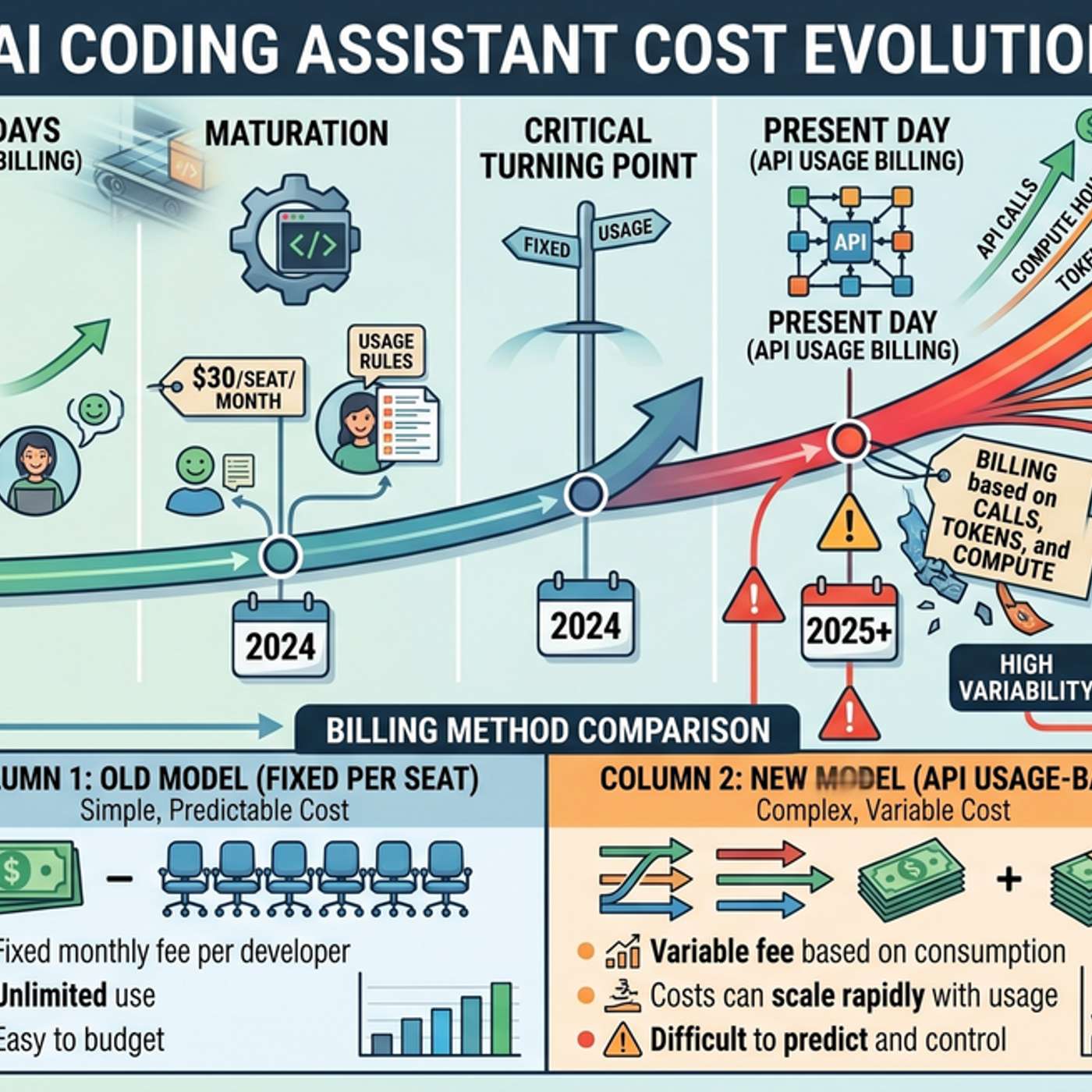
The shift to usage-based pricing for AI tools isn't just a revenue growth strategy. Enterprise vendors are adopting it to offset their own escalating cloud infrastructure costs, which scale directly with customer usage, thereby protecting their profit margins from their own suppliers.