Get your free personalized podcast brief
We scan new podcasts and send you the top 5 insights daily.
While an operating company must commit to a single, coherent strategy, a venture portfolio can invest in opposing models simultaneously (e.g., big vs. small models, open vs. closed source). This allows VCs to win regardless of which future unfolds.

Related Insights
Venture capitalists thrive by adopting one of two distinct personas: the "in the flow" consensus-driver focused on speed and connections, or the "out of the flow" contrarian focused on deep, isolated work. Attempting to straddle both paths leads to failure.

The 'classic' VC model hunts for unproven talent in niche areas. The now-dominant 'super compounder' model argues the biggest market inefficiency is underestimating the best companies. This justifies investing in obvious winners at any price, believing that outlier returns will cover the high entry cost.
The most successful venture investors share two key traits: they originate investments from a first-principles or contrarian standpoint, and they possess the conviction to concentrate significant capital into their winning portfolio companies as they emerge.

Undiversified founders can't afford a VC's portfolio mindset. Instead of pursuing ideas that *could* work, they must adopt strategies that would be *weird if they didn't work*. This shifts focus from optimizing for a chance of success to minimizing the chance of absolute failure.

Venture investors aren't concerned when a portfolio company launches products that compete with their other investments. This is viewed as a positive signal of a massive winner—a company so dominant it expands into adjacent categories, which is the ultimate goal.

The dominant VC narrative demands founders focus on a single venture. However, successful entrepreneurs demonstrate that running multiple projects—a portfolio approach mirrored by VCs themselves—is a viable path, contrary to the "focus on one thing" dogma.

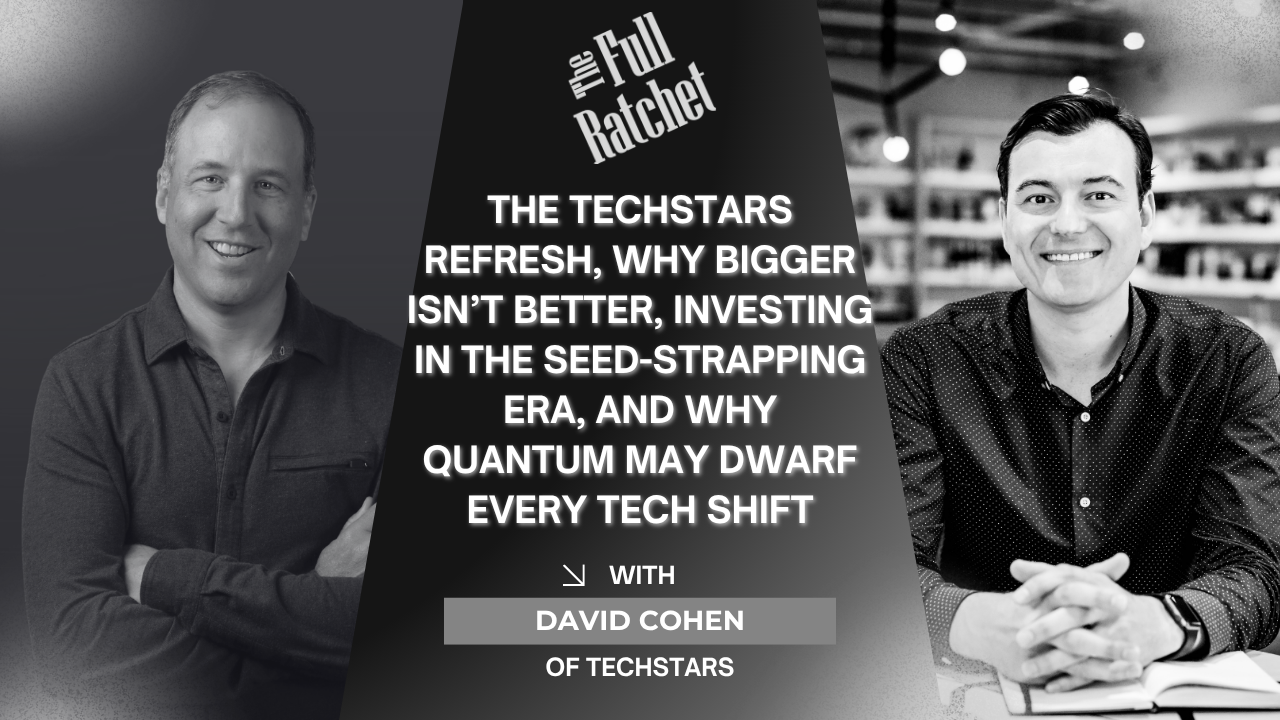
David Cohen predicts that in a decade, the view of venture as a risky, "go big or go home" art form will be obsolete. As the asset class matures, it will inevitably adopt principles from public markets, like diversification and index-fund-like strategies. Venture will become more of a science, making it more stable and systematic.
Large, contrarian investments feel like career risk to partners in a traditional VC firm, leading to bureaucracy and diluted conviction. Founder-led firms with small, centralized decision-making teams can operate with more decisiveness, enabling them to make the bold, potentially firm-defining bets that consensus-driven partnerships would avoid.

Unlike operating companies that seek consistency, VC firms hunt for outliers. This requires a 'stewardship' model that empowers outlier talent with autonomy. A traditional, top-down CEO model that enforces uniformity would stifle the very contrarian thinking necessary for venture success. The job is to enable, not manage.

Conventional venture capital wisdom of 'winner-take-all' may not apply to AI applications. The market is expanding so rapidly that it can sustain multiple, fast-growing, highly valuable companies, each capturing a significant niche. For VCs, this means huge returns don't necessarily require backing a monopoly.