Get your free personalized podcast brief
We scan new podcasts and send you the top 5 insights daily.
Generating real-time reports with AI can incur exorbitant expenses for insights that teams only inspect periodically. Treasure AI discovered a single real-time reporting workflow cost $450,000 despite only providing weekly or monthly utility. Aligning generation cadence with actual consumption prevents significant operational waste.

Related Insights
Implementing dozens of AI agents for business automation can lead to unexpected and massive operational costs. Freelancer.com's CEO was surprised by a $1,300 bill for 4 billion tokens in a single day, highlighting the financial scale required for serious AI implementation beyond simple monthly subscriptions.

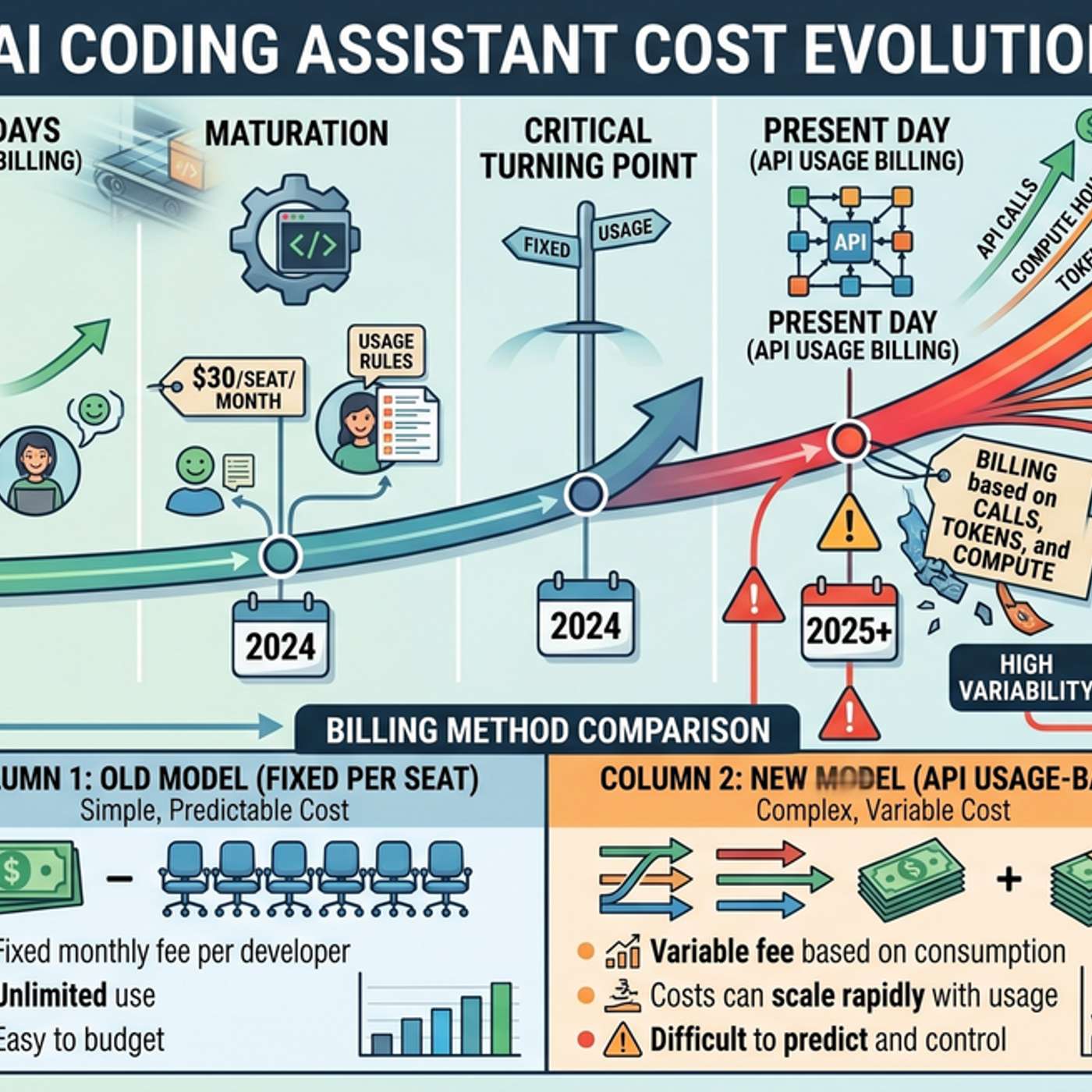
FP&A teams must develop a new muscle for managing AI costs, which behave like consumption-based cloud spend, not predictable recurring software fees. Uncapped token usage can lead to massive budget blowouts, requiring more dynamic tracking and forecasting than traditional expenses.

Traditional software budgeting fails for generative AI, where costs are variable and tied to tokens and usage. A CFO noted a team's daily per-person cost jumped 50% in one week. Companies must accept this volatility, run pilots to establish baseline costs, and then determine ROI, rather than trying to set a fixed budget upfront.

While 84% of businesses claim AI saves them money, many fall into a trap similar to impulse shopping at Target. The accumulation of small, seemingly insignificant AI-related charges (e.g., more compute, new features) leads to surprisingly large monthly bills, making the true ROI hard to calculate.

The compute power required for AI agents to operate ('inference') is a significant new cost. Without an optimized infrastructure to manage these costs, companies risk spending all their AI-driven productivity gains on 'feeding' their digital workers, making the initiative unprofitable.

An anecdote about an engineer spending $100M in a month on AI tokens reveals a core enterprise issue. For Lenovo's CFO, the problem isn't the amount but its lack of planning and clear ROI. This signals a shift from predictable software subscriptions to volatile, usage-based AI compute costs.

A simple diagnostic to find wasteful AI spend is the 'weekend test.' If your AI bill increases over a period of inactivity (like a weekend), it's a clear indicator that you have idle agents or over-frequent automated jobs running in the background, which should be investigated and eliminated.

While early generative AI costs were negligible, the shift to complex, multi-step agentic workflows is causing a massive spike in token usage. This has elevated cost optimization and ROI from a minor concern to a C-suite priority for the first time.

Unlike traditional SaaS where unit costs stay relatively flat, AI features incur per-interaction token expenses. Product and engineering teams must track costs down to workflows and users in the codebase to prevent uncontrolled margin erosion.

Just as uncontrolled cloud spending in the 2010s spawned the FinOps field, the shift to consumption-based AI pricing will necessitate a similar discipline. This involves attributing costs to specific workloads, setting granular budgets, and providing real-time visibility to prevent budget overruns and measure ROI accurately.