Get your free personalized podcast brief
We scan new podcasts and send you the top 5 insights daily.
Traditional software budgeting fails for generative AI, where costs are variable and tied to tokens and usage. A CFO noted a team's daily per-person cost jumped 50% in one week. Companies must accept this volatility, run pilots to establish baseline costs, and then determine ROI, rather than trying to set a fixed budget upfront.

Related Insights
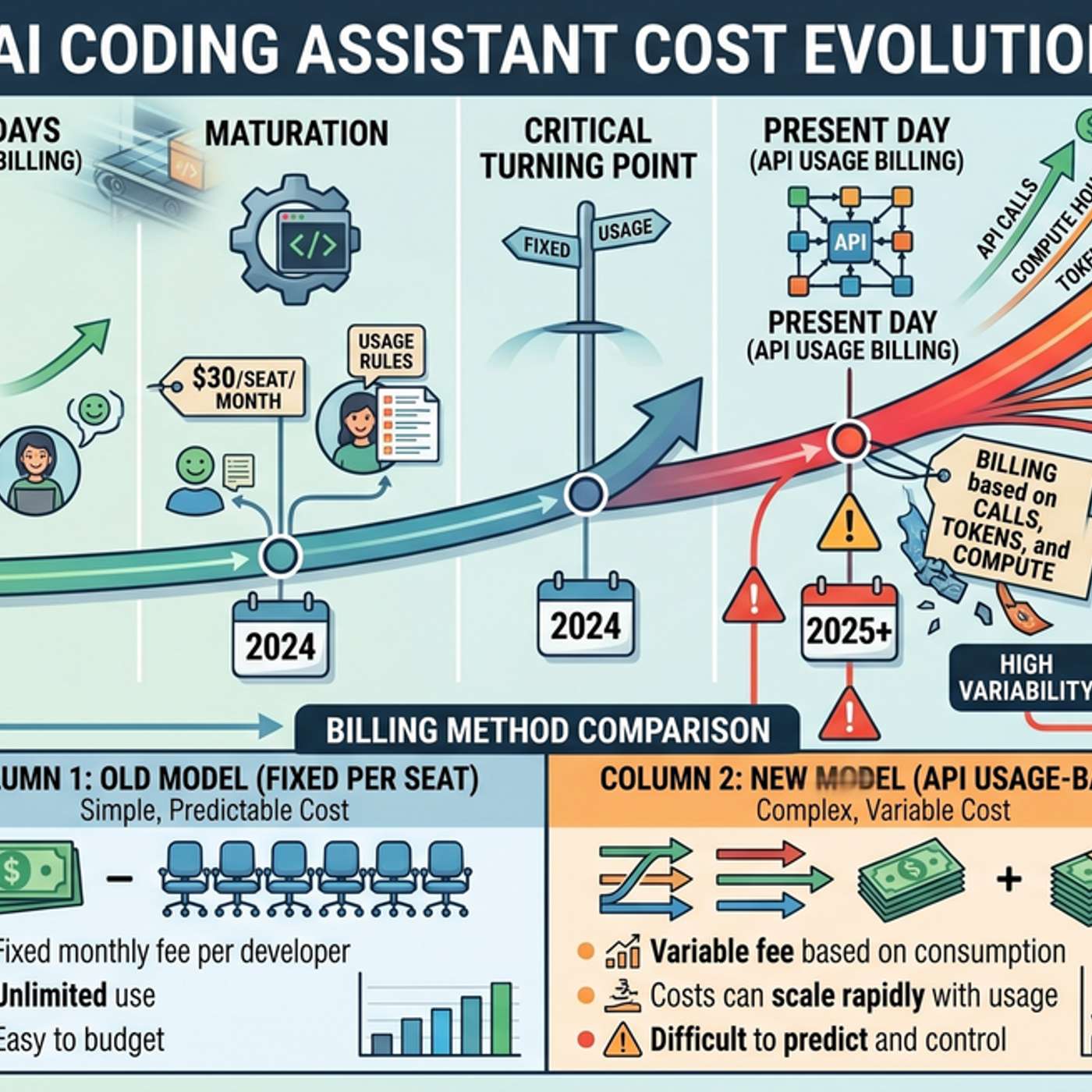
Flat-rate AI plans are becoming economically unviable due to token-hungry agents. Companies like Google and Microsoft are pushing usage-based billing, forcing enterprises to confront the surprisingly high real cost of running models at scale, which was previously hidden by subsidized pricing experiments.

Pure value-based pricing (e.g., per seat) fails for AI products due to unpredictable token costs from power users. Vercel's SVP of Product advises a hybrid model: one metric aligned with value (like seats) and another aligned with cost (like token usage) to ensure profitability.

As more companies integrate AI, their costs are tied to variable usage (e.g., tokens, inference). This is causing a profound, economy-wide transformation away from predictable seat-based subscriptions towards more dynamic usage-based models to align costs with revenue.

The shift to AI-driven development introduces a wildly unpredictable cost: token consumption. This expense could range from a minor line item to exceeding the entire engineering payroll, creating an unprecedented budgeting challenge for CFOs and threatening companies' profitability if not managed correctly.

The $15-$25 per-review price for Anthropic's tool moves AI expenses from a predictable monthly software subscription to a variable cost that scales like human labor. This forces CTOs to justify AI budgets with direct headcount savings, creating immense pressure on ROI.
The move away from seat-based licenses to consumption models for AI tools creates a new operational burden. Companies must now build governance models and teams to track usage at an individual employee level—like 'Bob in accounting'—to control unpredictable costs.

Just as uncontrolled cloud spending in the 2010s spawned the FinOps field, the shift to consumption-based AI pricing will necessitate a similar discipline. This involves attributing costs to specific workloads, setting granular budgets, and providing real-time visibility to prevent budget overruns and measure ROI accurately.
AI's usage-based pricing doesn't fit traditional seat-based software budgets. Frame it like a marketing program (e.g., paid ads). If increased spending on AI tools generates high ROI, it justifies a larger, flexible budget, shifting the conversation with finance from fixed cost to performance investment.

Giving teams a 'token budget' is flawed because it incentivizes generating low-value output to hit a quota, similar to bad hiring quotas. Instead, companies must tie token consumption directly to business KPIs. This reframes AI spend as a value-creating investment, not a cost to be managed.

Enterprises struggle to adopt AI agents due to unpredictable, consumption-based pricing. The inability to budget for fluctuating token or credit usage makes scalable deployment nearly impossible for finance departments to approve, creating a significant hurdle to widespread adoption.