Get your free personalized podcast brief
We scan new podcasts and send you the top 5 insights daily.
While 84% of businesses claim AI saves them money, many fall into a trap similar to impulse shopping at Target. The accumulation of small, seemingly insignificant AI-related charges (e.g., more compute, new features) leads to surprisingly large monthly bills, making the true ROI hard to calculate.

Related Insights
While the cost per AI query drops, companies find more complex, compute-intensive uses for it. This elasticity of demand means total AI spending becomes a significant and variable operational expense, similar to a utility bill, rather than a predictable software cost.

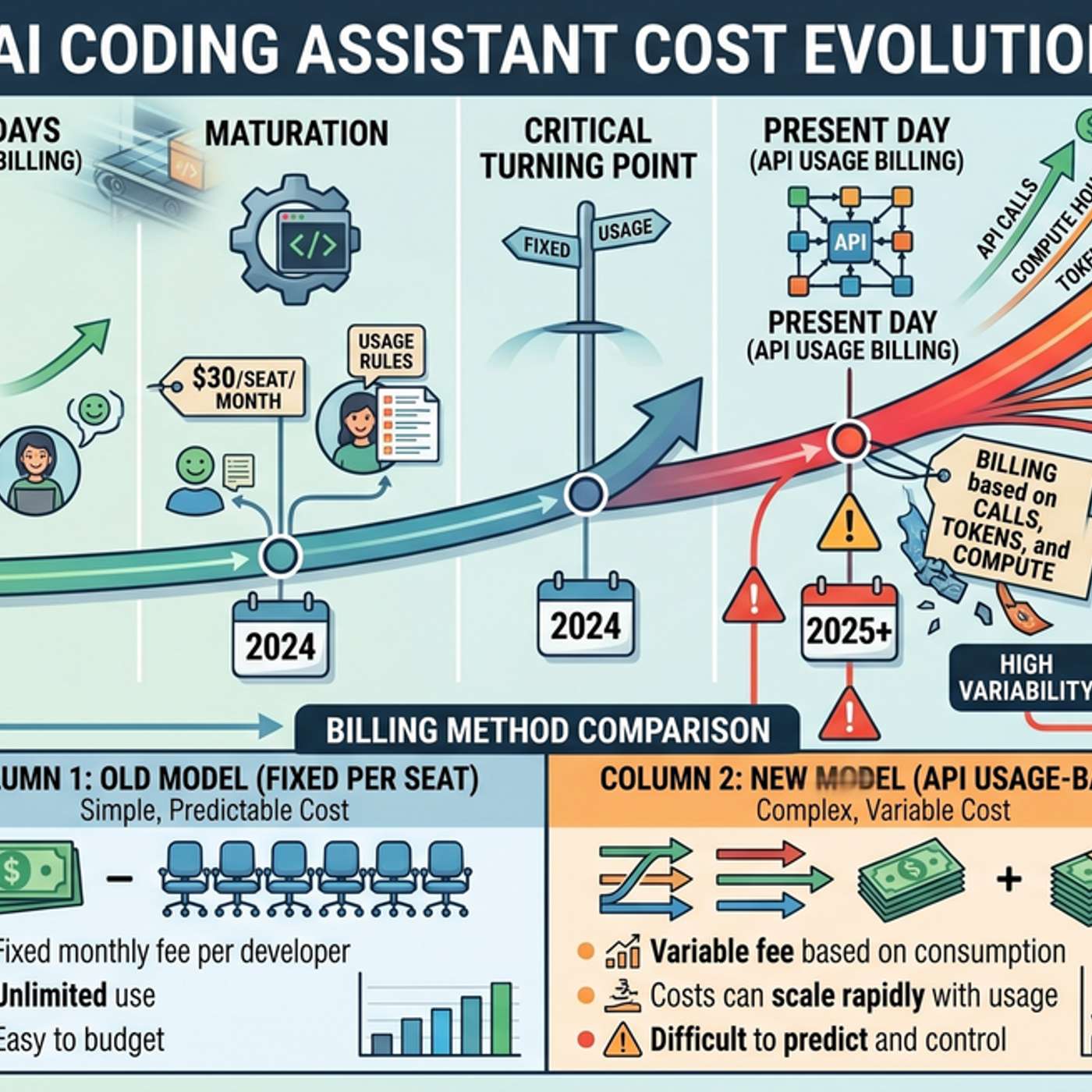
For years, flat-rate AI subscriptions heavily subsidized power users, masking the true cost of token consumption. As providers shift to usage-based billing, this subsidy is ending. Enterprises now face "sticker shock" and must justify AI spend with clear ROI, moving from rampant experimentation to cost-conscious implementation.
![The AI Token Shortage Begins [AI Monthly Recap] thumbnail](https://d3t3ozftmdmh3i.cloudfront.net/staging/podcast_uploaded_nologo/41472609/41472609-1752234663609-8665756a468e5.jpg)
The excitement around AI often overshadows its practical business implications. Implementing LLMs involves significant compute costs that scale with usage. Product leaders must analyze the ROI of different models to ensure financial viability before committing to a solution.

The compute power required for AI agents to operate ('inference') is a significant new cost. Without an optimized infrastructure to manage these costs, companies risk spending all their AI-driven productivity gains on 'feeding' their digital workers, making the initiative unprofitable.

The end of subsidized AI pricing is forcing companies to confront its true operational expense. As AI bills begin to rival payroll, a fundamental transition is occurring where capital expenditure on silicon (CapEx) is displacing operational expenditure on human neurons (OpEx), reshaping corporate budgets.
An anecdote about an engineer spending $100M in a month on AI tokens reveals a core enterprise issue. For Lenovo's CFO, the problem isn't the amount but its lack of planning and clear ROI. This signals a shift from predictable software subscriptions to volatile, usage-based AI compute costs.

A Bain survey reveals a critical financial risk in enterprise AI adoption. Nearly half of companies are funding their next wave of AI investment based on assumed cost savings from previous projects. With actual savings falling far short of projections, this creates a 'circular bet with a structural leak' that threatens future AI budgets.
Insatiable demand for AI tools is causing corporate AI spending to explode much faster than anticipated. Some companies have exhausted their entire annual AI budget in just three months, forcing leaders to scramble to ration usage, manage costs, and justify the return on investment.

Companies initially gamified AI use, leading to a "token maxing" culture. Now, facing enormous, unexpected bills, they are experiencing "sticker shock." This is forcing a strategic shift from encouraging maximum usage to demanding ROI calculations and finding the most cost-effective AI model for a given task.

Just as uncontrolled cloud spending in the 2010s spawned the FinOps field, the shift to consumption-based AI pricing will necessitate a similar discipline. This involves attributing costs to specific workloads, setting granular budgets, and providing real-time visibility to prevent budget overruns and measure ROI accurately.