Get your free personalized podcast brief
We scan new podcasts and send you the top 5 insights daily.
Adi chose a monorepo over the then-popular microservices architecture. This consolidated codebase made it significantly easier for AI agents to read and operate on, giving them a structural advantage years later when LLMs became viable.

Related Insights
Legacy platforms adding AI features are bottlenecked by their old architecture. Truly AI-native companies build agentic reasoning into the foundational control layer, enabling superior performance and interconnectivity between AI components, which creates a durable moat.

Instead of competing with labs on model training, the defensible strategy is to build the ideal environment or 'habitat' for an LLM in a specific vertical. Replit did this for programming by adapting its editor, cloud infrastructure, and deployment tools to serve the AI, not just the human.

The future value in code management isn't just storing files; it's owning the layer that understands how code connects across services. This operational domain is where AI agents function, signaling an inevitable category shift that companies like OpenAI are already exploring internally.

Anthropic overtook OpenAI by making deliberate strategic choices. They ignored the hype around multimodal, video, and hardware to focus all resources on coding and enterprise workflows. This tight focus allowed their smaller team to outmaneuver a larger, less focused competitor in a key market.

Andreessen presents the modern AI agent's architecture—a language model combined with a Unix shell and file system—as a major software breakthrough. This modular, extensible design mirrors the powerful Unix mindset, enabling agents that are independent of specific models and can modify themselves.
Legacy companies are siloed, creating IT "spaghetti" that blocks AI progress. In contrast, AI-native organizations structure themselves around a central "AI factory" or unified data platform. Business units function like apps on an iPhone, accessing shared, controlled data to rapidly innovate and deploy new services.
Powerful AI products are built with LLMs as a core architectural primitive, not as a retrofitted feature. This "native AI" approach creates a deep technical moat that is difficult for incumbents with legacy architectures to replicate, similar to the on-prem to cloud-native shift.

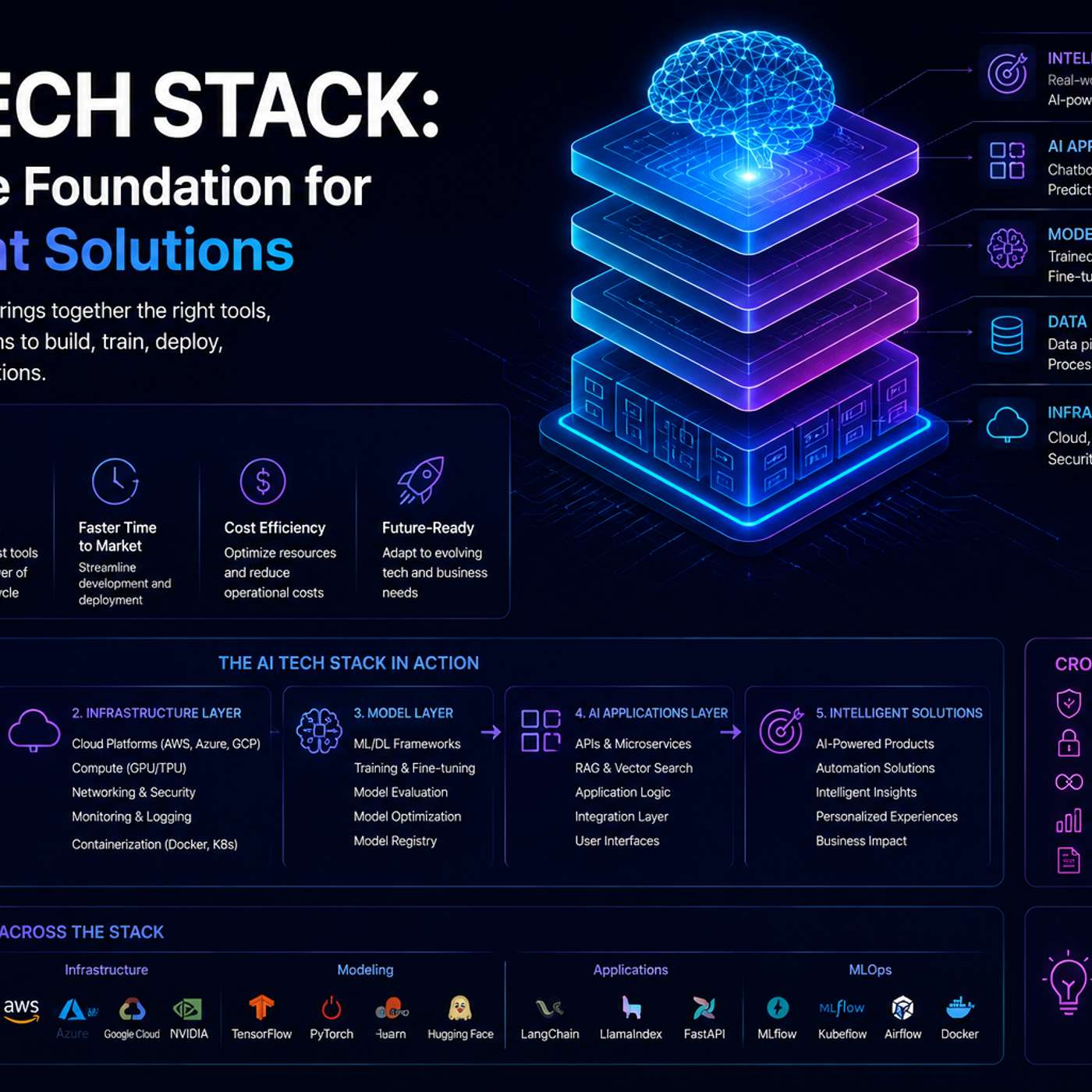
The modern AI stack has shifted from manually managed, monolithic systems to modular, cloud-native architectures. This change prioritizes scalability, reproducibility, and collaboration, reflecting AI's move from a research discipline to a core engineering function that supports scalable production systems.
Consolidating multiple applications (e.g., web, mobile, backend) into a single mono-repo gives AI agents access to a much richer, shared context. This allows them to learn from past architectural decisions and apply knowledge across different systems, significantly improving performance.

Historically, developer tools adapted to a company's codebase. The productivity gains from AI agents are so significant that the dynamic has flipped: for the first time, companies are proactively changing their code, logging, and tooling to be more 'agent-friendly,' rather than the other way around.
