Get your free personalized podcast brief
We scan new podcasts and send you the top 5 insights daily.
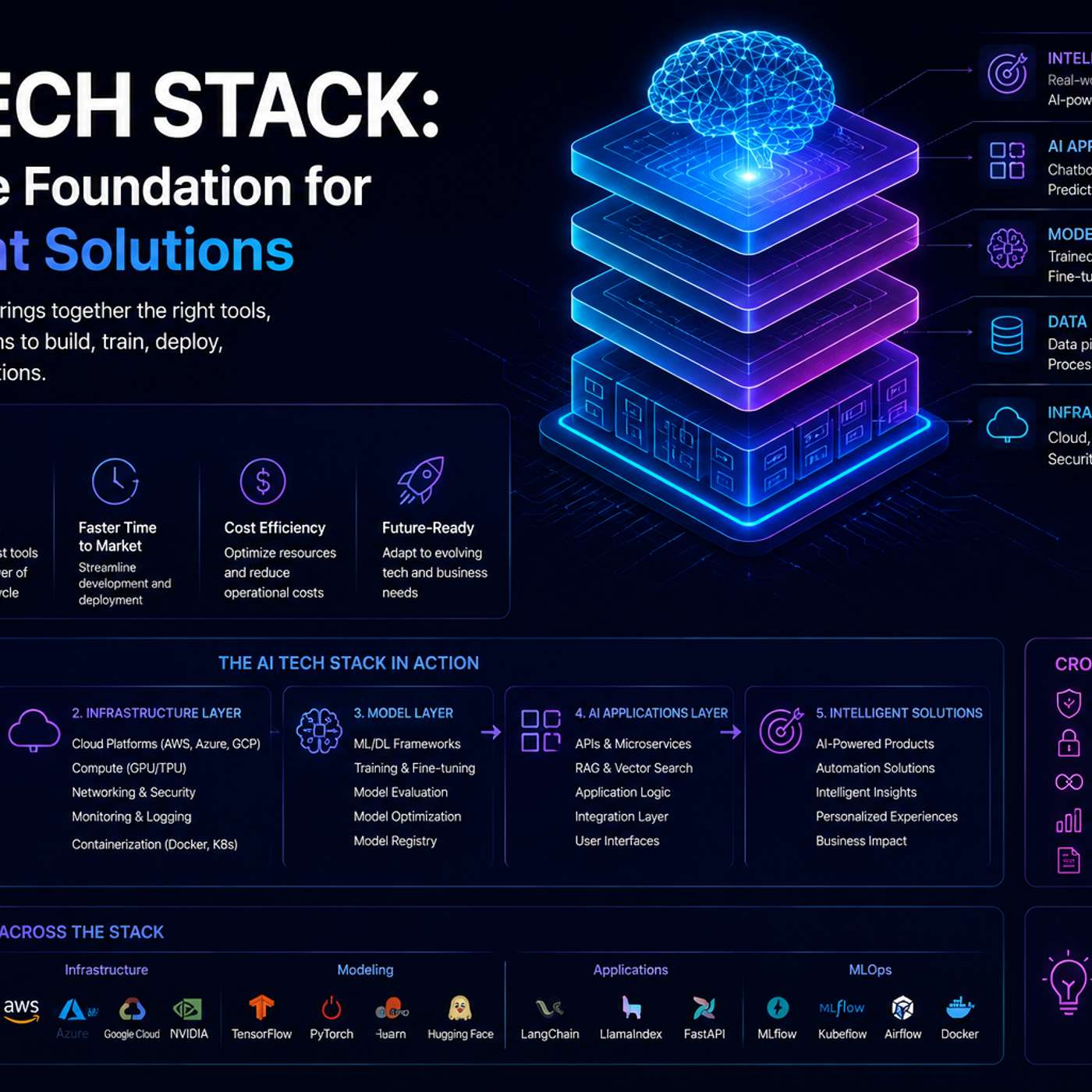
The modern AI stack has shifted from manually managed, monolithic systems to modular, cloud-native architectures. This change prioritizes scalability, reproducibility, and collaboration, reflecting AI's move from a research discipline to a core engineering function that supports scalable production systems.
Related Insights
For vertical AI applications, foundation models are now sufficiently intelligent. The primary challenge is no longer model capability but building the surrounding software infrastructure—tools, UIs, and workflows—that lets models perform useful work reliably and trustworthily.

Instead of chasing the latest hyped AI model, focus on building modular, system-based workflows. This allows you to easily plug in new, better models as they are released, instantly upgrading your capabilities without having to start over.

A major trend in AI development is the shift away from optimizing for individual model releases. Instead, developers can integrate higher-level, pre-packaged agents like Codex. This allows teams to build on a stable agentic layer without needing to constantly adapt to underlying model changes, API updates, and sandboxing requirements.

The next significant evolution in AI infrastructure is the shift to multimodal systems. Future tech stacks must move beyond single-modality paradigms (like text-only) to seamlessly handle and integrate text, images, audio, and video within a single, unified architecture.
The current focus on building massive, centralized AI training clusters represents the 'mainframe' era of AI. The next three years will see a shift toward a distributed model, similar to computing's move from mainframes to PCs. This involves pushing smaller, efficient inference models out to a wide array of devices.

Simply adding an AI layer on top of a traditional SaaS stack will fail. A true AI-native architecture requires an "AI data layer" sitting next to the "AI application layer," both controlled by ML engineers who need to constantly tune data ingestion and processing without dependencies on the core tech team.
The current AI landscape, with its many single-purpose tools for inference, vector storage, and training, mirrors the early days of cloud computing. Just as S3 and EC2 were primitives that AWS bundled into a comprehensive cloud, these disparate AI tools will eventually be integrated into a new, cohesive "AI Cloud" platform.

Enterprises will shift from relying on a single large language model to using orchestration platforms. These platforms will allow them to 'hot swap' various models—including smaller, specialized ones—for different tasks within a single system, optimizing for performance, cost, and use case without being locked into one provider.

Large enterprises are avoiding commitment to a single AI provider like OpenAI or Anthropic. Instead, they're building control planes and abstraction layers that allow them to hot-swap the underlying models, mitigating technology risk and preventing dependence on one provider's terms of service.

Building one centralized AI model is a legacy approach that creates a massive single point of failure. The future requires a multi-layered, agentic system where specialized models are continuously orchestrated, providing checks and balances for a more resilient, antifragile ecosystem.