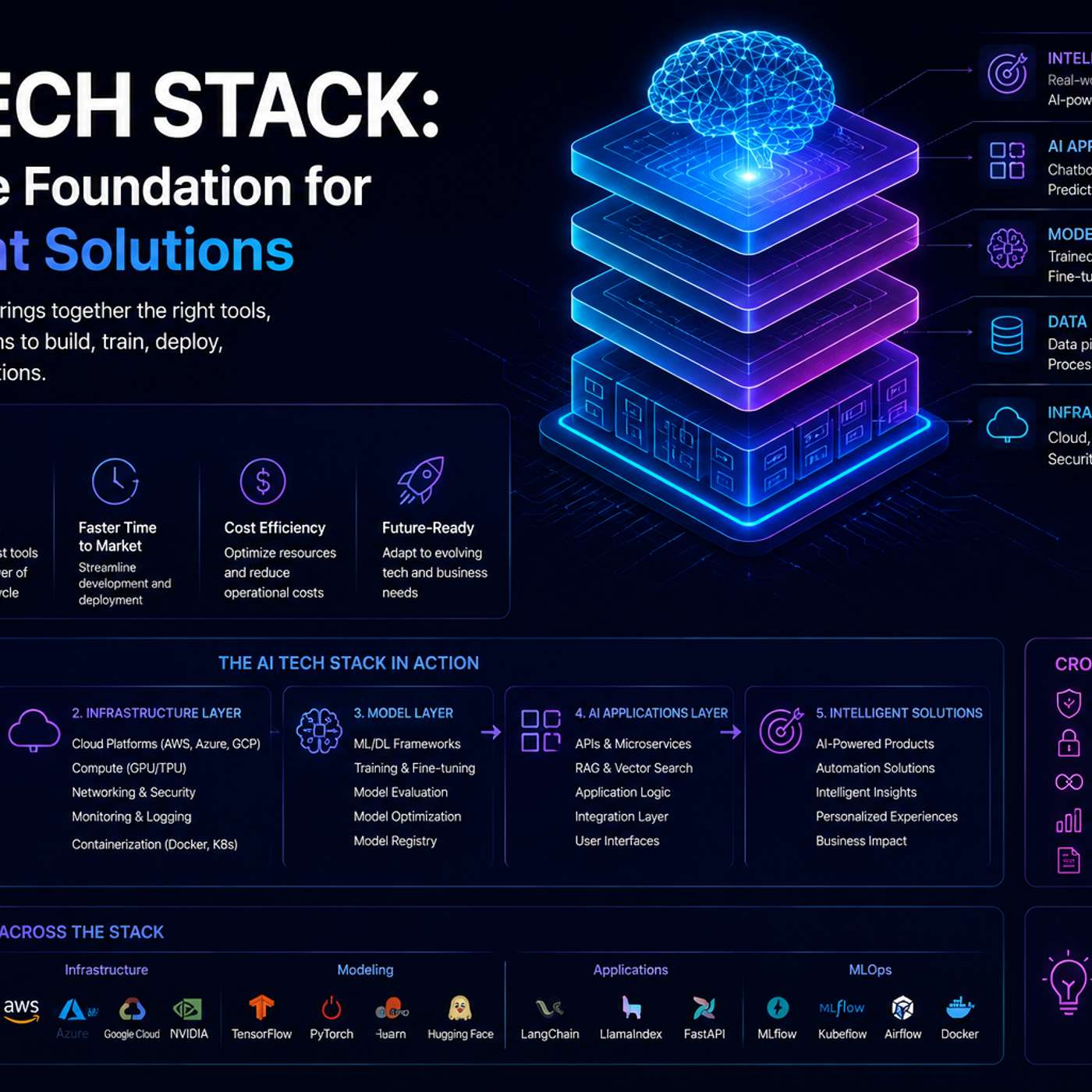
The modern AI stack has shifted from manually managed, monolithic systems to modular, cloud-native architectures. This change prioritizes scalability, reproducibility, and collaboration, reflecting AI's move from a research discipline to a core engineering function that supports scalable production systems.
Integrating generative AI is not a simple model upgrade. It demands new architectural components like vector databases (e.g., Pinecone, Weaviate) for semantic search and prompt orchestration frameworks (e.g., LangChain) to manage complex model interactions and proprietary data.
When choosing an AI tech stack, prioritize your team's existing skills over the allure of cutting-edge tools. Adopting complex new technologies without relevant expertise can create significant productivity bottlenecks, negating any potential feature advantages and stalling innovation.
The next significant evolution in AI infrastructure is the shift to multimodal systems. Future tech stacks must move beyond single-modality paradigms (like text-only) to seamlessly handle and integrate text, images, audio, and video within a single, unified architecture.
Generative AI is moving beyond pure experimentation. Practices like fine-tuning, prompt engineering, and retrieval-augmented generation (RAG) are now becoming standardized disciplines with established best practices, signaling a maturation of the field toward reliable and repeatable engineering.