Get your free personalized podcast brief
We scan new podcasts and send you the top 5 insights daily.
Don't default to the most powerful AI. A better architectural principle is to give each task the minimum model capability required to solve it reliably. This means knowing when a simple program is better than an SLM, or an SLM is better than a large model.

Related Insights
Instead of relying on a single, large language model to solve every problem, organizations can achieve higher ROI with faster, more accurate results. The key is deploying smaller, specialized AI tools focused on targeted use cases and curated data sets, which avoids introducing unnecessary complexity and error.

Don't use your most powerful and expensive AI model for every task. A crucial skill is model triage: using cheaper models for simple, routine tasks like monitoring and scheduling, while saving premium models for complex reasoning, judgment, and creative work.

An LLM shouldn't do math internally any more than a human would. The most intelligent AI systems will be those that know when to call specialized, reliable tools—like a Python interpreter or a search API—instead of attempting to internalize every capability from first principles.

The guest proposes focusing on 'bicycles of AI'—efficient, specialized models like DeepMind's AlphaFold that solve targeted problems with small datasets. This contrasts with 'rockets' like LLMs, which are massively resource-intensive and create widespread negative externalities.

The path to robust AI applications isn't a single, all-powerful model. It's a system of specialized "sub-agents," each handling a narrow task like context retrieval or debugging. This architecture allows for using smaller, faster, fine-tuned models for each task, improving overall system performance and efficiency.

Not every business problem requires an LLM. Using a simple classifier (Layer 2) for email sorting or a deep learning model (Layer 4) for recommendations is more efficient than defaulting to the latest generative AI (Layer 5/6). This layered thinking saves costs, reduces complexity, and builds better products.
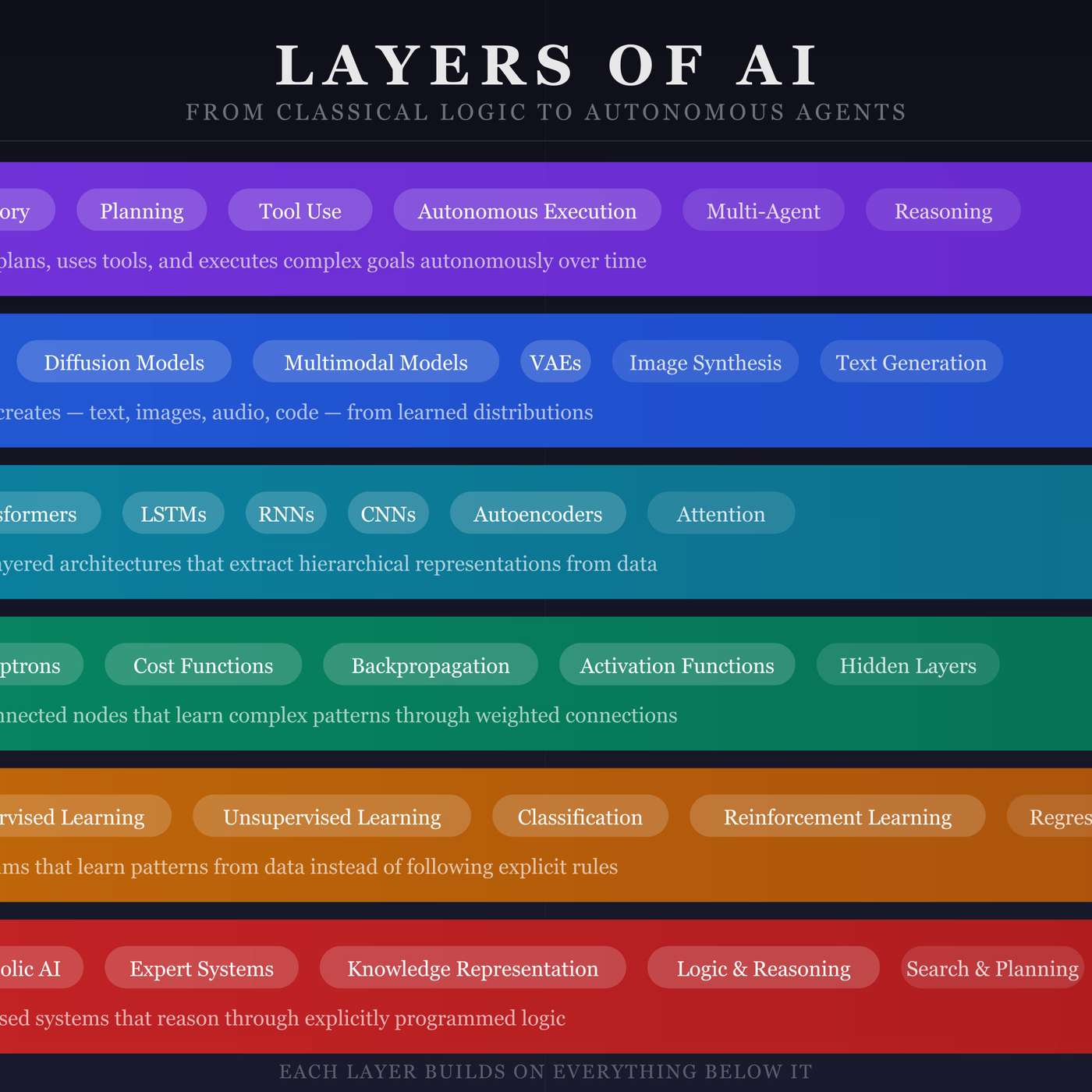
Resist the urge to apply LLMs to every problem. A better approach is using a 'first principles' decision tree. Evaluate if the task can be solved more simply with data visualization or traditional machine learning before defaulting to a complex, probabilistic, and often overkill GenAI solution.

The critical new AI skill isn't just using the most powerful model, but discerning when a free, private local model is sufficient versus when an expensive cloud model is necessary. This model-to-task matching instinct separates amateurs from pros by optimizing for cost, speed, and privacy.

State-of-the-art models like Claude Opus are often overkill and unnecessarily expensive for simple, routine tasks like summarizing emails. Using cheaper, less powerful models for these straightforward automations provides significant cost savings without sacrificing performance where it's not needed.
To manage costs, the optimal architecture isn't running everything on the most powerful model. Instead, a smart orchestrator agent should break down complex problems and dispatch simpler sub-tasks to smaller, cheaper models, optimizing for both cost and performance.
