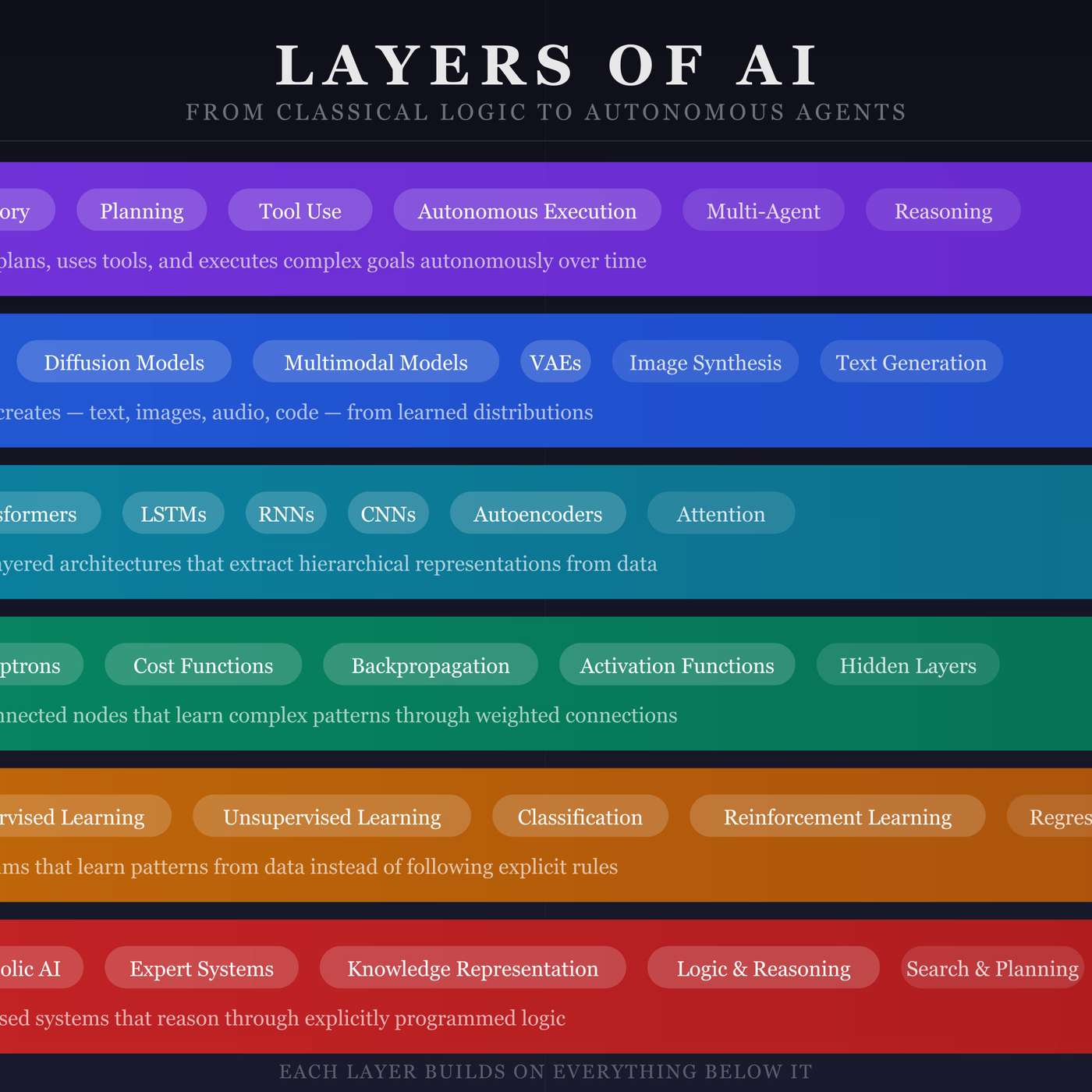
While the theories behind neural networks existed for decades, their practical application was infeasible. The true catalyst wasn't a new algorithm, but the parallel processing power of GPUs and the availability of massive datasets, which finally made training complex models a reality.
The current pinnacle of the AI stack, 'Agentic AI,' moves beyond simply generating answers to performing autonomous actions. By combining generative models with planning, memory, and tool use (like APIs or code interpreters), these systems can execute complex, multi-step tasks, defining the next wave of product development.
Not every business problem requires an LLM. Using a simple classifier (Layer 2) for email sorting or a deep learning model (Layer 4) for recommendations is more efficient than defaulting to the latest generative AI (Layer 5/6). This layered thinking saves costs, reduces complexity, and builds better products.
Contrary to the idea that new technologies make old ones obsolete, AI's evolution is a cumulative stack. Each new layer, like deep learning or generative AI, is built upon and extends the capabilities of the one beneath it, all the way down to the principles of classical AI.