Get your free personalized podcast brief
We scan new podcasts and send you the top 5 insights daily.
The primary interface for knowledge work is shifting away from traditional applications like IDEs. Professionals are increasingly initiating and managing complex tasks within conversational, agent-driven environments (e.g., in Slack with Claude tag), signaling a fundamental change in human-computer interaction.

Related Insights
Work will bifurcate into two modes: delegating tasks to asynchronous agents (e.g., in Slack) and performing core work inside AI-native environments like Codex. These platforms will become the primary operating system where you run other apps, rather than AI being just a feature within apps.

The emergence of personal AI assistants that can be integrated with private data (email, Slack) and execute tasks (send emails, build CRMs) represents a new paradigm. This moves AI from a passive research tool to an active, autonomous agent capable of performing complex knowledge work, fundamentally changing productivity.
The future of knowledge work will bifurcate into two surfaces. The first is asynchronous delegation to AI agents in collaborative spaces like Slack. The second is a deep, synchronous co-working surface, like an IDE or creative tool, where a user and an agent collaborate intensely on a single task.

Power users are discovering that direct, conversational interaction with AI agents is more efficient than clicking through graphical user interfaces (GUIs). This signals a shift toward an 'app-less' world where tasks are accomplished via chat, potentially making traditional UI/UX design roles redundant for many applications.
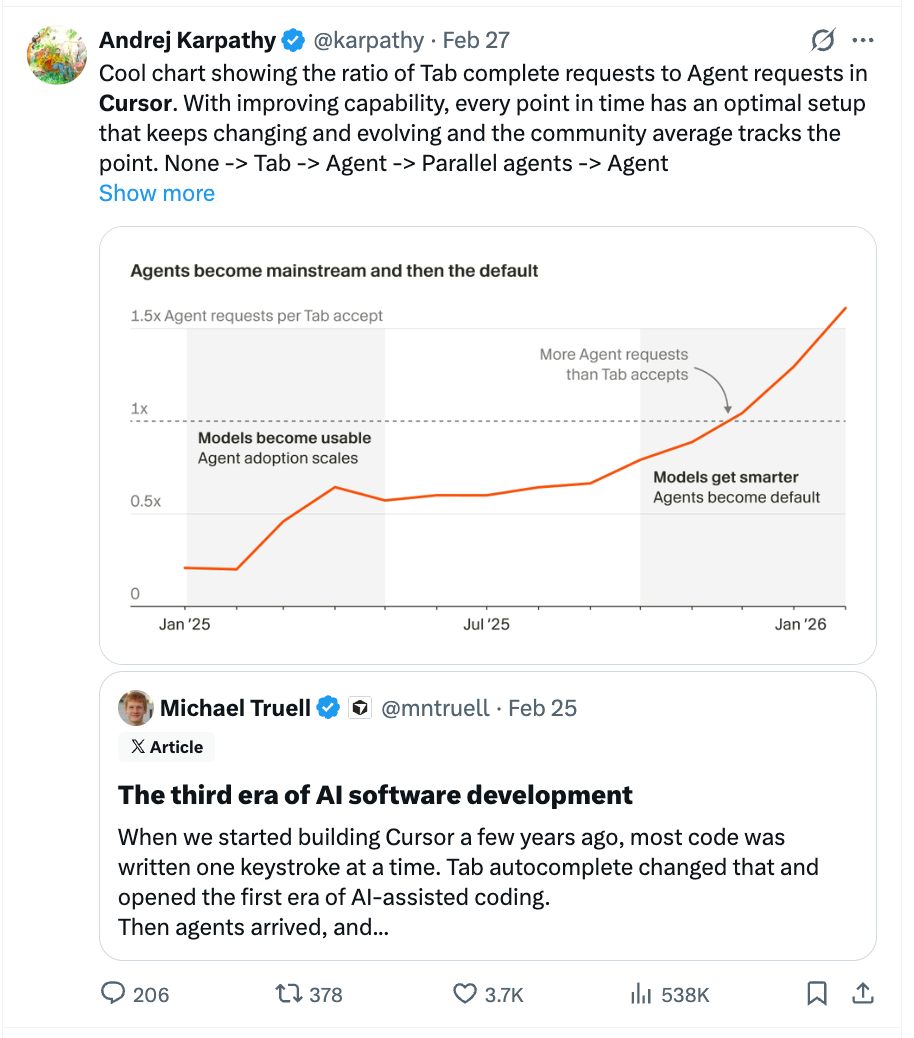
At Cursor, development is increasingly happening in Slack channels. Team members collectively kick off and redirect a cloud agent in a thread, turning development into a collaborative discussion. The IDE becomes a secondary tool, while communication platforms become the primary surface.
As users increasingly rely on AI agents, traditional graphical user interfaces will become obsolete. SaaS products must evolve to offer conversational interfaces that other agents can interact with directly. The primary user will shift from a human clicking buttons to another AI sending messages.
The future of work is shifting from app-switching to managing tasks through a unified agent interface. Companies like OpenAI (Codex) and Anthropic (Claude Code) are racing to create this new "operating system," a desktop app that serves as the primary surface for all agent-driven knowledge work.
The next user interface paradigm is delegation, not direct manipulation. Humans will communicate with AI agents via voice, instructing them to perform complex tasks on computers. This will shift daily work from hours of clicking and typing to zero, fundamentally changing our relationship with technology.

Users will stop interacting with countless individual apps and websites. Instead, they'll communicate with a personal AI agent that handles tasks by interfacing with services via APIs, making traditional graphical user interfaces obsolete.

The future of enterprise software is not better UIs, but their complete removal. AI agents will handle tasks based on natural language prompts, interacting with backend systems like Salesforce directly. This will fundamentally re-engineer systems of work away from human-centric interfaces.
