Get your free personalized podcast brief
We scan new podcasts and send you the top 5 insights daily.
The future of knowledge work will bifurcate into two surfaces. The first is asynchronous delegation to AI agents in collaborative spaces like Slack. The second is a deep, synchronous co-working surface, like an IDE or creative tool, where a user and an agent collaborate intensely on a single task.

Related Insights
Work will bifurcate into two modes: delegating tasks to asynchronous agents (e.g., in Slack) and performing core work inside AI-native environments like Codex. These platforms will become the primary operating system where you run other apps, rather than AI being just a feature within apps.

Current communication tools like Slack are ill-suited for managing AI agents. The future lies in integrated "super apps" that combine chat interfaces with built-in credential management, file systems, and API key provisioning, creating a unified environment for human-agent collaboration.

The primary interface for managing AI agents won't be simple chat, but sophisticated IDE-like environments for all knowledge workers. This paradigm of "macro delegation, micro-steering" will create new software categories like the "accountant IDE" or "lawyer IDE" for orchestrating complex AI work.

At Cursor, development is increasingly happening in Slack channels. Team members collectively kick off and redirect a cloud agent in a thread, turning development into a collaborative discussion. The IDE becomes a secondary tool, while communication platforms become the primary surface.
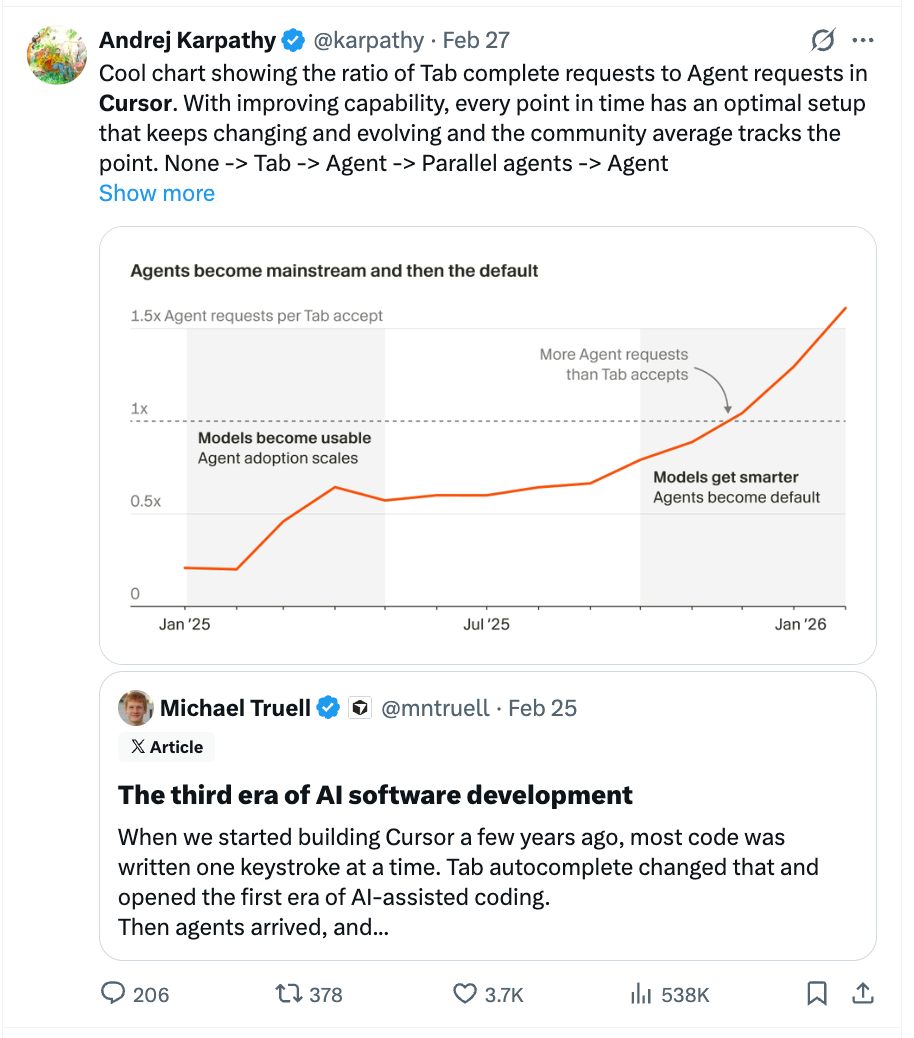
Building a bespoke communication layer for multiple AI agents is a complex "scaffolding" problem. A simpler, more direct solution is to treat agents as digital coworkers, assigning them accounts on existing platforms like Slack or Google Docs, enabling them to interact using established human workflows.
Tools like Claude CoWork preview a future where teams of AI agents collaborate on multi-faceted projects, like a product launch, simultaneously. This automates tactical entry-level tasks, elevating human workers to roles focused on high-level strategy, review, and orchestrating these AI "employees."
The next evolution for autonomous agents is the ability to form "agentic teams." This involves creating specialized agents for different tasks (e.g., research, content creation) that can hand off work to one another, moving beyond a single user-to-agent relationship towards a system of collaborating AIs.

The next leap in productivity isn't just using an AI assistant for synchronous tasks. It's becoming an "IC manager of agents," overseeing a team of 20-30 AI agents working concurrently on long-running, asynchronous tasks, creating a massive leverage factor.

The ideal AI-powered engineering workflow isn't just one tool, but a fluid cycle. It involves synchronous collaboration with an AI for planning and review, then handing off to an asynchronous agent for implementation and testing, before returning to synchronous mode for the next phase.

Today's AI agents like Codex primarily operate as single-player tools on your desktop. The next wave involves multiplayer agents that live in collaborative spaces like Slack. These team-based agents can be accessed by anyone, share knowledge, and automate group workflows, creating new challenges in permissions and shared memory.
