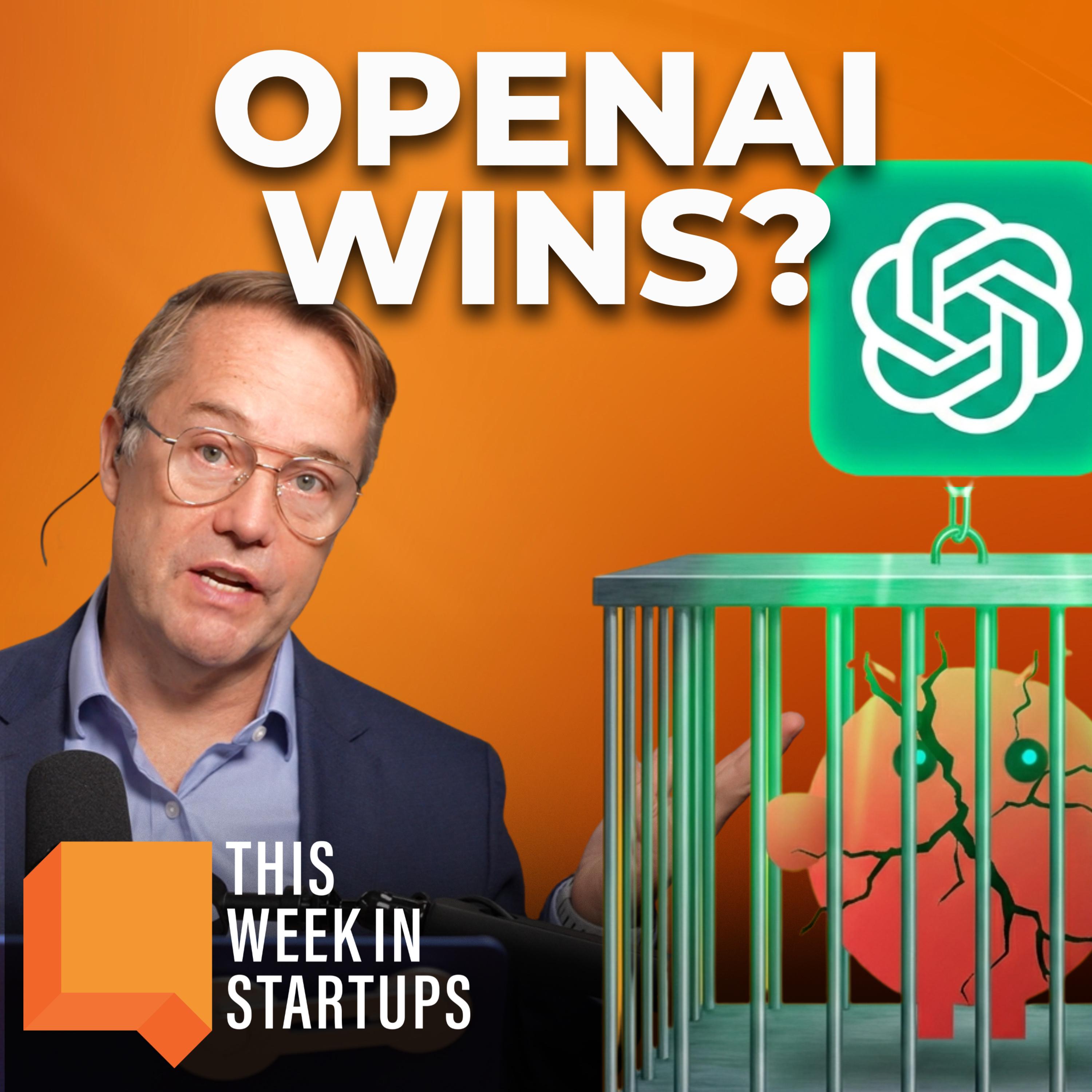
AI agents like OpenClaw dramatically lower the barrier to creating software. Founders with no prior coding experience can now build complex applications simply by issuing conversational commands, effectively making software development feel 'free' and accessible to anyone with an idea.
Entrepreneurs are predictably obsessed with tools like OpenClaw because they fulfill a core psychological drive: agency. These agents grant the ability to act on ideas immediately and at a scale that previously required a team, radically extending a founder's individual capacity to build and ship.
Power users are discovering that direct, conversational interaction with AI agents is more efficient than clicking through graphical user interfaces (GUIs). This signals a shift toward an 'app-less' world where tasks are accomplished via chat, potentially making traditional UI/UX design roles redundant for many applications.
The optimistic take is that OpenAI paid a premium to bring founder Peter in-house for his talent and to gain strategic insights from the open-source project's development. Placing OpenClaw in a foundation led by the ethical Dave Morin is a move to reassure the community.
A homeschooling parent is using OpenClaw to automate the entire educational workflow, from generating curricula to logging lessons via voice notes. This demonstrates AI's power to create bespoke learning experiences and tools, like a private, 'slop-free' YouTube client for kids.
To counteract OpenAI's potential control over the OpenClaw project, venture firm Launch announced a dedicated investment thesis to fund startups building core infrastructure around it. The strategy is to foster a decentralized ecosystem focused on security, ease of use, hosting, and skills to ensure the project remains open.
The high operational cost of using proprietary LLMs creates 'token junkies' who burn through cash rapidly. This intense cost pressure is a primary driver for power users to adopt cheaper, local, open-source models they can run on their own hardware, creating a distinct market segment.
The cynical view of OpenAI's acquisition of OpenClaw is that it's a defensive move to control the dominant user interface. By owning the 'front door' to AI, they can prevent competing models from gaining traction and ultimately absorb all innovation into their closed ecosystem.
The controversial AI-generated Scott Adams podcast highlights a gaping hole in estate planning. The incident suggests an emerging need for a legal instrument akin to a 'Do Not Resuscitate' order, allowing individuals to legally specify whether their likeness can be replicated by AI after their death.
The simple, text-based structure of Markdown (.md) files is uniquely suited for both AI processing and human readability. This dual compatibility is establishing it as the default file format for the AI era, ideal for creating knowledge bases and training documents that both humans and agents can easily use.
The AI Scott Adams channel was banned from YouTube for potentially confusing users, not for a clear legal violation. This demonstrates that platform policies and their opaque enforcement mechanisms are currently a more immediate and powerful regulator of AI-generated content than established right-of-publicity laws.