Get your free personalized podcast brief
We scan new podcasts and send you the top 5 insights daily.
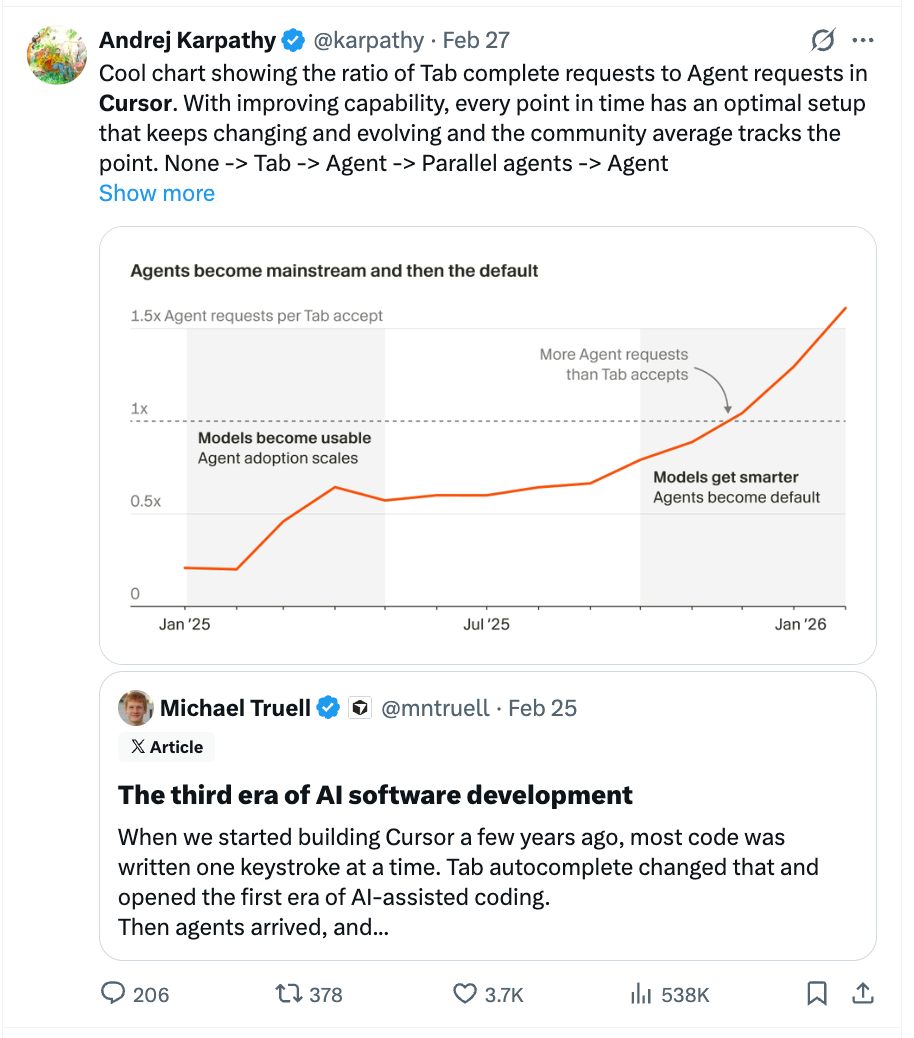
At Cursor, development is increasingly happening in Slack channels. Team members collectively kick off and redirect a cloud agent in a thread, turning development into a collaborative discussion. The IDE becomes a secondary tool, while communication platforms become the primary surface.
Related Insights
New IDEs like Gastown, with roles like 'overseer' and 'mayor' managing AI agent 'convoys,' reveal the developer's future. The job is becoming less about writing code line-by-line and more about high-level orchestration, prompting, and reviewing the output of specialized AI agents to complete complex tasks.
Because AI agents operate autonomously, developers can now code collaboratively while on calls. They can brainstorm, kick off a feature build, and have it ready for production by the end of the meeting, transforming coding from a solo, heads-down activity to a social one.

The next frontier for AI in development is a shift from interactive, user-prompted agents to autonomous "ambient agents" triggered by system events like server crashes. This transforms the developer's workbench from an editor into an orchestration and management cockpit for a team of agents.

The developer workflow is evolving with tools like Gastown that orchestrate multiple AI agents. This leads to a scenario where the IDE "melts away," and developers' core skills atrophy in code writing but must improve in code reading, reviewing, and prompting.

Using AI agents in shared Slack channels transforms coding from a solo activity into a collaborative one. Multiple team members can observe the agent's work, provide corrective feedback in the same thread, and collectively guide the task to completion, fostering shared knowledge.
Instead of a multi-week process involving PMs and engineers, a feature request in Slack can be assigned directly to an AI agent. The AI can understand the context from the thread, implement the change, and open a pull request, turning a simple request into a production feature with minimal human effort.
The IDE Zed was built for synchronous, Figma-like human collaboration to overcome asynchronous Git workflows. This foundation of real-time, in-code presence serendipitously created the perfect environment for integrating AI agents, which function as just another collaborator in the same shared space.

The ideal AI-powered engineering workflow isn't just one tool, but a fluid cycle. It involves synchronous collaboration with an AI for planning and review, then handing off to an asynchronous agent for implementation and testing, before returning to synchronous mode for the next phase.
For over a decade, software development fragmented into siloed roles (PM, Design, Eng) with their own tools. AI code editors are collapsing these boundaries by creating a unified workspace where a single "maker" or a streamlined team can build, iterate, and ship, much like in the early days of computing.

Cursor's founder predicts AI developer tools will bifurcate into two modes: a fast, "in-the-loop" copilot for pair programming, and a slower, asynchronous "agent" that completes entire tasks with perfect accuracy. This requires building products optimized for both speed and correctness.
