Get your free personalized podcast brief
We scan new podcasts and send you the top 5 insights daily.
Contrary to popular belief, the choice of embedding model significantly impacts AI system performance. MongoDB's Pete Johnson highlights benchmarks showing up to a 14% difference in retrieval quality between models, a margin that can be the deciding factor between a useful response and a costly hallucination.

Related Insights
Google's Embedding 2 model is a significant infrastructure upgrade because it is 'natively multimodal.' This allows AI to directly understand and retrieve images, diagrams, and text without first converting non-text data into lossy captions. This makes internal knowledge bases and co-pilots dramatically more effective and accurate for enterprises.

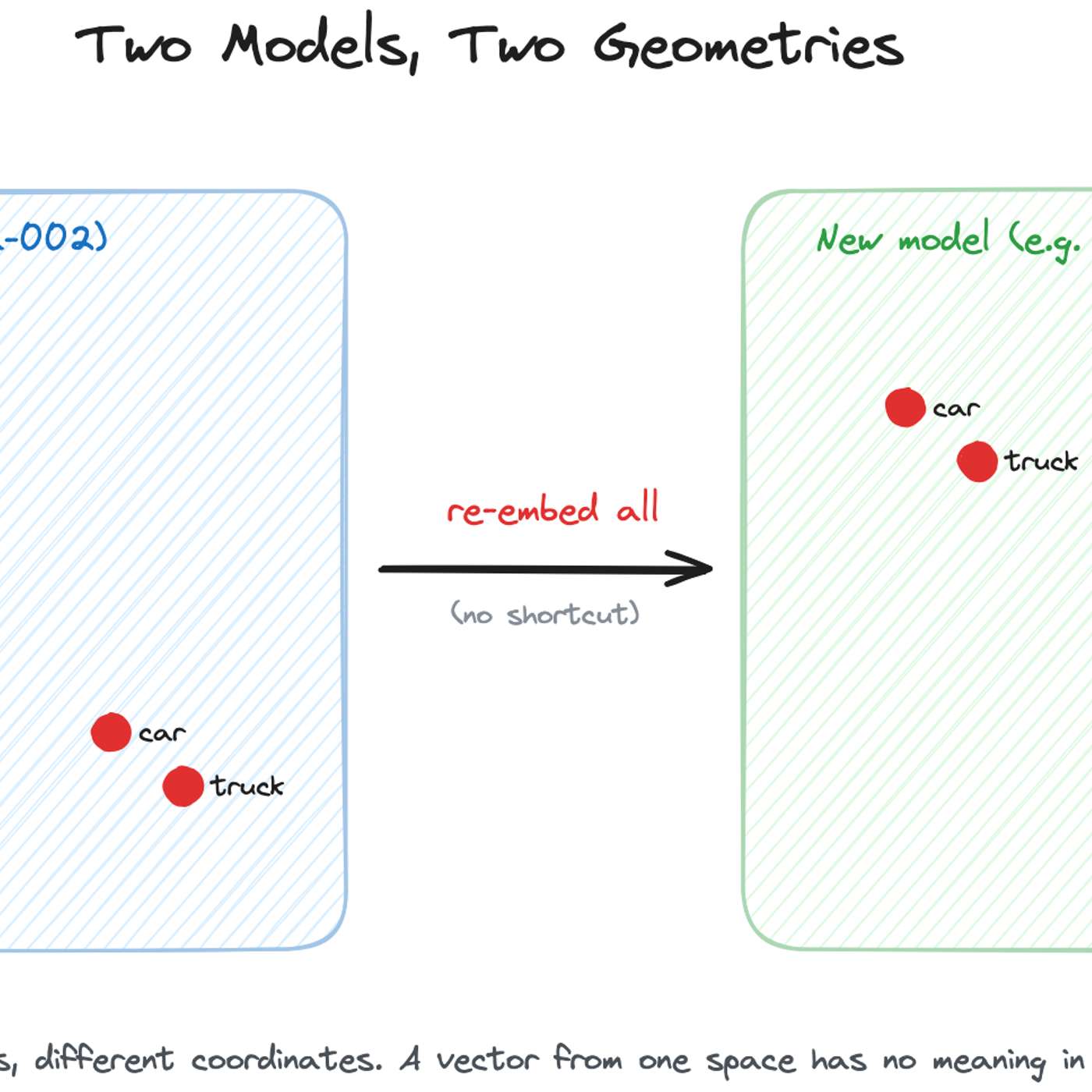
While academic research explores techniques like 'embedding space alignment' to avoid costly re-embeddings, no major company has publicly confirmed using them in production. Industry accounts from Uber, Pinterest, and Google all describe full, parallel re-embedding as the current, practical standard, highlighting a significant gap between research and real-world adoption.
Testing different vector dimensions usually requires costly re-embedding of the entire dataset. Matryoshka embeddings are ordered, allowing developers to test smaller dimensions by simply truncating a larger vector. This “Russian nesting doll” approach dramatically reduces developer friction and experimentation time.

AI's hunger for context is making search a critical but expensive component. As illustrated by Turbo Puffer's origin, a single recommendation feature using vector embeddings can cost tens of thousands per month, forcing companies to find cheaper solutions to make AI features economically viable at scale.

Teams often default to convenient embedding models from their cloud provider, treating them as interchangeable. This is a critical mistake. The choice of embedding model directly impacts retrieval quality, with specialized models offering double-digit performance gains that can unlock new capabilities.
To avoid frantic, high-pressure migrations when an embedding model is deprecated, teams should treat model selection as a dependency that requires planned updates, like any other software library. This mindset shifts the process from an emergency scramble to routine, planned maintenance, making upgrades predictable and manageable.
Contrary to the hype, year-over-year performance gains for LLMs have dramatically slowed and nearly flatlined. Furthermore, the performance variance between competing models has collapsed. It's now nearly impossible to distinguish between them in a blind test, indicating they are becoming commoditized.

Embeddings from different sizes of Voyage AI models are compatible. This lets teams embed production data with a large model while developers use a free, local “Nano” model for queries. This novel approach eliminates token costs during development and testing, improving developer experience.
A typical A/B test re-ranks the same set of results. However, changing the embedding model alters the fundamental retrieval step, meaning the two versions return entirely different sets of documents for the same query. This complicates analysis, as performance differences reflect both model quality and the content of the newly retrieved documents.
Contrary to relying on a single frontier model, companies in production use a diverse portfolio of, on average, 32 different models. They switch between them to optimize for cost and performance on specific tasks, fueled by the rise of capable open-weight models.
