Get your free personalized podcast brief
We scan new podcasts and send you the top 5 insights daily.
Embeddings from different sizes of Voyage AI models are compatible. This lets teams embed production data with a large model while developers use a free, local “Nano” model for queries. This novel approach eliminates token costs during development and testing, improving developer experience.

Related Insights
Instead of using massive, expensive LLMs for every task, companies can solve the "tokenpocalypse" (runaway token costs) by pairing smaller models with high-quality retrieval systems. This allows cheap models to act like large ones, saving significant costs.

While often discussed for privacy, running models on-device eliminates API latency and costs. This allows for near-instant, high-volume processing for free, a key advantage over cloud-based AI services.
Testing different vector dimensions usually requires costly re-embedding of the entire dataset. Matryoshka embeddings are ordered, allowing developers to test smaller dimensions by simply truncating a larger vector. This “Russian nesting doll” approach dramatically reduces developer friction and experimentation time.
A Stanford study found that the vast majority of queries sent to powerful frontier models don't require their advanced capabilities. These tasks could be handled by smaller, faster, and more private local models at virtually no cost, revealing a massive inefficiency in the current API-centric approach.
Instead of each team member paying for API access, Buzz allows one powerful machine to host a local LLM. The team can then connect to and share this single compute resource, making powerful AI more accessible and affordable for bootstrapped teams.

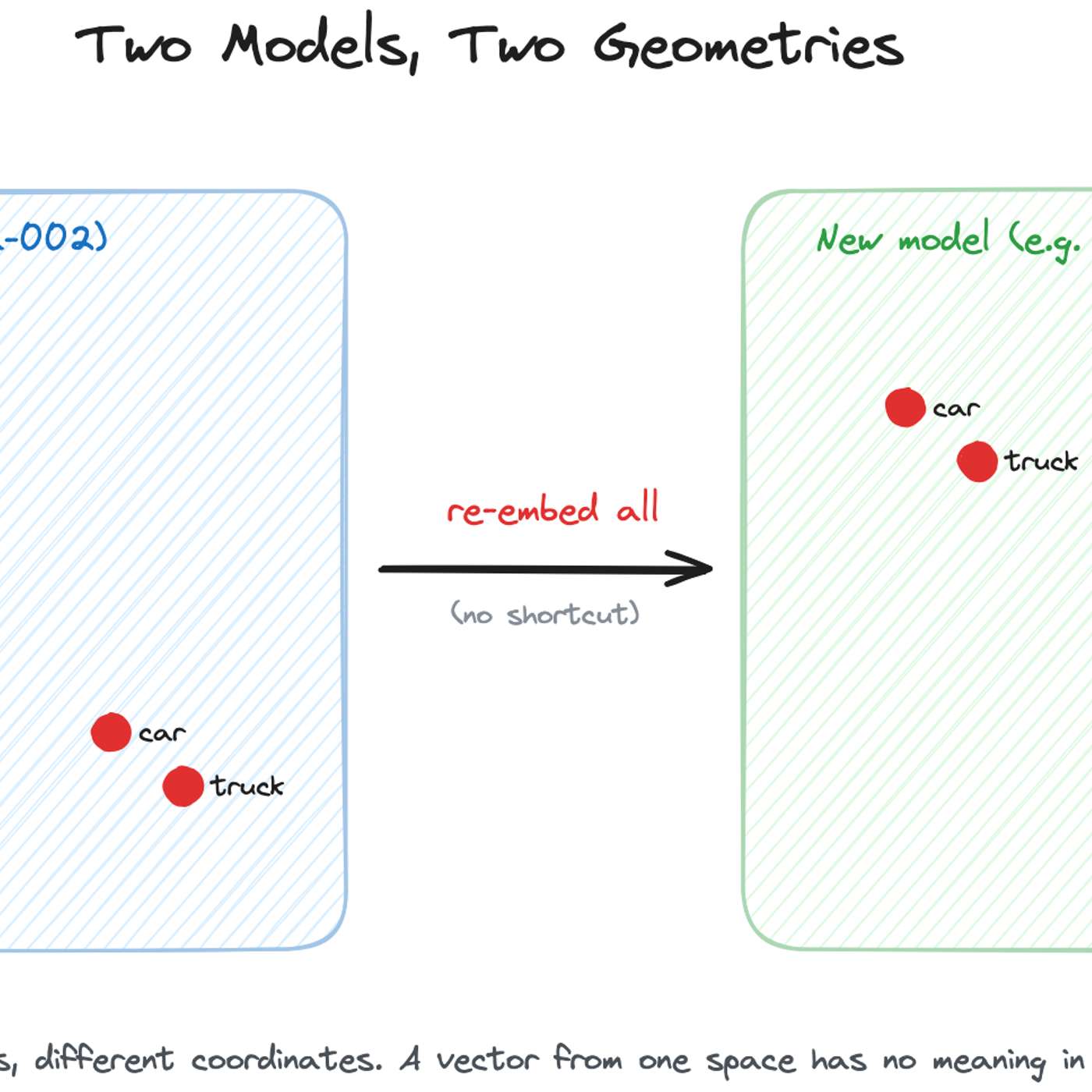
To avoid frantic, high-pressure migrations when an embedding model is deprecated, teams should treat model selection as a dependency that requires planned updates, like any other software library. This mindset shifts the process from an emergency scramble to routine, planned maintenance, making upgrades predictable and manageable.
Relying solely on premium models like Claude Opus can lead to unsustainable API costs ($1M/year projected). The solution is a hybrid approach: use powerful cloud models for complex tasks and cheaper, locally-hosted open-source models for routine operations.

Criteo builds multiple, specialized foundation models (for products, user timelines, etc.) rather than a single monolithic one. The embeddings from these models are made available across the company, serving as a "warm start" to accelerate the development and improve the performance of new AI products.

By training a smaller, specialized model where company data is in the weights, firms avoid the high token costs of repeatedly feeding context to large frontier models. This makes complex, data-intensive workflows significantly cheaper and faster.

To manage high API costs, a hybrid architecture is emerging. Startups use powerful models like Anthropic's Fable 5 to generate reusable 'skills' (as simple text files), which are then executed by cheap, efficient local models running on-device.