Get your free personalized podcast brief
We scan new podcasts and send you the top 5 insights daily.
Instead of switching between ChatGPT, Claude, and others, a multi-agent workflow lets users prompt once to receive and compare outputs from several LLMs simultaneously. This consolidates the AI user experience, saving time and eliminating 'LLM ping pong' to find the best response.

Related Insights
Instead of prompting a specialized AI tool directly, experts employ a meta-workflow. They first use a general LLM like ChatGPT or Claude to generate a detailed, context-rich 'master prompt' based on a PRD or user story, which they then paste into the specialized tool for superior results.
Before delegating a complex task, use a simple prompt to have a context-aware system generate a more detailed and effective prompt. This "prompt-for-a-prompt" workflow adds necessary detail and structure, significantly improving the agent's success rate and saving rework.
When building Spiral, a single large language model trying to both interview the user and write content failed due to "context rot." The solution was a multi-agent system where an "interviewer" agent hands off the full context to a separate "writer" agent, improving performance and reliability.

Building a single, all-purpose AI is like hiring one person for every company role. To maximize accuracy and creativity, build multiple custom GPTs, each trained for a specific function like copywriting or operations, and have them collaborate.
Separating AI agents into distinct roles (e.g., a technical expert and a customer-facing communicator) mirrors real-world team specializations. This allows for tailored configurations, like different 'temperature' settings for creativity versus accuracy, improving overall performance and preventing role confusion.
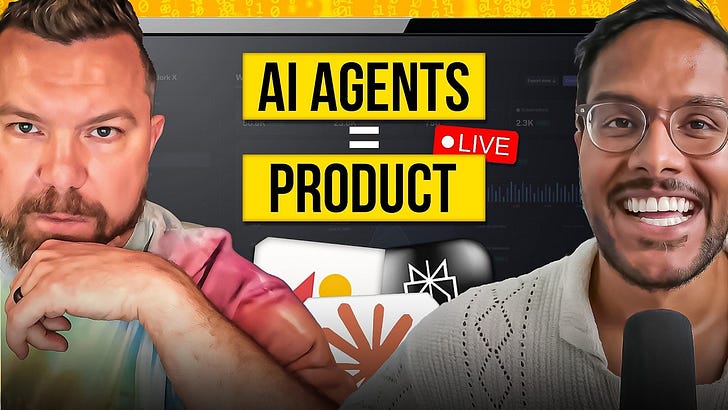
Instead of relying on a single, all-purpose coding agent, the most effective workflow involves using different agents for their specific strengths. For example, using the 'Friday' agent for UI tasks, 'Charlie' for code reviews, and 'Claude Code' for research and backend logic.
While chat works for human-AI interaction, the infinite canvas is a superior paradigm for multi-agent and human-AI collaboration. It allows for simultaneous, non-distracting parallel work, asynchronous handoffs, and persistent spatial context—all of which are difficult to achieve in a linear, turn-based chat interface.
Replit's leap in AI agent autonomy isn't from a single superior model, but from orchestrating multiple specialized agents using models from various providers. This multi-agent approach creates a different, faster scaling paradigm for task completion compared to single-model evaluations, suggesting a new direction for agent research.
Top performers won't rely on a single AI platform. Instead, they will act as a conductor, directing various specialized AI agents (like Claude, Gemini, ChatGPT) to perform specific tasks. This requires understanding the strengths of different tools and combining their outputs for maximum productivity.

Treat generative AI not as a single assistant, but as an army. When prototyping or brainstorming, open several different AI tools in parallel windows with similar prompts. This allows you to juggle and cross-pollinate ideas, effectively 'riffing' with multiple assistants at once to accelerate creative output and overcome latency.