Get your free personalized podcast brief
We scan new podcasts and send you the top 5 insights daily.
An AI agent reviewing its own code is prone to confirmation bias, as it operates from the same context that created an error. To achieve genuine quality assurance, use a different AI model, preferably from another vendor, for review. This introduces diverse training and uncovers blind spots.

Related Insights
Before coding a complex AI project, validate the plan by presenting it to diverse AI models (including different families like Chinese open models). Use their critical feedback to identify blind spots, challenge assumptions, and refine the core concept before committing to development.
The agent that writes code is biased and may miss its own errors. Kun Chen uses a tool spawning a new agent with a fresh context. This 'reviewer' agent analyzes the original intent and scrutinizes the code for bugs, catching far more edge cases than self-review.

To get an objective critique of AI-generated content, use a dedicated 'reviewer' sub-agent. This separates the drafting and evaluation processes, preventing the original agent from being biased by its own creation and ensuring a higher quality output.
Instead of relying on a single AI model, Josh Pigford's workflow uses Opus for initial code generation and then runs a review pass with a different powerful model like GPT. This adversarial, multi-model process consistently uncovers 3-5 bugs that the primary model overlooks.
Use workflows to spin up separate "worker" and "verifier" sub-agents. A model is more lenient checking its own work ("self-preferential bias"). Using a distinct agent with a clear rubric for verification leads to higher quality, more reliable outputs for non-deterministic tasks.
To overcome the challenge of reviewing AI-generated code, have different LLMs like Claude and Codex review the code. Then, use a "peer review" prompt that forces the primary LLM to defend its choices or fix the issues raised by its "peers." This adversarial process catches more bugs and improves overall code quality.

Prompting a different LLM model to review code generated by the first one provides a powerful, non-defensive critique. This "second opinion" can rapidly identify architectural issues, bugs, and alternative approaches without the human ego involved in traditional code reviews.

A common failure in AI workflows is that the same model generates and grades its own work. A robust graph separates these roles by including a 'skeptic' agent. This agent's sole job is to challenge claims, find stale evidence, and identify areas of unproven confidence, preventing self-reinforcing bias.

To improve code quality, use a secondary AI model from a different provider (e.g., Moonshot AI's Kimi) to review plans generated by a primary model (e.g., Anthropic's Claude). This introduces cognitive diversity and avoids the shared biases inherent in a single model family, leading to a more robust and enriching review process.
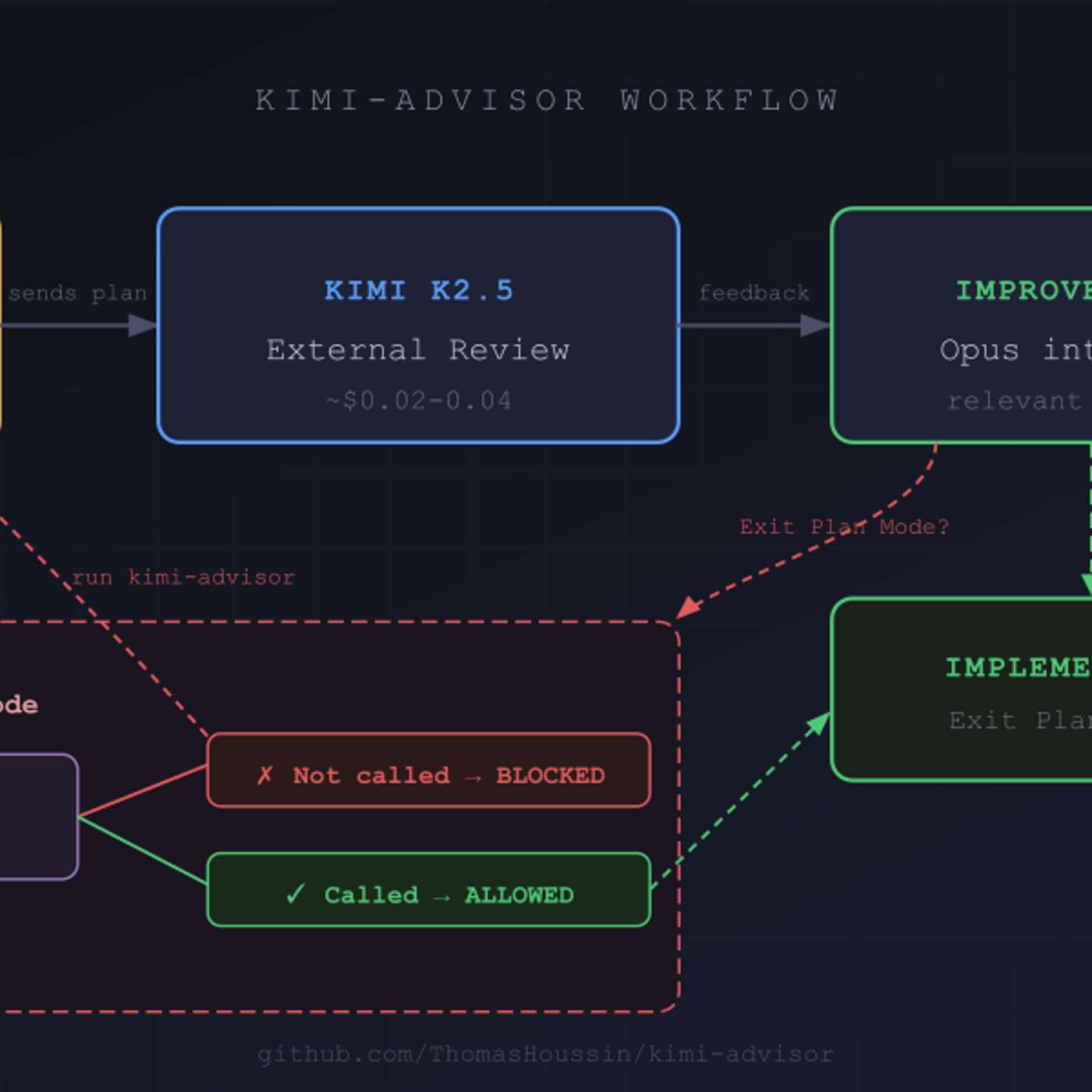
Shopify's CTO argues against running many AI agents in parallel. A more effective, higher-quality method is a "critique loop," where one agent (ideally using a different model) reviews and suggests improvements to another's work. Though slower, this process significantly boosts code quality.