Get your free personalized podcast brief
We scan new podcasts and send you the top 5 insights daily.
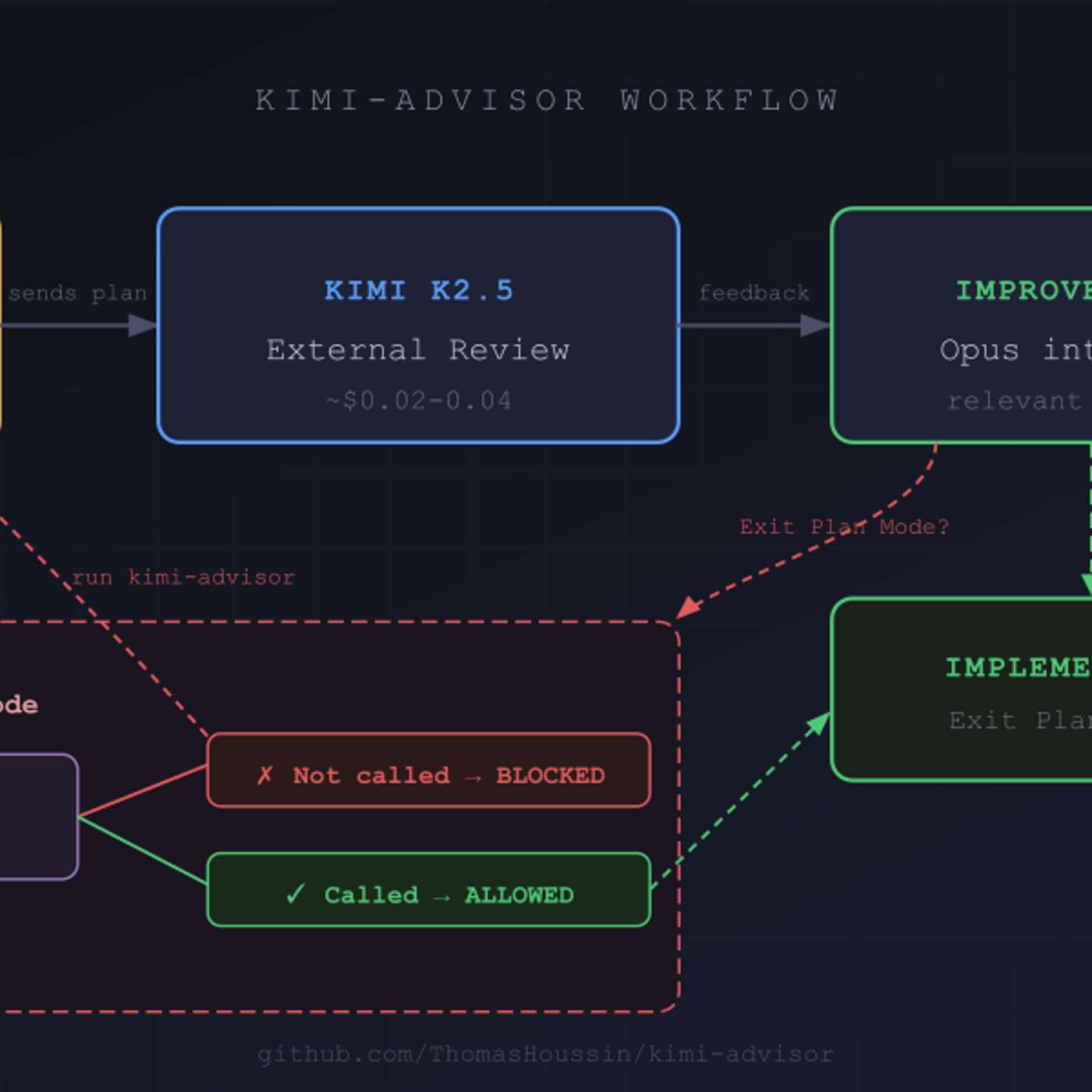
Before coding a complex AI project, validate the plan by presenting it to diverse AI models (including different families like Chinese open models). Use their critical feedback to identify blind spots, challenge assumptions, and refine the core concept before committing to development.

Related Insights
By default, AI models are designed to be agreeable. To get true value, explicitly instruct the AI to act as a critic or 'devil's advocate.' Ask it to challenge your assumptions and list potential risks. This exposes blind spots and leads to stronger, more resilient strategies than you would develop with a simple 'yes-man' assistant.

Instead of relying on a single AI model, Josh Pigford's workflow uses Opus for initial code generation and then runs a review pass with a different powerful model like GPT. This adversarial, multi-model process consistently uncovers 3-5 bugs that the primary model overlooks.

Instead of relying on a single AI, use different models (e.g., ChatGPT for internal context, Claude for an objective view) for the same problem. This multi-model approach generates diverse perspectives and higher-quality strategic outputs.

AI models can amplify confirmation bias by finding evidence to support any idea. To counteract this, founders should explicitly instruct AI to argue against their idea, find disconfirming evidence, and make the strongest possible case for why a competitor would succeed. This reframes the AI from a validator to a powerful sparring partner.

To overcome the challenge of reviewing AI-generated code, have different LLMs like Claude and Codex review the code. Then, use a "peer review" prompt that forces the primary LLM to defend its choices or fix the issues raised by its "peers." This adversarial process catches more bugs and improves overall code quality.

AI models tend to be overly optimistic. To get a balanced market analysis, explicitly instruct AI research tools like Perplexity to act as a "devil's advocate." This helps uncover risks, challenge assumptions, and makes it easier for product managers to say "no" to weak ideas quickly.

Elevate AI from a productivity tool to a strategic sparring partner. Prompt the AI to adopt a critical persona, like a skeptical board member, and instruct it to find weaknesses, challenge assumptions, and ask hard questions about your strategy. This provides surprisingly rigorous and unbiased feedback to strengthen your plan.

To combat hallucinations and bias, don't rely on a single AI tool. For important decisions, query multiple large language models (e.g., Claude, Gemini) with the same prompt. This "second opinion" approach allows you to compare answers, identify inconsistencies, and blend the best elements for a more reliable outcome.

To improve code quality, use a secondary AI model from a different provider (e.g., Moonshot AI's Kimi) to review plans generated by a primary model (e.g., Anthropic's Claude). This introduces cognitive diversity and avoids the shared biases inherent in a single model family, leading to a more robust and enriching review process.
A powerful technique for creating robust software plans is to use AI as an adversarial partner. After drafting a specification, prompt an AI to "tear it apart" by identifying underspecified or inconsistent points. Iterate on this process until the AI's feedback becomes niche, indicating a solid spec.
