Get your free personalized podcast brief
We scan new podcasts and send you the top 5 insights daily.
Use workflows to spin up separate "worker" and "verifier" sub-agents. A model is more lenient checking its own work ("self-preferential bias"). Using a distinct agent with a clear rubric for verification leads to higher quality, more reliable outputs for non-deterministic tasks.

Related Insights
Anthropic's Claude Code team reports that AI agent skills designed for "verification"—teaching an agent to test and validate its own output—provide an extremely high return on investment. This suggests that building reliability and correctness into AI workflows is as critical, if not more so, than the initial generation capability.

The agent that writes code is biased and may miss its own errors. Kun Chen uses a tool spawning a new agent with a fresh context. This 'reviewer' agent analyzes the original intent and scrutinizes the code for bugs, catching far more edge cases than self-review.
To get an objective critique of AI-generated content, use a dedicated 'reviewer' sub-agent. This separates the drafting and evaluation processes, preventing the original agent from being biased by its own creation and ensuring a higher quality output.
AI models have an emergent "human laziness factor," often doing the minimum work necessary to provide an answer. To ensure correctness, Genesis builds harnesses that force agents to provide proof for their work, then uses a second AI to review and validate those outputs, preventing corner-cutting.

To improve the quality and accuracy of an AI agent's output, spawn multiple sub-agents with competing or adversarial roles. For example, a code review agent finds bugs, while several "auditor" agents check for false positives, resulting in a more reliable final analysis.

To improve code quality, use a secondary AI model from a different provider (e.g., Moonshot AI's Kimi) to review plans generated by a primary model (e.g., Anthropic's Claude). This introduces cognitive diversity and avoids the shared biases inherent in a single model family, leading to a more robust and enriching review process.
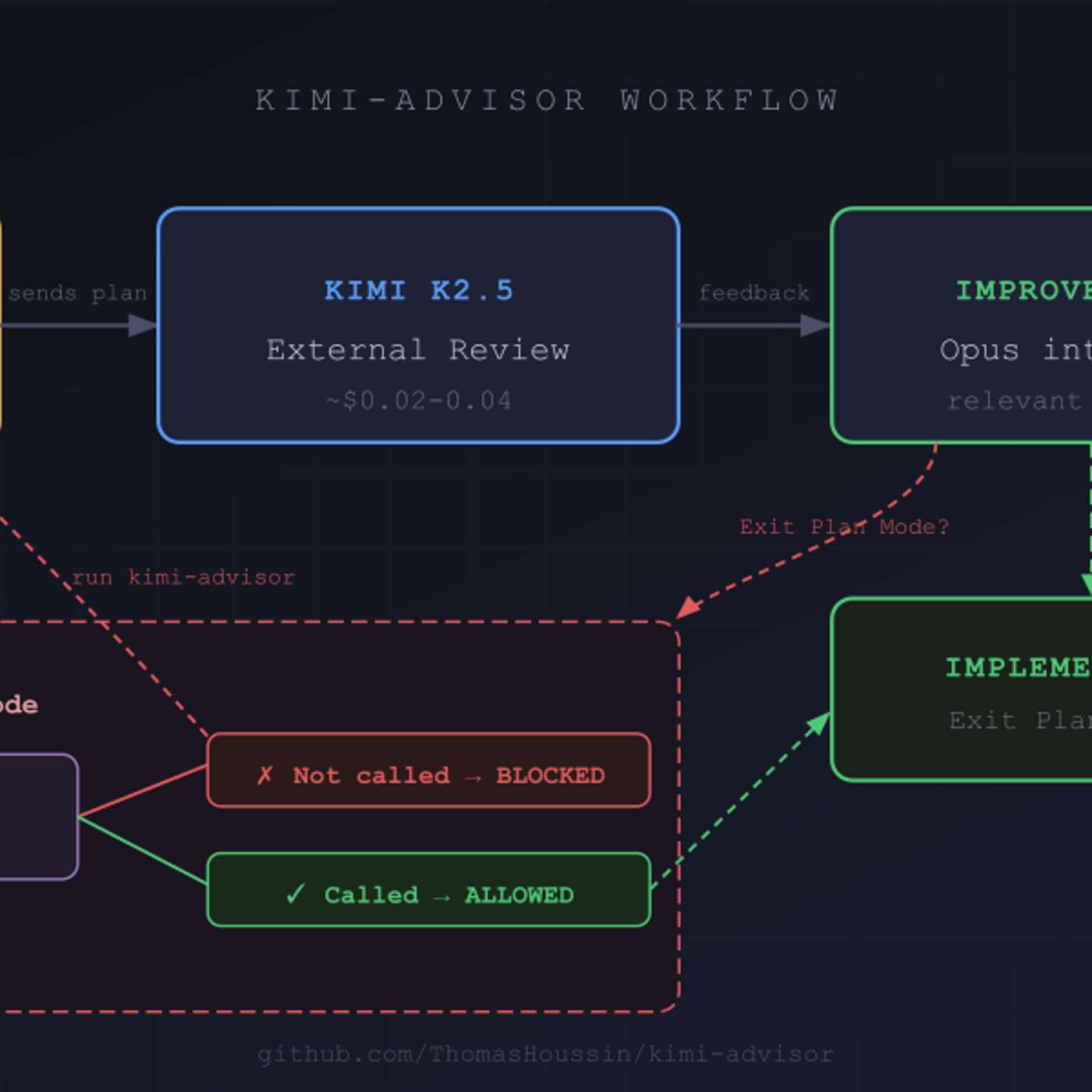
An agent's effectiveness is limited by its ability to validate its own output. By building in rigorous, continuous validation—using linters, tests, and even visual QA via browser dev tools—the agent follows a 'measure twice, cut once' principle, leading to much higher quality results than agents that simply generate and iterate.
Traditional evals fall short for sophisticated agents. A more effective method is a built-in evaluation loop where one agent is tasked with grading the output of another. This allows for continuous, automated quality assessment, especially when done in separate context windows to avoid bias.
Claude Code's 'Dynamic Workflows' feature represents a major architectural leap for AI agents. The model can now autonomously create and manage hundreds of specialized sub-agents to solve complex problems in parallel. The system includes adversarial agents that challenge and verify the work, mimicking a senior engineering team and moving closer to truly autonomous AI workforces.
Using an LLM to grade another's output is more reliable when the evaluation process is fundamentally different from the task itself. For agentic tasks, the performer uses tools like code interpreters, while the grader analyzes static outputs against criteria, reducing self-preference bias.
