Get your free personalized podcast brief
We scan new podcasts and send you the top 5 insights daily.
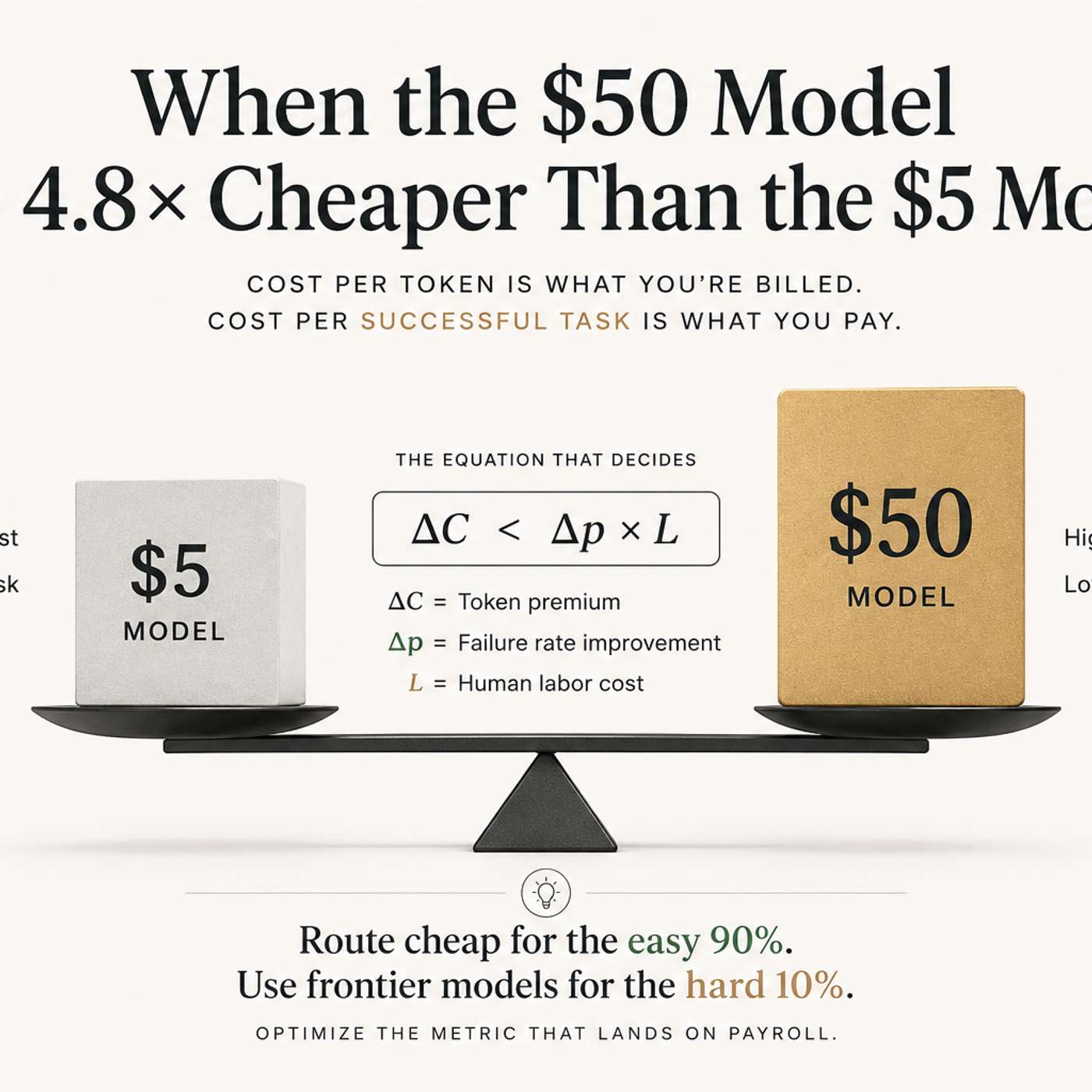
The decision to use a cheaper but less reliable AI model hinges on the cost of human labor to fix errors. Teams with high engineering salaries can justify premium models for even minor reliability gains, while lower-cost teams should use them more selectively. Your staffing costs directly inform your AI architecture.
Related Insights
For critical enterprise uses like coding, the cost to remediate a single error from a cheaper AI model far outweighs any savings. This high cost of failure ensures businesses will continue paying a premium for more reliable, high-end proprietary models for crucial tasks, while using open-source options for lower-stakes work.

Don't use your most powerful and expensive AI model for every task. A crucial skill is model triage: using cheaper models for simple, routine tasks like monitoring and scheduling, while saving premium models for complex reasoning, judgment, and creative work.

To properly evaluate the cost of advanced AI tools, shift your mental framework. Don't compare a $200/month plan to a $20/month entertainment subscription. Compare it to the cost of a human employee, which could be thousands per month. The AI is a productive asset, making its price a high-leverage investment.

The era of using the most powerful AI model for every task is ending. Companies are now focused on the trade-off between quality, cost, and latency. The key question is no longer "Which model is best?" but "Which model is good enough for this task at the lowest price point?"

To combat rising AI costs, firms are creating hybrid systems that use cheaper "worker" models for routine tasks while delegating complex problems to powerful "advisor" models. This approach, used by Harvey and explored by Microsoft, can outperform state-of-the-art models alone for a fraction of the cost.
The $15-$25 per-review price for Anthropic's tool moves AI expenses from a predictable monthly software subscription to a variable cost that scales like human labor. This forces CTOs to justify AI budgets with direct headcount savings, creating immense pressure on ROI.
The smartest 'AI-pilled' companies adopt a two-tiered model strategy. They use expensive, frontier models for internal, high-leverage tasks like creating new knowledge and optimizing processes. However, they use cheaper, open-weight models in the 'bill of materials' for the customer-facing product to manage costs effectively.
Evaluating AI models on cost-per-token is misleading because it ignores the hidden cost of human labor to fix failures. The true 'cost per successful task' is a business metric that accounts for both the API invoice and the payroll expense for rework, revealing a more accurate total cost of ownership.
As AI costs rise, using one powerful frontier model for every task is no longer financially viable. The solution is to create a dedicated "Model Sommelier" role responsible for curating a portfolio of models, continuously testing and selecting the most cost-effective option for each specific business use case.
An optimal AI architecture routes tasks to different models based on complexity and risk. Simple, low-stakes work like data extraction should go to the cheapest models. Ambiguous, high-stakes work like system design warrants expensive frontier models, where preventing one engineering mistake justifies the premium token cost.