Get your free personalized podcast brief
We scan new podcasts and send you the top 5 insights daily.
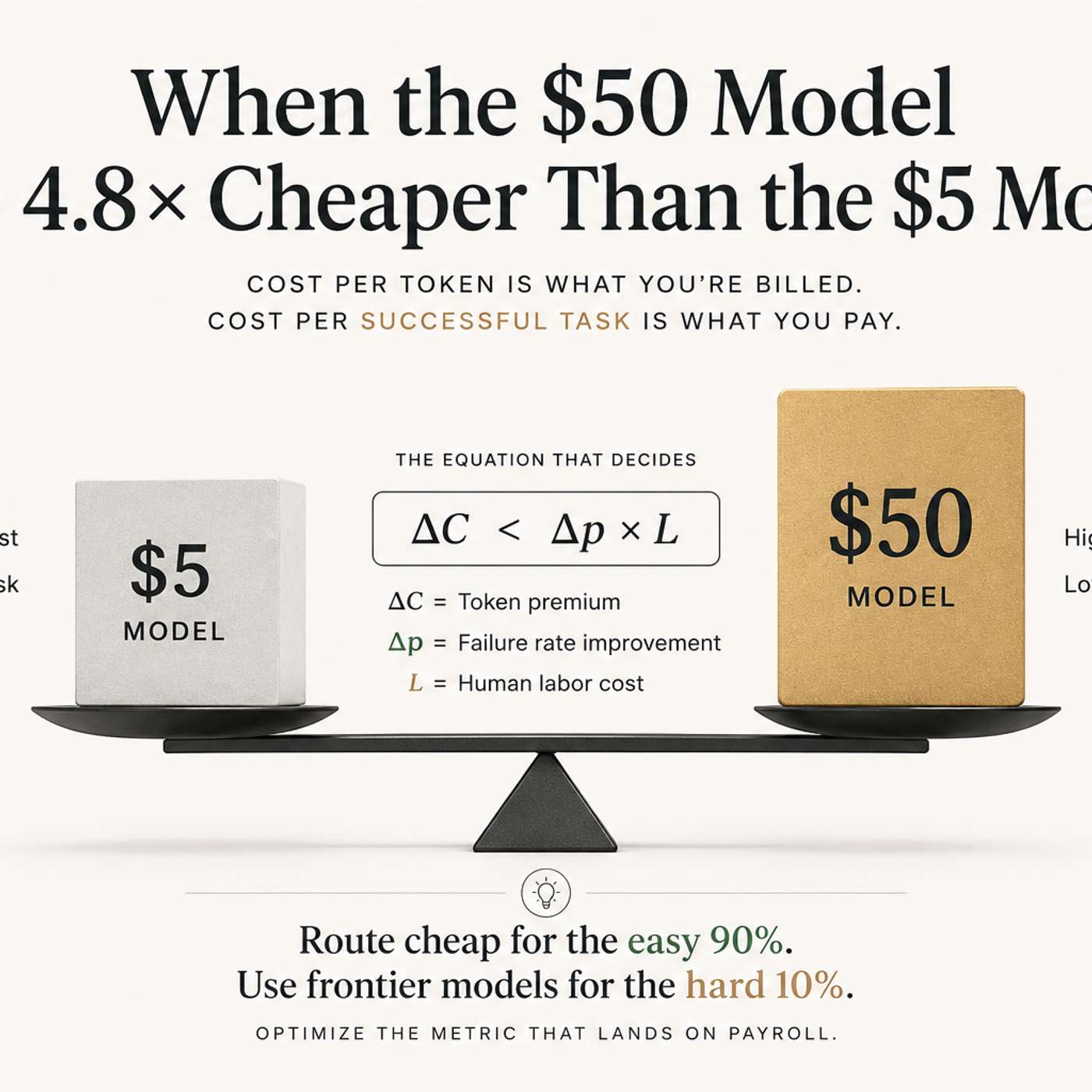
An optimal AI architecture routes tasks to different models based on complexity and risk. Simple, low-stakes work like data extraction should go to the cheapest models. Ambiguous, high-stakes work like system design warrants expensive frontier models, where preventing one engineering mistake justifies the premium token cost.
Related Insights
Don't use your most powerful and expensive AI model for every task. A crucial skill is model triage: using cheaper models for simple, routine tasks like monitoring and scheduling, while saving premium models for complex reasoning, judgment, and creative work.

Advanced AI architectures will use small, fast, and cheap local models to act as intelligent routers. These models will first analyze a complex request, formulate a plan, and then delegate different sub-tasks to a fleet of more powerful or specialized models, optimizing for cost and performance.
Instead of relying on one powerful model for all tasks, the leading strategy is 'smart routing'—using a panel of models and directing each task to the most appropriate one. This compound architecture demonstrably beats single frontier models on both cost and performance.
Instead of relying on a single large AI model, companies are adopting "model orchestration" to control costs. This involves using a router to send prompts to the most appropriate model based on the task, often cascading from cheap, small models to more expensive ones only when necessary.

Companies are building intelligent systems that analyze a user's prompt and automatically route it to the most cost-effective model that can handle the task. This avoids using expensive frontier models for simple requests, with some companies like Coinbase successfully keeping costs flat despite exponential usage growth.

To optimize AI costs in development, use powerful, expensive models for creative and strategic tasks like architecture and research. Once a solid plan is established, delegate the step-by-step code execution to less powerful, more affordable models that excel at following instructions.

To manage the high cost of Fable 5, Replit is not making it the default model. Instead, it internally decides when a task's complexity justifies escalating to the expensive model, thus avoiding "regrettable tokens" on simpler tasks.
To prevent AI agent usage costs from spiraling, GitHub expects the solution will be intelligent model routing. These systems will automatically select the most efficient and cost-effective AI model for a given task, such as using a cheap model for simple refactoring instead of a powerful, expensive one.

To control inference costs, companies are implementing model routing systems. They differentiate between expensive tokens from frontier models for complex reasoning and cheaper tokens from fine-tuned open-source models for simpler workflow tasks. This tiered approach optimizes both performance and budget, avoiding "token maxing."
To manage costs, the optimal architecture isn't running everything on the most powerful model. Instead, a smart orchestrator agent should break down complex problems and dispatch simpler sub-tasks to smaller, cheaper models, optimizing for both cost and performance.
