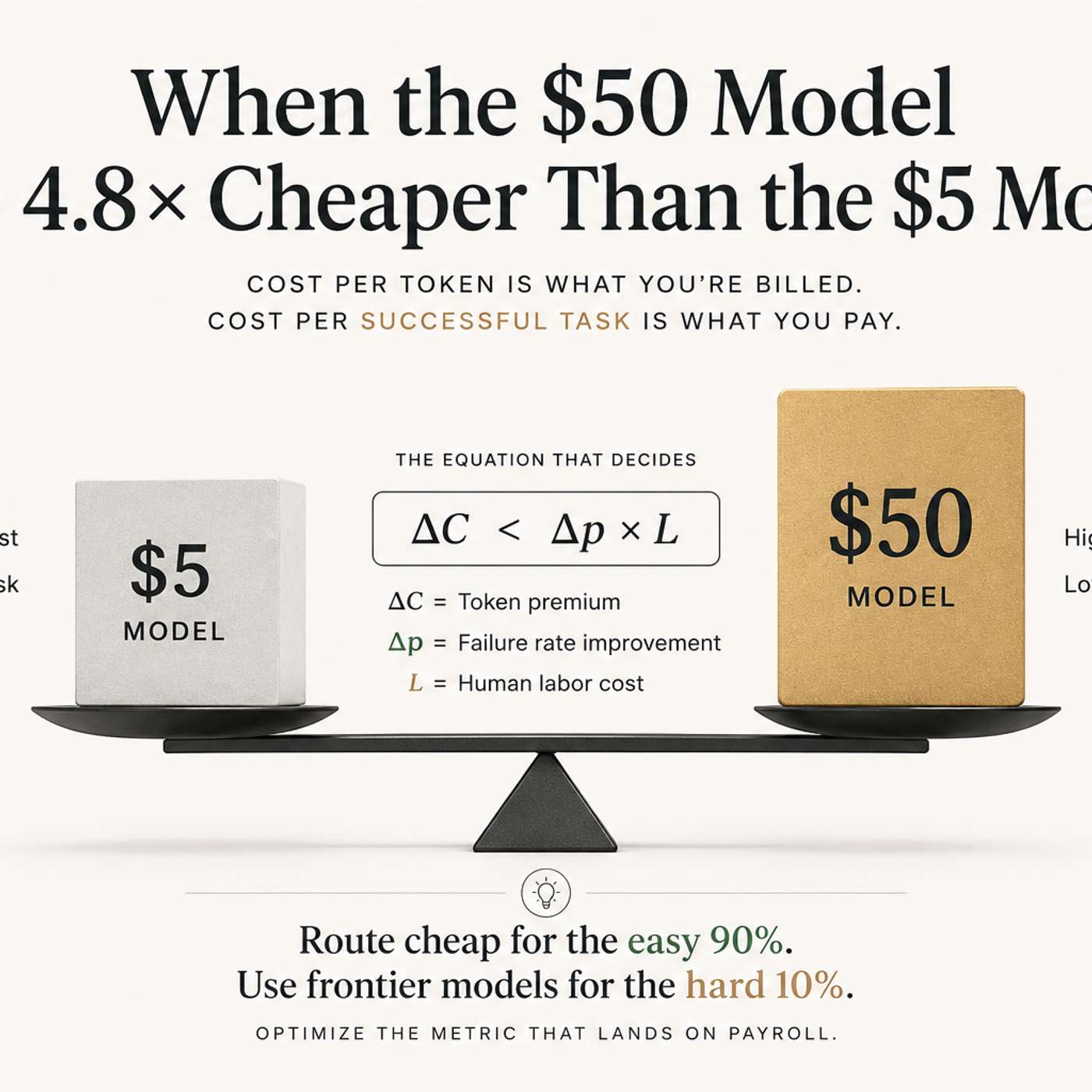
Evaluating AI models on cost-per-token is misleading because it ignores the hidden cost of human labor to fix failures. The true 'cost per successful task' is a business metric that accounts for both the API invoice and the payroll expense for rework, revealing a more accurate total cost of ownership.
The decision to use a cheaper but less reliable AI model hinges on the cost of human labor to fix errors. Teams with high engineering salaries can justify premium models for even minor reliability gains, while lower-cost teams should use them more selectively. Your staffing costs directly inform your AI architecture.
An optimal AI architecture routes tasks to different models based on complexity and risk. Simple, low-stakes work like data extraction should go to the cheapest models. Ambiguous, high-stakes work like system design warrants expensive frontier models, where preventing one engineering mistake justifies the premium token cost.