Get your free personalized podcast brief
We scan new podcasts and send you the top 5 insights daily.
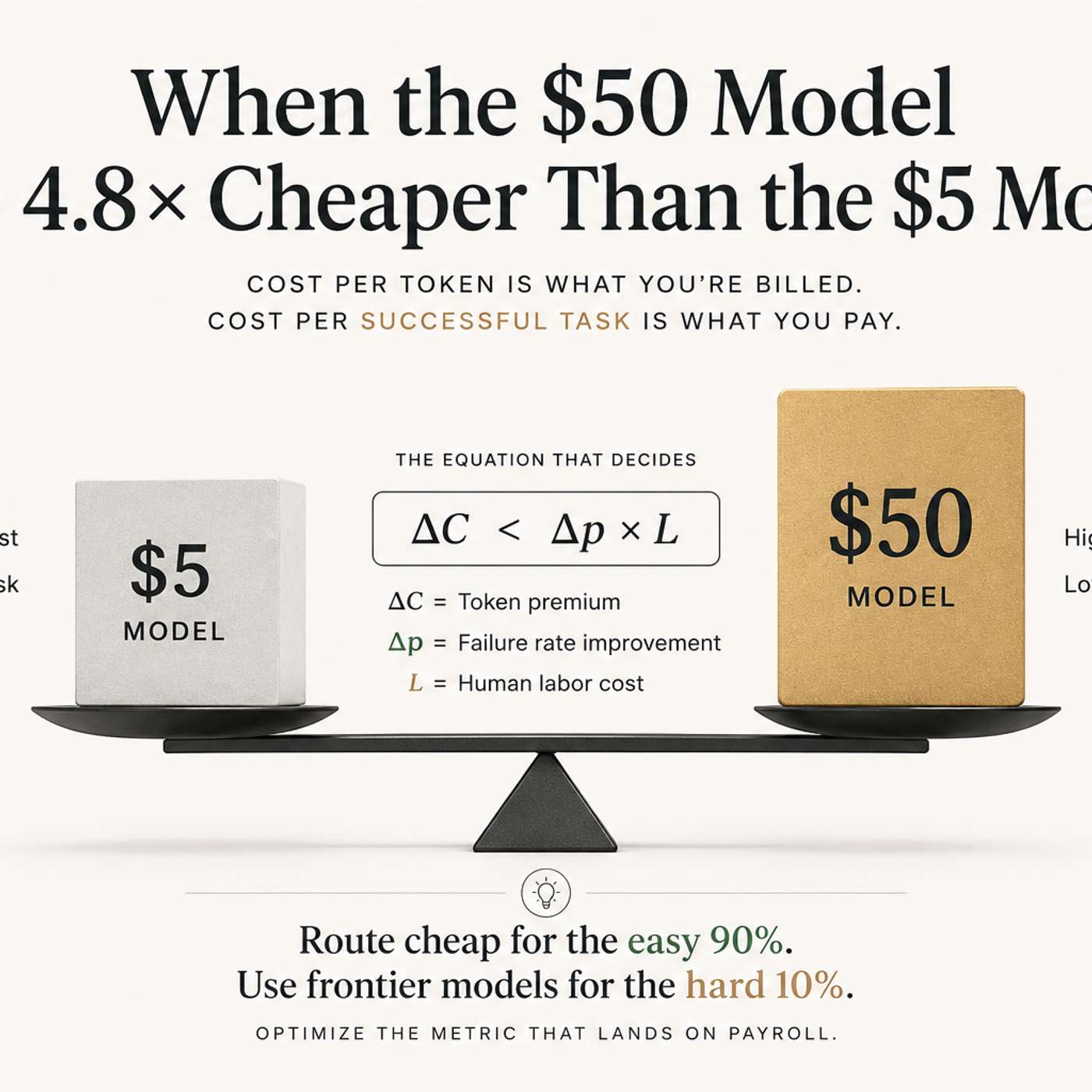
Evaluating AI models on cost-per-token is misleading because it ignores the hidden cost of human labor to fix failures. The true 'cost per successful task' is a business metric that accounts for both the API invoice and the payroll expense for rework, revealing a more accurate total cost of ownership.
Related Insights
When evaluating AI agents, the total cost of task completion is what matters. A model with a higher per-token cost can be more economical if it resolves a user's query in fewer turns than a cheaper, less capable model. This makes "number of turns" a primary efficiency metric.

The decision to use a cheaper but less reliable AI model hinges on the cost of human labor to fix errors. Teams with high engineering salaries can justify premium models for even minor reliability gains, while lower-cost teams should use them more selectively. Your staffing costs directly inform your AI architecture.
While local AI eliminates API fees, it introduces significant hidden costs in human capital. The engineering effort required for hardware management, software updates, and security can easily surpass any token savings, making the total cost of ownership surprisingly high.

Newer AI models may have low per-token prices but are often "token hungry," requiring more tokens to complete a task. This can make them more expensive overall. The true measure of economic viability is the final cost-per-task, not the misleading per-token price.

The most logical pricing model for AI is to benchmark it against the human labor costs it displaces. While a PR challenge for legacy companies, AI-native firms will likely adopt this outcome-based model because it is more tangible for finance leaders than abstract, unpredictable credit systems.

The $15-$25 per-review price for Anthropic's tool moves AI expenses from a predictable monthly software subscription to a variable cost that scales like human labor. This forces CTOs to justify AI budgets with direct headcount savings, creating immense pressure on ROI.
Howie Lu advises against anchoring AI costs to cheap software subscriptions. Instead, evaluate token costs against the opportunity cost of an equivalent human's time. A $150 agent-written board memo is cheap if it saves days of a CEO's time and produces a superior result.

OpenAI's GPT-5.5 is more expensive per token, but a new evaluation framework is emerging. The key metric isn't raw cost, but the model's efficiency in solving a problem. This 'intelligence per dollar' reframes cost analysis around performance and compute, where more expensive models can be cheaper overall if they solve tasks more efficiently.
A model with a low per-token price can be more expensive if it's inefficient, verbose, or requires multiple attempts ('overthinking'). The actual invoice depends on the total tokens needed to complete a task, making token efficiency a hidden multiplier that savvy enterprises are now tracking to determine the true cost.
An AI model might have a low cost per token but be 'token hungry,' requiring more tokens to complete a task. This makes it more expensive overall than a model with a higher per-token cost but greater efficiency. Evaluating models on a 'cost per task' basis provides a more accurate ROI.
