Get your free personalized podcast brief
We scan new podcasts and send you the top 5 insights daily.
Predictive models often mistake correlation for causation, leading to poor decisions. For example, a model might link marketing spend to revenue, but causal analysis can reveal that customer seasonality is the true cause of both. This deeper understanding prevents wasteful investments based on misleading correlations.
Related Insights
An estimated 80% of companies fail to scale their AI initiatives because they are caught in a 'prediction trap.' Their models produce accurate forecasts but do not support or inform actual business decisions, rendering them commercially ineffective. Causal reasoning is positioned as the solution to bridge this gap from prediction to actionable intelligence.
Marketers no longer need complex, opaque attribution models that require data scientists to configure. By integrating channel data with CRM outcomes, AI can directly interpret what drives pipeline and revenue, providing clear, C-suite-ready insights without the need for convoluted multi-touch models and their debatable assumptions.

AI is less a direct cause of business failure and more an accelerant that exposes pre-existing weaknesses. In the case of Tailwind CSS, AI highlighted a fragile model with one-time purchases, no recurring revenue, and a weak value capture mechanism. This suggests AI forces companies to confront foundational business model flaws sooner than they otherwise would have.

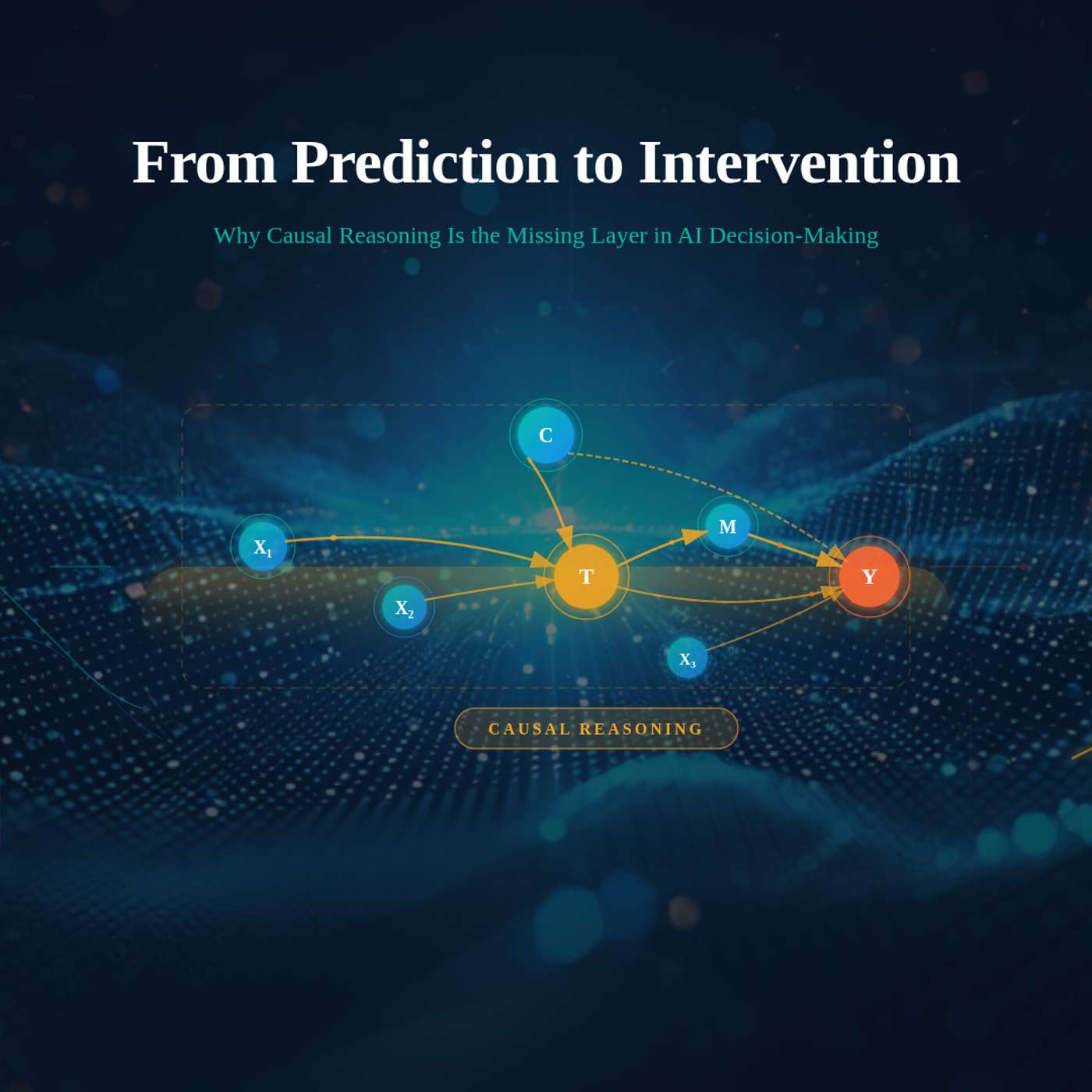
Causal AI is transforming the analyst's function from passively interpreting model predictions to actively prescribing and validating business interventions. This shift requires new skills, such as communicating causal diagrams and developing 'what if' narratives to guide stakeholder decisions and challenge model assumptions.
Marketing analytics firm Alembic uses spiking neural networks, a digital twin of the human brain, for attribution. Unlike predictive models needing vast historical data, these networks can identify the impact of a rare event (like the Olympics) by detecting pattern changes in real-time, similar to how a child learns "dog" after seeing one once.

The sheer number of variables in a consumption model—individual customer seasonality, new bookings, timing, and rep forecasts—creates a level of complexity that is nearly impossible for humans to manage effectively. AI is becoming essential to aggregate and analyze this data to produce a reliable forecast.

Product managers often harbor untested hypotheses that, over time, solidify into organizational 'facts.' AI provides instant answers, forcing rapid validation or rejection of these ideas. This dismantles damaging myths and accelerates the path to accurate, data-driven decisions.

It's tempting to think you can intuit the few factors a decision hinges on. This is often wrong. Complex systems have non-obvious leverage points. The process of building an explicit model reveals which variables have the most impact—a discovery you can't reliably make with intuition alone.

When building revenue models, AI can quickly analyze infinite data slices to spot outliers that skew metrics, such as zero-day service renewals or old opportunities creating survivorship bias. This leads to a more accurate model, representing a performance gain, not just an efficiency one.

Attribution models, even multi-touch, are fundamentally designed to answer "Who gets credit?" and often become weaponized internally. Causality analysis asks a more strategic question: "What sequence of events causes a deal to progress faster?" It focuses on optimizing the process, not distributing credit for the outcome.
