Get your free personalized podcast brief
We scan new podcasts and send you the top 5 insights daily.
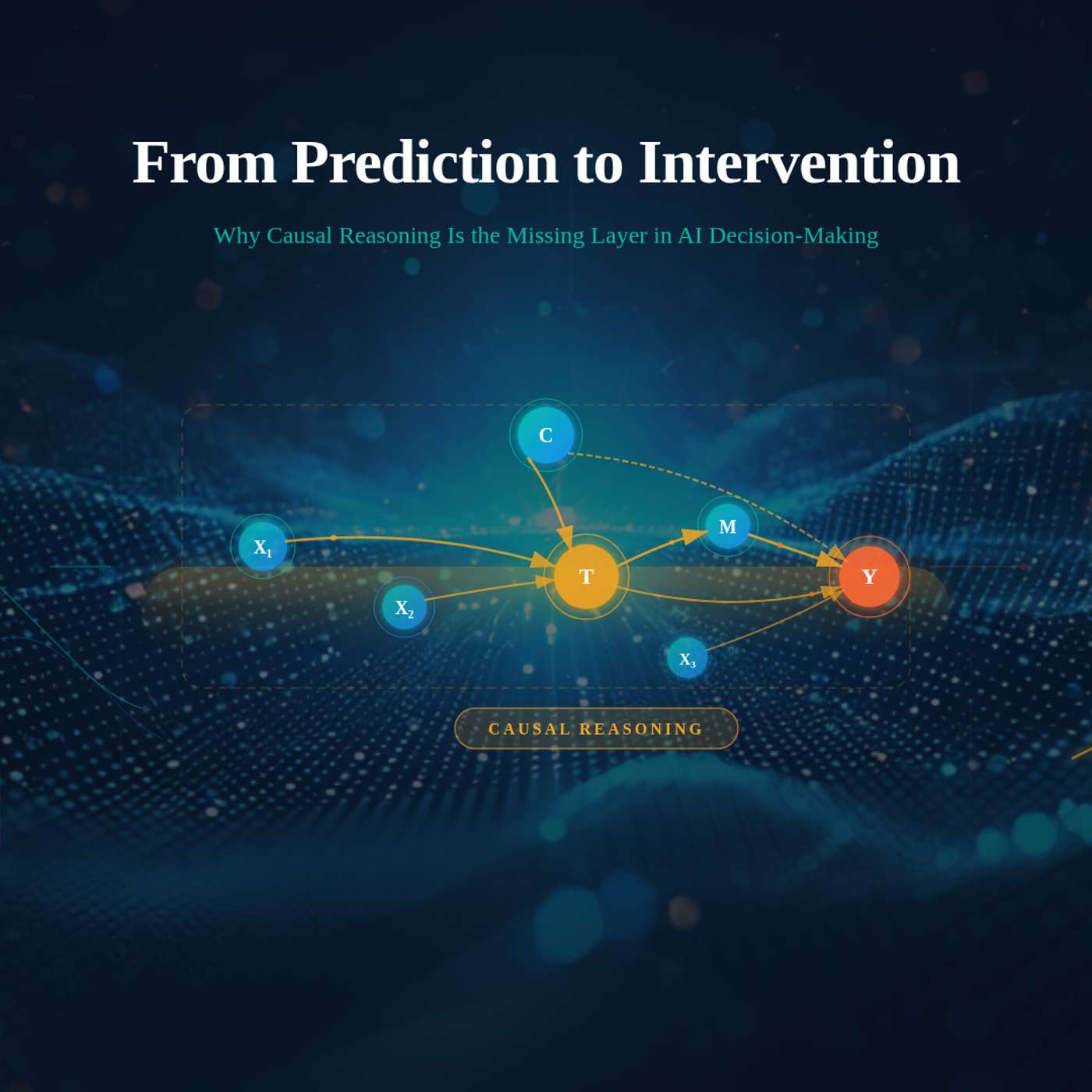
Causal AI is transforming the analyst's function from passively interpreting model predictions to actively prescribing and validating business interventions. This shift requires new skills, such as communicating causal diagrams and developing 'what if' narratives to guide stakeholder decisions and challenge model assumptions.
Related Insights
An estimated 80% of companies fail to scale their AI initiatives because they are caught in a 'prediction trap.' Their models produce accurate forecasts but do not support or inform actual business decisions, rendering them commercially ineffective. Causal reasoning is positioned as the solution to bridge this gap from prediction to actionable intelligence.
Previously, data analysis required deep proficiency in tools like Excel. Now, AI platforms handle the technical manipulation, making the ability to ask insightful business questions—not technical skill—the most valuable asset for generating insights.

Despite AI's power, it cannot replace the human element of data analysis, which requires stakeholder management, domain knowledge, and critical thinking to validate results. An AI can produce errors, making human judgment more crucial than ever to avoid costly mistakes and provide true insights.

Predictive models often mistake correlation for causation, leading to poor decisions. For example, a model might link marketing spend to revenue, but causal analysis can reveal that customer seasonality is the true cause of both. This deeper understanding prevents wasteful investments based on misleading correlations.
The new paradigm requires humans to act as managers for AI agents. This involves teaching them business context, decision-making logic, and providing continuous feedback—shifting the human role from task execution to strategic oversight and AI training.

The true value of a data analyst isn't just crunching numbers but asking counterintuitive and unique questions of the data. This creative problem-framing uncovers remarkably different outcomes. While AI can handle the technical execution, the human expert's role is to define what to investigate.
AI doesn't replace analysts in revenue planning; it changes their focus. By automating tedious formula creation and data pulls, it allows them to concentrate on higher-value activities like running sophisticated scenarios, incorporating new business context, and exploring deeper data insights.

As AI automates insight generation, the primary role of CX professionals will shift to training and refining AI models. Their focus will be on validating AI-driven recommendations, teaching the system brand standards, and ensuring the AI is current and accurate, rather than performing manual data analysis themselves.
Dashboards show data but not the 'so what.' While conversational AI helps answer user questions, the next evolution is proactive insight generation. Future AI tools will solve the 'we don't know what we don't know' problem by suggesting actions and surfacing opportunities marketers haven't thought to ask about.

As AI automates analysis, human value will shift from performing analysis to acquiring unique data. The future analyst won't just build models but will be in the field gathering proprietary, first-party information to give the company's AI decision-making engine a competitive edge.
