Get your free personalized podcast brief
We scan new podcasts and send you the top 5 insights daily.
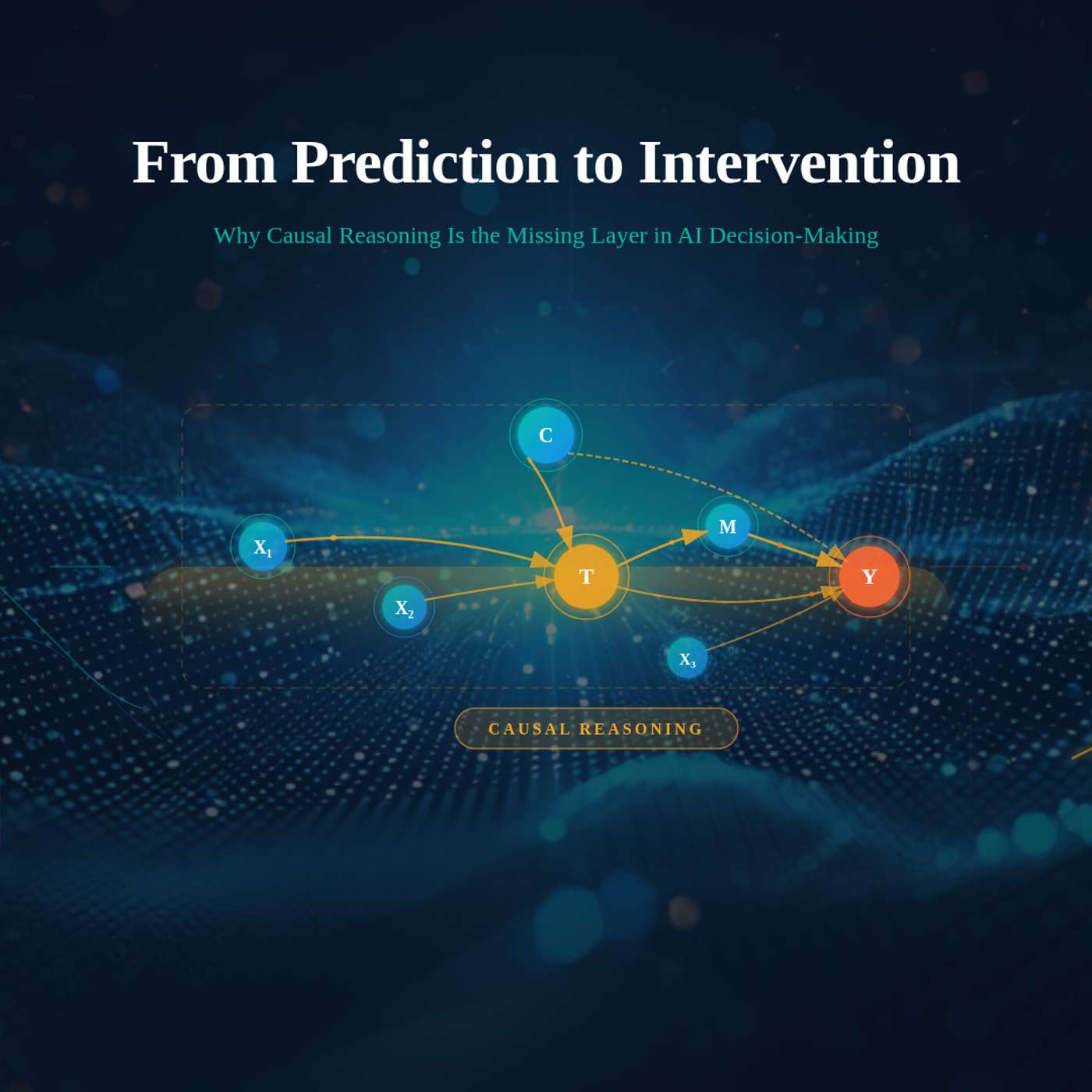
An estimated 80% of companies fail to scale their AI initiatives because they are caught in a 'prediction trap.' Their models produce accurate forecasts but do not support or inform actual business decisions, rendering them commercially ineffective. Causal reasoning is positioned as the solution to bridge this gap from prediction to actionable intelligence.
Related Insights
Leaders mistakenly treat AI like prior tech shifts (cloud, digital). However, those were deterministic, whereas AI is probabilistic and constantly learning. Building AI on rigid, 'if-then' systems is a recipe for failure and misses the chance to create entirely new business models.

Predictive models often mistake correlation for causation, leading to poor decisions. For example, a model might link marketing spend to revenue, but causal analysis can reveal that customer seasonality is the true cause of both. This deeper understanding prevents wasteful investments based on misleading correlations.
The primary barrier for enterprise AI is the 'context gap.' Models trained on public data have no understanding of your specific business—its metrics, language, or history. The key is building infrastructure to feed this proprietary context to the AI, not waiting for smarter models.

AI models fail in business applications because they lack the specific context of an organization's operations. Siloed data from sales, marketing, and service leads to disconnected and irrelevant AI-driven actions, making agents seem ineffective despite their power. Unified data provides the necessary 'corporate intelligence'.

The 85% AI project failure rate isn't a technology problem. It stems from four business and process issues: failing to identify a narrow use case, using data that isn't clean or ready, not defining success and risk, and applying deterministic Agile methods to probabilistic AI development.

Teams often fall into the trap of optimizing for model accuracy, a metric popularized by academic settings like Kaggle. In business, this is misleading. A highly accurate model might be too passive and miss opportunities. The focus must shift from pure accuracy to real-world business outcomes and ROI.
AI companies are pivoting from simply building more powerful models to creating downstream applications. This shift is driven by the fact that enterprises, despite investing heavily in AI promises, have largely failed to see financial returns. The focus is now on customized, problem-first solutions to deliver tangible value.

Much like the big data and cloud eras, a high percentage of enterprise AI projects are failing to move beyond the MVP stage. Companies are investing heavily without a clear strategy for implementation and ROI, leading to a "rush off a cliff" mentality and repeated historical mistakes.

The primary reason most pharmaceutical AI projects fail to deliver value is not technical limitation but strategic failure. Organizations become obsessed with optimizing algorithms while neglecting the foundational blueprint that connects AI investment to measurable business outcomes and operational readiness.

Businesses mistakenly believe that a functioning ML model is intrinsically valuable. However, value is only realized when a model is deployed to change organizational operations. This fixation on the technology itself, rather than its practical implementation, is a primary cause of project failure.
